27 June, 2026 | 3:08 PM


TJS chief takes swipe at KCR’s role in Telangana movement
13-05-2026 12:00:00 AM
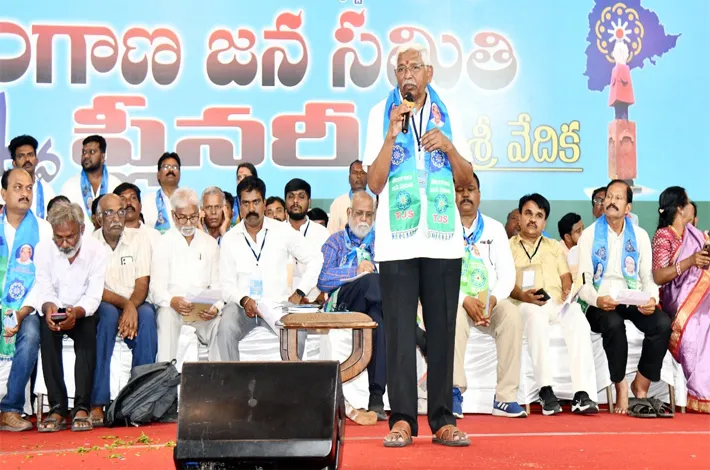
We may not have Money or Votes, But we have People’s Trust, says Kodandaram
TJS adopts 20 Resolutions at Fourth State Plenary in Hyderabad
Metro India News | Hyderabad
The Telangana Jana Samithi (TJS), led by M. Kodandaram, held its fourth State Plenary Meeting on Monday at Jalavihar in Hyderabad, where the party discussed its future political strategy, organizational strengthening, and public outreach initiatives. The plenary also adopted 20 resolutions focusing on democratic governance, social justice, employment, education, agriculture, and protection of Telangana’s aspirations.
Addressing party leaders and cadre, Prof. Kodandaram said the Telangana movement was carried out with honesty and commitment, despite repeated suspicions from ruling establishments that he would compromise or “sell out” the movement. He stated that he never betrayed the trust reposed in him by the people of Telangana.
Kodandaram remarked that former Chief Minister K. Chandrashekar Rao entered the Telangana movement after him and alleged that the BRS government functioned primarily for commissions and contracts after the formation of Telangana. He said the previous regime failed to recognize the sacrifices of Telangana activists and operated with an attitude that “Telangana was achieved by one individual alone.”
The TJS president clarified that the party extended support to the Congress in the 2023 Assembly elections only to defeat the BRS, as TJS alone lacked the political strength to unseat KCR. He reiterated that the party has not merged with the Congress and will continue as an independent political organization while supporting democratic governance and people’s causes.
He said the present political environment allows democratic space to question the government directly and stressed the need to provide recognition and livelihood opportunities for Telangana movement activists.
Kodandaram candidly admitted that TJS lacks financial resources and electoral strength compared to major parties, but asserted that the party has earned public trust through its commitment to people’s issues. He emphasized that TJS would continue to raise public concerns, mobilize democratic forces, and actively participate in upcoming local body elections. The plenary extensively reviewed Telangana’s political developments since statehood and resolved to continue the struggle for a democratic, socially just, and transparent Telangana in line with the aspirations of the statehood movement.
This is my last term as TJS chief: Kodandaram
Speaking again in the concluding session of the TJS Plenary, M. Kodandaram said this would be his final term as president of the Telangana Jana Samithi (TJS), adding that the party would give an opportunity to new leadership in the next term. Stressing that social change is possible only through politics, he said that was the reason behind forming a political party. Kodandaram said the TJS would strategically focus on select constituencies keeping future elections in mind and continue strengthening its political presence in the State.
Launching a sharp attack on the BRS, Kodandaram alleged that the conflict between the BRS and TRS was nothing but a “family dispute” and accused the party of functioning entirely as a family run outfit. He said former Chief Minister K. Chandrashekar Rao had created severe difficulties for the TJS, but the party survived and stood firm despite political pressure. “If anyone asks what TJS has achieved, proudly say that it played a key role in unseating KCR,” he remarked.
He also claimed that during the BRS regime it was nearly impossible for common people to meet the Chief Minister or ministers, whereas the present Congress government was more accessible. Criticizing Prime Minister Narendra Modi, Kodandaram said Modi speaks about public savings but fails to explain what measures he himself is taking. Taking a dig at KCR again, he remarked that the former Chief Minister was now confined to his farmhouse and was unlikely to return to active public life.