27 June, 2026 | 11:56 AM


NEET Cancelled Amid Massive Paper Leak
13-05-2026 12:00:00 AM
Lakhs of Aspirants Face Uncertainty. 2.2 L aspirants in Telugu states
hema singuluri I hyderabad
In an unfortunate turn of events that has sent shockwaves through India’s medical education ecosystem, the National Testing Agency (NTA) on Tuesday officially cancelled the NEET UG 2026 examination, citing a large-scale question paper leak that allegedly compromised the integrity of the test conducted on May 3.
The decision, taken with the approval of the Government of India, has left over 22 lakh aspiring doctors grappling with dashed hopes, financial strain, and an uncertain future as the agency promises to reconduct the exam on dates to be announced soon.
The cancellation comes after weeks of swirling allegations that a detailed “guess paper” containing around 410 questions circulated widely through private WhatsApp and Telegram groups. Investigators claim that a significant number—reports vary between 120 to over 135—of these questions, particularly in Chemistry and Biology sections, bore striking similarities to the actual 180-question NEET paper. Some sources suggest the leaked material could have accounted for questions worth nearly 600 marks out of 720, giving an unfair advantage to those who accessed it.
According to Rajasthan Police’s Special Operations Group (SOG), the leak appears to have originated from organized networks operating across multiple states, with coaching hubs like Sikar and Jaipur emerging as focal points. Officials confirmed that the guess paper was shared with students as early as a month before the exam, and some candidates reportedly attended mock sessions where questions from the circulated material were discussed. The SOG has already arrested 13 suspects in connection with the case, and the probe has been referred to central agencies, including the CBI, for a thorough investigation.
NTA, in its official statement, emphasized that the move was taken “in the interest of transparency and preserving trust in the national examination system.” The agency said it received inputs regarding malpractice on May 7 and acted swiftly after coordinating with law enforcement. “The examination will be reconducted on fresh dates to be notified separately,” the statement added, assuring candidates of a full refund of application fees and a fair process ahead.
A Pattern of Repeated Failures
This is not the first time NEET has been mired in controversy. The 2026 fiasco has reignited painful memories of past leaks, underscoring systemic vulnerabilities in one of India’s most high-stakes entrance tests.
In 2024, allegations of a paper leak traced back to a school in Hazaribagh, Jharkhand, with partially burnt question papers recovered in Patna, Bihar. The Supreme Court intervened, noting that at least 155 students were impacted but ruling against a full nationwide re-test. Scorecards of over 1,500 candidates were later cancelled, and a re-test was held. Similar irregularities surfaced in 2021, involving proxy solvers and WhatsApp circulation of questions in places like Jaipur.
The 2015 AIPMT (predecessor to NEET) was cancelled outright after a major Bluetooth-enabled leak affected hundreds of candidates across states. In 2014, the CPMT exam faced cancellation due to tampered question paper boxes. Education experts warn that recurring incidents point to deep-rooted issues in question paper security, printing, distribution, and digital vigilance.
Political Firestorm and Stakeholder Outrage
The cancellation has triggered sharp political reactions. Telangana Pradesh Congress Committee (TPCC) Medical & Health Wing State Chairman Dr. M. Rajeev lambasted the “Double Engine Sarkar,” accusing the Centre and NTA of administrative failure.
“Around 22 lakh students appeared, including nearly 70,000 from Telangana. Reports suggest 135 out of 180 questions were leaked. This has become a blot on the education system,” he said, demanding strict accountability since NTA functions under the Union Government.
Dr. K. Ramadas, Honorary President of the Telangana Pharmacy and B.Ed Colleges Managements Association, called the situation “unfair,” highlighting delays in student progression and admissions. He echoed concerns raised by Tamil Nadu Chief Minister M.K. Stalin, who has repeatedly criticized NEET and once again labelled the system a “scam,” advocating for admissions based on Class 12 marks.
Students’ Dreams Shattered
The human cost of the scandal is immense. For millions of young aspirants who sacrificed months—often years—of their lives, the news has been devastating.
Nissi Grace, a dedicated student preparing at Sri Chaitanya/Aakash, expressed her heartbreak: “I prepared tirelessly for one full year, sacrificing sleep, family time, and personal life. I felt I had performed well despite the pressure. The sudden cancellation has shattered me.”
Sai Rohith, preparing for NEET at Gitam Institute of Medical Sciences, echoed the sentiment: “Sleepless nights and hard work, only for those who sacrifice everything to understand how heartbreaking paper leaks are.”
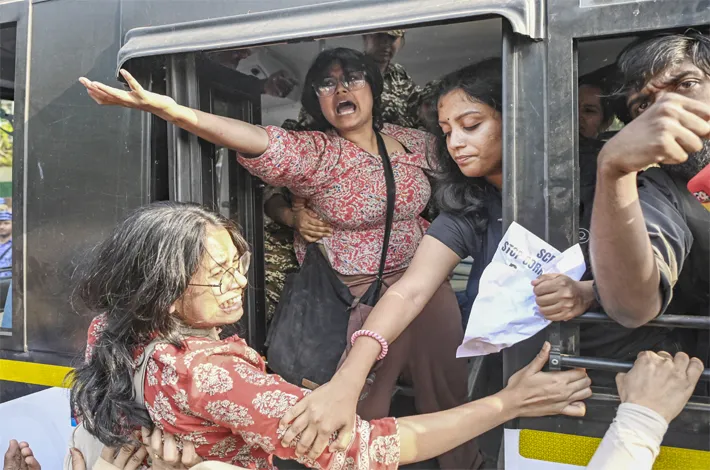
Protests have erupted in Delhi and other cities, with students demanding swift justice and reforms. Many families, having invested heavily in coaching fees, travel, and preparation, now face another cycle of uncertainty as medical college admissions timelines are likely to be delayed.
The Road Ahead
As the CBI and state agencies intensify their probe into the multi-state network, questions loom large over the future of competitive examinations in India. Experts call for technological upgrades like encrypted digital delivery, stricter vetting of printing presses, AI-based anomaly detection, and greater accountability for coaching centers.