27 September, 2026 | 10:34 AM


US targets RSS, trouble ahead?
18-03-2026 12:00:00 AM
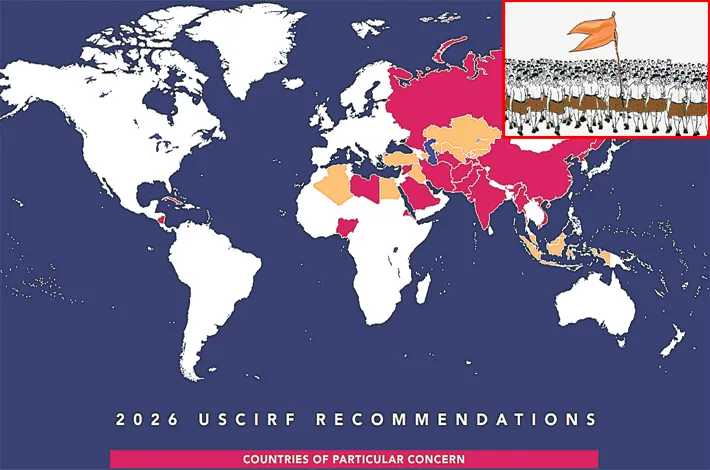
The United States Commission on International Religious Freedom (USCIRF) has once again set off a storm in India with its 2026 Annual Report, recommending targeted sanctions against Indian entities, including the Rashtriya Swayamsevak Sangh (RSS) and the Research and Analysis Wing (R&AW). The commission called for measures such as freezing assets and barring entry into the United States, alleging that these organizations bear “responsibility and tolerance of severe violations of religious freedom.” The report also urged designating India as a “Country of Particular Concern” (CPC) for the seventh consecutive year, citing a continued deterioration in religious freedom during 2025, including discriminatory laws and enforcement disproportionately affecting religious minorities.
The recommendations immediately drew sharp criticism from the Indian government, which dismissed the report as “motivated and biased.” Officials accused USCIRF of presenting a distorted and selective picture of India while relying on questionable sources. The Ministry of External Affairs emphasized India’s pluralistic society, rejecting any need for external certification on religious harmony. Many critics within India also highlighted perceived hypocrisy in the report, pointing out its framing of the Pahalgam terror attack in Kashmir. In April 2025, gunmen targeted predominantly Hindu tourists, forcing victims to recite Islamic verses and killing those who could not comply. While USCIRF had condemned the attack separately, its annual report appeared to emphasize alleged anti-Muslim sentiment in India rather than focusing on cross-border terrorism as the root cause.
The report immediately ignited a political firestorm, exposing deep divisions along party lines. Opposition parties, including the Congress, used the USCIRF findings to renew calls for banning the RSS. Leaders argued that the organization opposes constitutional values, promotes majoritarian mobilization along religious lines, and undermines equality and communal harmony. Congress described the RSS as a threat to national unity and brotherhood, likening its influence to divisive forces during the pre-independence era. They accused the current government of weak leadership, claiming it compromises national interests by allowing foreign entities to interfere in India’s internal affairs.
A Congress spokesperson stressed that the core issue was not USCIRF’s credibility, but the audacity of foreign interference. At the same time, he reiterated the long-standing demand to ban the RSS, arguing that it harms communal harmony and divides society. He pointed to ongoing inquiries against the RSS in states like Kerala and Karnataka as evidence that the organization should be under scrutiny.
The BJP countered by highlighting perceived hypocrisy in the opposition’s position. While Congress criticized foreign interference, it relied on USCIRF’s report to attack the RSS politically. Party representatives praised Prime Minister Narendra Modi’s diplomacy, citing India’s successful oil tanker movements through the Strait of Hormuz amid geopolitical tensions as proof of India’s growing international influence. BJP spokespeople defended the RSS as the world’s largest NGO, emphasizing its millions of volunteers engaged in disaster relief, tribal education, and charitable work across 156 countries, impacting over 200 million lives.
Former Rajya Sabha members and analysts outright rejected USCIRF’s report, calling it hypocritical and pointing to discrimination against minorities, including Muslims and Sikhs, in the United States itself. They framed the report as a modern attempt at foreign interference in India, lauding Modi’s leadership in projecting India’s non-aligned status and peaceful role globally. Senior leaders from other parties, including the PDP, reminded the public that scrutiny of powerful organizations like the RSS was not unprecedented, citing past bans after the assassination of Gandhi, the Emergency, and the Babri Masjid demolition. They warned that mixing religion with politics risks deepening divisions in India’s diverse society and emphasized India’s constitutional commitments to secularism, equality, and the rule of law.
The debate over USCIRF’s recommendations laid bare deep ideological rifts in India. Supporters of the government saw the intervention as unwarranted meddling and biased, even noting the commission’s vice chair, Asif Mahmood, has Pakistani roots, as a potential source of partiality. Opposition parties, on the other hand, seized the opportunity to challenge the RSS’s role in society and push for action against it. Amid accusations of foreign bias and domestic hypocrisy, the controversy highlights the ongoing tensions in India over religious freedom, national sovereignty, and the intersection of ideology and politics.
The government has firmly rejected USCIRF’s recommendations, maintaining that India’s democratic and pluralistic framework is robust enough to handle internal issues without external scrutiny. Meanwhile, the opposition continues to push the narrative that organizations like the RSS threaten national unity and equality. The episode reflects the polarized discourse surrounding India’s internal affairs, international image, and the balance between foreign pressure and domestic political agendas.
As India grapples with the USCIRF report, the conversation underscores one enduring question: can the country maintain its pluralistic values while managing powerful ideological groups, foreign scrutiny, and domestic political battles simultaneously?