27 September, 2026 | 11:07 AM


India plans massive stabilization fund
18-03-2026 12:00:00 AM
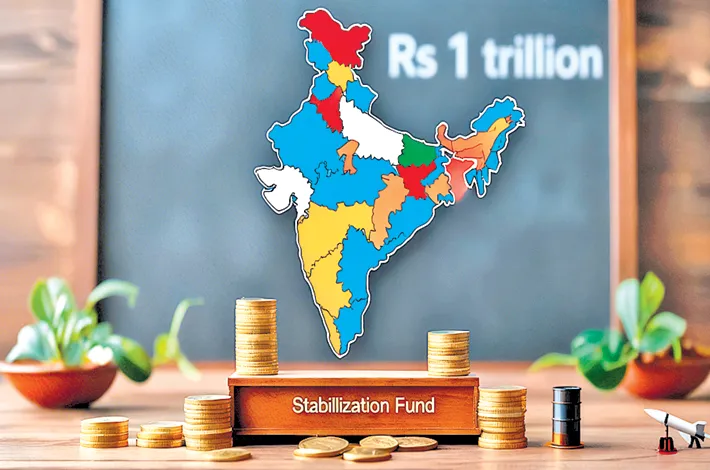
Finance Minister of India announced establishment of Economic Stabilization Fund with Rs. 1 trillion. For this fund, she proposed an initial capitalization of Rs. 57,381 crs and balance in due course.
India is spending additional $8 billion (Rs. 73,000 crs) every month due to increased oil prices. This additional expenditure abnormally increases inflation. Stabilization fund is needed to levelise price fluctuations by adjusting surplus and deficits from time to time. India already has few price stabilization funds in agriculture sector. Although the current mention is to withstand global headwinds, the focus is on oil prices. Instead of only against oil price volatility, India should have Funds adequately meeting the need, and volume.
Kuwait Investment Authority (KIA) was the first such Fund formed in year 1953. ‘Sovereign Wealth Fund’ as a term was coined later in year 2005. Currently, there are 150 SWFs in 60 countries but only about 100 SWFs are noteworthy. Their collective assets under management (AUMs) is $15 trillion.
SWFs invest in safe instruments and release funds to meet increased costs during exigencies such as geopolitical tensions, war situations, severe scarcity of oil, food grains, medicines, chemicals, electronics, etc. SWFs absorb shock of fiscal challenges and reduce disturbances.
Norway’s Norges Bank Investment Management is the world’s largest SWF with AUM up to $2 trillion. Second is China Investment Corporation with $1.6 trillion. Next in order are Safe Investment of China with $1.5 trillion, Abu Dhabi Investment Authority (ADIA) with $1.2 trillion, and Saudi Arabia’s Public Investment Fund (PIF) with $1 trillion. Collectively, Chinese SWFs manage close to $2.7 trillion and collectively Singapore SWFs manage about $1.7 trillion. Although few States in US have small SWFs, the country does not have any national level SWF until now. Similarly, UK does not have an SWF.
Of late, more SWFs are being formed. Indonesia’s Danantara was formed in year 2025 with $900 billion of which $20 investment was already made. Adding to ADIA, ADQ, and Mubadala, Abu Dhabi launched L’imad in 2026 as its 4th SWF. Similarly, about 11 new SWFs were established in 2025, majority of them related to emerging markets.
Historically SWFs have served several situational difficulties. Recent major situation was Covid-19 when countries withdrew funds from SWFs and met exigencies. Covid time drawings from Norway’s SWF were $37 billion and Singapore SWFs were $37 billion. During oil crisis between 2015 and 2016, Saudi Arabia withdrew $70 billion and Russia withdrew $90 billion, both to meet their funds shortage.
SWFs invest 30% to 50% in equities, 10% to30% in fixed income securities or cash, and 20% to 30% in real estate or energy assets. SWFs have global investments for diversification, stability, liquidity, and safety. Their investment strategies include co-investments, joint ventures, and horizon-linked assets. Over the last 2 decades, SWFs are dominantly investing in real estate for stable income bearing the liquidity risk.
India has been discussing about SWF since 2014. The purpose was to manage country’s forex reserves, surplus funds, insurance funds, and pension funds by investing in global sources and to earn higher returns with diversification. National Investment and Infrastructure Fund (NIIF) established in year 2015 is a quasi-SWF mandated to invest within India.
India has $700 billion forex reserves but has current account deficit of 1% to 1.3% of its gross domestic product (GDP). Therefore, India should have more than 1 SWFs for both price levelizations and for long term wealth creation. One for oil price stabilization which is a regular requirement, and other SWFs for building long term wealth for the nation, and to deploy forex reserves to support infrastructure.
India may need SWFs with volume of $140 billion (Rs. 12,75,000 crs) which is 20% of its forex reserves. This can be distributed between price stabilizations, and wealth creation. Thus, the proposed Rs. 100,000 crs volume should be considerably enhanced. The Funds should also ensure efficient management.
SWFs have been successful in building fiscal backstops and safety nets for their economies. But there are few black sheep as well. In year 2015, Malaysia’s IMDB saw embezzlement of $4.5 billion with offshore shells and luxury asset purchases. During 2017-2019, Zambia’s FSDEA suffered huge losses with fund diversion in offshore loans.
Objectives of India’s SWFs should allow global deployment of funds with wider diversification. The SWFs should have autonomy without interferences. In this regard, India may learn from SWFs of Norway and Singapore which are known for their proven transparency, efficiency, and higher returns.
- Dr. Kishore Nuthalapati CFO of BEKEM Infra Projects Infra Pvt Ltd, Hyderabad