27 October, 2026 | 1:20 AM


Telangana leads AP in welfare reach
27-10-2026 12:00:00 AM
Reaches 92% of families in Telangana, 89% in Andhra Pradesh
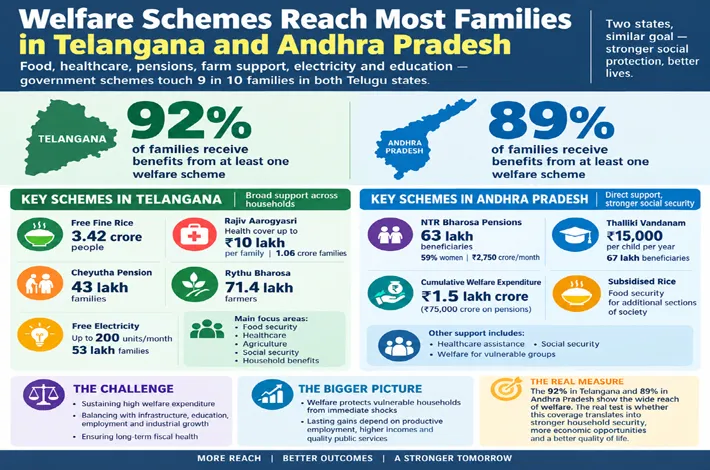
metro india news I hyderabad : Welfare schemes have become an integral part of everyday life in Telangana and Andhra Pradesh, with an estimated 92 per cent of families in Telangana and 89 per cent in Andhra Pradesh receiving benefits from at least one government programme. The figures underline the extensive reach of social protection in the two Telugu states, where subsidised food, pensions, healthcare, agricultural assistance, electricity concessions and education support have emerged as major instruments of governance.
Despite differences in political leadership and the design of their welfare policies, both states have developed extensive networks of government assistance. Telangana’s approach combines food security, healthcare, agricultural support and household benefits, while Andhra Pradesh has placed considerable emphasis on direct cash transfers, social security pensions and financial assistance to families.
In Telangana, Deputy Chief Minister Bhatti Vikramarka has stated that approximately 1.06 crore of the state’s 1.15 crore families benefit from at least one government welfare scheme. This translates into coverage of around 92 per cent of families, reflecting the breadth of the state’s social assistance network.
The Congress government has sought to extend support across several categories, including low-income households, farmers, pensioners and families requiring medical assistance. Rather than relying on a single flagship programme, its welfare framework brings together multiple schemes addressing different needs.
The free fine rice programme is among the most extensive, providing food security to approximately 3.42 crore people. The initiative is intended to reduce the burden of essential food expenditure on households, particularly those with limited and irregular incomes.
Healthcare is another important component. Rajiv Aarogyasri provides health coverage of up to Rs 10 lakh to eligible families, with the reported coverage extending to approximately 1.06 crore families. By helping eligible households’ access treatment for covered medical conditions, the scheme seeks to reduce the risk of families falling into financial distress because of hospital expenses.
The Cheyutha pension programme supports around 43 lakh families, providing assistance to vulnerable groups, including elderly people and other eligible beneficiaries. Agricultural support is another major element, with Rythu Bharosa assisting approximately 71.4 lakh farmers. The state also provides free electricity for eligible domestic consumers using up to 200 units a month, benefiting around 53 lakh families.
Together, these programmes demonstrate how welfare in Telangana operates across different stages of household life, from food consumption and healthcare to farming, electricity expenditure and social security.
Andhra Pradesh, meanwhile, reports that approximately 89 per cent of families receives benefits from at least one welfare scheme. The figure places the state relatively close to Telangana in terms of the reported reach of government assistance, despite differences in their welfare priorities and delivery mechanisms.
Chief Minister N. Chandrababu Naidu has repeatedly highlighted the state’s social security pension programme, describing its scale and generosity as a significant feature of the government’s welfare policy. NTR Bharosa pensions cover approximately 63 lakh beneficiaries, with women accounting for around 59 per cent of recipients. The monthly expenditure on the pension programme is estimated at Rs 2,750 crore.
The government has also cited cumulative welfare expenditure of approximately Rs 1.5 lakh crore, including around Rs 75,000 crore spent on pensions. The pension programme supports eligible elderly people, widows, persons with disabilities and other designated categories. For many recipients, the monthly payment provides a predictable source of income to meet essential expenses, particularly when household earnings are uncertain or family support is limited.
Education assistance forms another important part of the state’s welfare strategy. Under Thalliki Vandanam, eligible mothers or guardians receive Rs 15,000 annually per child to support school attendance and education-related needs. The scheme has been reported to reach approximately 67 lakh beneficiaries. Alongside pensions and education assistance, subsidised rice, healthcare support and other welfare programmes extend government assistance to additional sections of society.
The reported figures illustrate the scale of the welfare systems built by the two states, but they also raise questions about long-term outcomes and fiscal sustainability.
Telangana’s combination of food distribution, health coverage, and agricultural assistance and electricity concessions requires substantial and continuing public expenditure. Andhra Pradesh faces its own fiscal challenge, particularly because of the recurring cost of pensions and other direct financial transfers.
Both governments must balance these commitments with investments in infrastructure, education, employment generation and industrial development. Welfare can protect vulnerable households from immediate financial shocks, but sustainable improvements in living standards also depend on productive employment, higher incomes and access to quality public services.