26 July, 2026 | 7:39 AM


Once guilty, twice rewarded
30-05-2026 12:00:00 AM
A Hyderabad based company has been awarded contracts overlooking giants has proved costly
J DEEPAK I hyderabad
The bogey of On-Screen Marking (OSM) system going wrong has once again resurfaced and a private limited company Globarena Technologies Private Limited has been found shy of faults galore and also of rechristening itself to Coempt EduTeck Private Limited (also referred to as Coempt Edu Tech or OEMPT EDUTECK) and guilty of severe examination disasters.
In 2019, when the Telangana State Board of Intermediate Education (TSBIE) announced results that triggered widespread outrage. Globarena Technologies Private Limited, the company contracted to develop and manage the digital platform for exam processing, results, and related administrative tasks, faced intense scrutiny. Thousands of students reported discrepancies such as missing marks, incorrect subject scores, failures despite strong prior performance, and cases of students marked absent despite appearing for exams.
Over 3.8 lakh out of nearly 9.7 lakh students were declared failed initially, leading to protests, political turmoil, and reports of around 20 student suicides linked to the distress. A government- appointed committee faulted both TSBIE and Globarena for inadequate planning, lack of a signed contract at the time of results, and failures in following standard operating procedures. Critics alleged the firm lacked sufficient capability for a large-scale project, and questions were raised about how it secured the contract.
Less than six months after the 2019 fiasco, Globarena Technologies changed its name to Coempt EduTeck Private Limited (also referred to as Coempt Edu Tech or OEMPT EDUTECK). Corporate records show the company, originally incorporated around 2000, underwent previous name variations including Globarena Iteknowledge Pvt. Ltd. before the transition. Key leadership remained unchanged. VSN Raju, who was CEO of Globarena during the Telangana controversy, continues as Director and CEO of Coempt EduTeck.
The company’s core business in e-learning, digital evaluation, on-screen marking (OSM), and examination software persists, with overlapping operations and client references between the old and new identities. Raju has described the name change as a standard branding exercise, noting that clients were informed and that courts (Telangana High Court and Supreme Court) cleared the company in related litigation.
Once again in spotlight
The company has once again come under national scrutiny for its role in the Central Board of Secondary Education’s (CBSE) new On-Screen Marking (OSM) system for the 2026 board exams. Following the Class 12 results announcement, thousands of students and parents reported issues including blurred or mismatched answer sheets, swapped scripts, missing pages or marks, and problems with the re-evaluation portal. Opposition leaders, including Rahul Gandhi, highlighted Coempt’s past as Globarena and demanded a judicial probe and SIT investigation,
questioning the contract award despite the firm’s history. CBSE has defended the process as compliant with General Financial Rules, attributed complaints to isolated cases, and involved IIT experts for review. Coempt’s leadership maintains that issues are minimal and often stem from human error.
While Coempt EduTeck has not been directly implicated in the core operational aspects of the NEET UG controversies (primarily handled by the National Testing Agency involving allegations of paper leaks, grace marks, and result irregularities in recent years), the company’s name has surfaced in broader political and public discourse linking successive national-level exam crises. Critics have framed the CBSE OSM issues as part of a larger pattern of “exam fiascos” from NEET to CBSE, using Coempt’s involvement in digital evaluation as a focal point to question overall accountability and vendor selection in India’s high-stakes examination ecosystem.
The recurring association of the same entity and leadership with sensitive digital components of public examinations has intensified debates on transparency in tender processes, due diligence by educational boards, and the need for stronger oversight to safeguard student futures. As admission pressures mount, demands for independent audits and systemic reforms in exam technology vendors continue to grow.
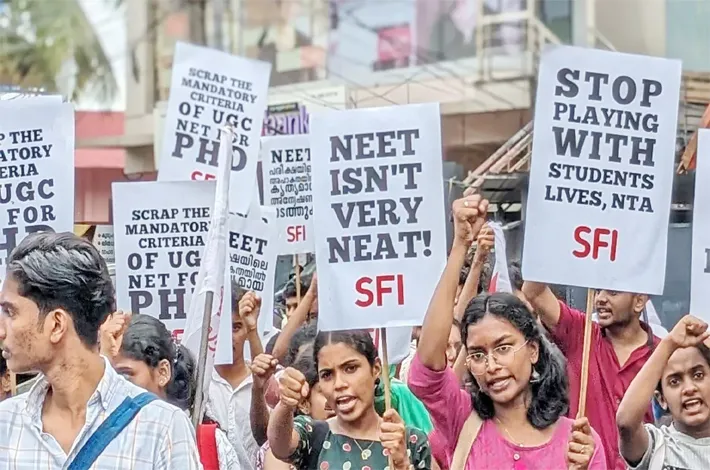
NEET NOT SO TIDY
The Supreme Court on Friday expressed serious concerns over the ad-hoc functioning of the National Testing Agency (NTA) while hearing petitions related to the cancellation of the NEET-UG 2026 examination due to a paper leak. A bench comprising Justice PS Narasimha and Justice Alok Aradhe directed the Union of India to file an affidavit detailing measures to create an "institutional memory of continuity" by employing specialized personnel.
The bench further suggested establishing a permanent mechanism, including collaboration with universities and IITs, for continuous improvement in examination processes Solicitor General Tushar Mehta, appearing for the Centre, assured the Court that the government was treating the matter with utmost seriousness, with the Prime Minister personally supervising reforms.
The SG added that a detailed review of the entire examination chain had been conducted and new corrective mechanisms devised. Dr. K Radhakrishnan, former ISRO chairman and head of the Court-constituted Monitoring Committee on NEET reforms. He informed the Court that the committee had submitted around 35 long-term and 60 short-term recommendations, most of which were implemented. He noted that NEET-PG 2025 was conducted mostly satisfactorily, though some operational issues like power outages occurred.
IAF to transport NEET papers?
The government is now considering transporting NEET re-exam papers using the Indian Air Force. Authorities no longer trust the existing system enough to guarantee that the papers will remain secure through normal channels.