21 September, 2026 | 3:26 PM


Will India's new student awakening reshape politics?
26-07-2026 12:00:00 AM
From Campus to Catalyst
kiranmai tutika | AMARAVATI
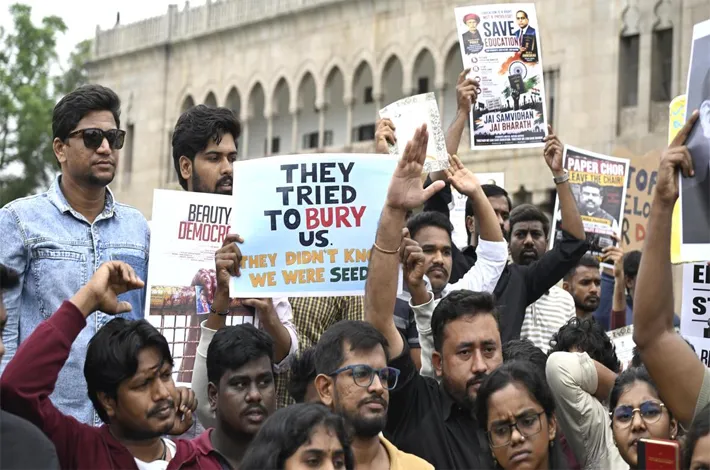
The recent nationwide student mobilisation over examination irregularities, particularly the NEET paper leak controversy, has once again demonstrated a political reality that governments rarely ignore, when students leave classrooms and occupy the streets in large numbers, power begins to listen.
The Union government's swift response, investigations by central agencies, and promises of systemic reforms did not emerge in a vacuum. They followed weeks of sustained public pressure led primarily by students, aspirants and parents. It reaffirmed a historical lesson: governments may overlook opposition criticism for months, but prolonged student unrest carries a different political cost.
The larger question, however, extends far beyond entrance examinations. If students can compel governments to respond on an issue affecting their futures, can the same collective energy be channelled towards broader public concerns such as corruption, unemployment, inflation, poor infrastructure, environmental degradation, public healthcare, educational reforms and governance failures? Or will this movement, like many before it, dissolve once the immediate grievance subsides?
Indian politics has repeatedly shown that students are not merely participants in democracy; they have often been its strongest corrective mechanism. From the freedom movement to the JP Movement in the 1970s, from the Assam agitation to anti-corruption campaigns, students have frequently acted as the first organised resistance whenever institutions appeared unresponsive.
Unlike political parties, students usually begin with issue-based mobilisation rather than electoral calculations. Their moral legitimacy often attracts wider public support.
Yet, in recent decades, that independent identity appears to have weakened.
Most university campuses today witness student organisations functioning largely as ideological or organisational extensions of mainstream political parties. Elections in campuses increasingly mirror Assembly or Parliament contests, with party symbols, funding networks and external leadership exerting considerable influence. The result is a gradual erosion of student politics as an independent democratic institution.
Many prominent politicians who dominated Andhra Pradesh politics for decades first learnt organisation, public speaking, negotiations and agitation through student movements. Before entering mainstream politics, Chandrababu Naidu emerged through student leadership during his university years at Sri Venkateswara University. His involvement in campus politics helped develop his organisational skills, eventually leading him into electoral politics at a young age.
Also, Former Vice President M. Venkaiah Naidu built his political identity through student activism associated with the Akhil Bharatiya Vidyarthi Parishad (ABVP). His participation during the Emergency period transformed him into one of the country's recognised parliamentary leaders. Although KCR's rise is more closely associated with mainstream politics and later the Telangana movement, his early political exposure was influenced by student activism and youth politics that shaped an entire generation in Telangana.
No discussion on student politics can ignore Osmania University. The campus became the emotional epicentre of the Telangana movement between 2009 and 2014. Thousands of students participated despite police restrictions, arrests and prolonged uncertainty over academic careers. Many observers argue that without sustained student participation, Telangana's political momentum would have been difficult to maintain.
United Andhra Pradesh too witnessed vibrant student organisations. Whether it was AISF, SFI, ABVP, NSUI or various regional student bodies, campuses once functioned as nurseries of political leadership. Student union elections were fiercely contested but were equally viewed as platforms to understand public policy, constitutional values, debating skills and organisational management. Several legislators, ministers and parliamentarians across party lines acknowledge that their first political lessons came from campus elections rather than family backgrounds.
What changed? First, mainstream parties gradually realised that controlling student unions meant controlling future political narratives. Independent student organisations capable of mobilising thousands could evolve into future centres of dissent. Consequently, parties increasingly invested in affiliate student wings, reducing their autonomy.
Second, educational institutions themselves began discouraging student politics. Concerns over campus violence, academic disruptions and administrative control resulted in restrictions on student elections in several universities. The unintended consequence was the disappearance of legitimate democratic training spaces.
Third, politics itself underwent transformation. Instead of producing leaders through decades of organisational work, parties increasingly began rewarding visibility, financial capacity, caste arithmetic, media presence and electoral winnability. Grassroots organisational experience became less important.
Perhaps the greatest criticism today is not merely the weakening of student unions but the shrinking pathways for ordinary youth to enter politics. Across India, including Telugu states, many major parties increasingly promote political heirs. Children, spouses and close relatives of established politicians often receive organisational positions and election tickets much earlier than grassroots workers.
For aspiring young leaders, the message can appear discouraging: years of organisational work do not necessarily translate into political advancement. The consequence is visible. Students who once viewed politics as a merit-based ladder increasingly perceive it as a closed ecosystem.
The present student mobilisation has demonstrated one important fact. Young people still possess the capacity to organise rapidly around issues directly affecting their future. The challenge is sustaining that civic consciousness beyond examination crises. Historically, issue-based civic movements succeed only when they remain non-partisan and retain public trust.
If universities again become centres of democratic engagement rather than political recruitment alone, they could rebuild the pipeline of leaders who rise through debate, public service and organisational ability.
If parties continue treating youth wings merely as extensions of electoral machinery while reserving meaningful leadership for political families, they risk disconnecting an entire generation from representative politics.
History suggests that every major democratic transformation has begun with citizens refusing to remain silent. In India, students have often been the first to speak. The unanswered question is whether the current generation will limit itself to demanding fair examinations or broaden its agenda to demand fair governance itself.