21 September, 2026 | 7:58 AM


Genz Reclaims India
26-07-2026 12:00:00 AM
metro india news I hyderabad
In a landmark assertion of people’s power, India’s Gen Z has scripted history. By mounting sustained, nationwide pressure that culminated in the resignation of Union Education Minister Dharmendra Pradhan on Saturday, July 25 the country’s youth have secured their first major political victory against the BJP-led NDA government at the Centre — and, in the process, rekindled faith in democratic accountability.
The resignation comes after months of intense protests triggered by the NEET-UG 2026 paper leak scandal. Over 22.79 lakh aspirants appeared for the exam conducted on May 3, only for it to be cancelled on May 12 following revelations that a widely circulated “guess paper” shared striking similarities — with around 120 questions allegedly matching the actual Chemistry section. The controversy, investigated by Rajasthan Police and later handed over to the CBI, exposed deep vulnerabilities in the National Testing Agency’s (NTA) systems, echoing the 2024 breach and sparking outrage over compromised futures in medicine and allied fields.
Led largely by Gen Z mobilisations — prominently featuring the youth-driven Cockroach Janta Party (CJP) — demonstrations swelled at Jantar Mantar and spread across cities. Students demanded not just justice for the leak but systemic overhaul, accountability at the highest levels, and an end to repeated examination failures that have eroded trust in one of India’s most critical gateways to professional education. Tragically, the unrest claimed over 20 young lives amid mounting despair. Pradhan’s exit, tendered in the “larger interest of students and the nation,” marks a rare instance of a Union Minister stepping down under public pressure in the Modi era.
For a generation often dismissed as digitally distracted, this victory underscores a maturing civic consciousness — proving that persistent, peaceful democratic agitation can force institutional course-correction. As India grapples with restoring credibility to its examination ecosystem, today’s development signals that the youth will no longer accept opacity in systems that shape their destinies.
Dharmendra Pradhan's resignation marks more than just the exit of a Union Minister. It is being widely seen as the first major political victory of a new generation of Indians who refused to let the NEET paper leak controversy fade away. What began as a peaceful sit in at Delhi's Jantar Mantar, led largely by Gen Z students and young professionals, soon transformed into a nationwide movement demanding accountability, transparency, and justice for millions of aspirants. Despite police restrictions, protests spread across several states, keeping public attention firmly on the issue until the government was forced to respond.
The resignation has also come to symbolize the resilience of democratic protest. For many young Indians, it reiterated that peaceful public mobilisation, sustained civic participation, and constitutional methods can compel those in power to accept political responsibility.
Hailing it as a big victory, CJP described the resignation as only the first step, insisting that broader reforms in the examination system, accountability within the National Testing Agency, and justice for affected students remain unfinished goals. Even so, the developments have already established an important democratic precedent: that the collective voice of students and youth, when expressed peacefully and persistently, can shape the national political agenda and secure accountability from the highest levels of government
Facing spiralling protests for his ouster over the NEET issue, Education Minister Dharmendra Pradhan resigned on Saturday afternoon, saying it is not a matter of "individual prestige" for him and he wanted to prevent anti-national forces from exploiting the situation at Jantar Mantar and across the country.
In a letter in Hindi posted on his X account, Pradhan said he has taken responsibility from day one for the NEET paper leak and has sent his resignation to Prime Minister Narendra Modi as he is disturbed to see the series of events that have unfolded in the last 10 days.
Cockroach Janta Party (CJP) hailed it as the first victory of their 36-day agitation. The opposition parties, which had supported the stir and had joined the chorus for Pradhan's resignation, called it a victory for students, youth and democracy.
Protests had spiralled since the CJP-led march to Parliament on July 20 that saw violence, with police and protesters blaming each other for it. Pradhan's resignation on Saturday sparked scenes of celebration at Jantar Mantar, where students and members of the CJP have been holding a sit-in since June 20, demanding his accountability over the NEET-UG 2026 paper leak and irregularities in the CBSE's on-screen marking process, besides seeking wider reforms in the conduct of public examinations.
On Saturday, Pradhan said while he took responsibility for the NEET paper leak from day one, individuals holding responsible positions attempted to create obstacles and mislead students.
"I am pained by the events of the past ten days. This is not a matter of personal prestige for me. It is my resolve not to let the country's youth get ensnared in a web of confusion.
"Considering the situation at Jantar Mantar and across the country --with the aim of preventing anti-national forces from exploiting it, preserving national unity, ensuring that not a single Indian student's future gets entangled in legal complexities, and allowing our children to devote their time to studies and focus on building their careers -- I have submitted my resignation to the Prime Minister," he said.
Pradhan said he respects the aspirations, sentiments and legitimate expectations of the country's youth.
"Realising the dreams of India's young generation has been a moral commitment in our political and social lives. Irregularities came to light regarding the NEET-UG examination held on May 3, 2026. Taking immediate cognisance of this, the Government of India handed the investigation over to the CBI, cancelled the exam, and announced a date for a re-examination. "Additionally, a decision was made to conduct this exam in CBT (Computer-Based Test) mode starting next year. Throughout this period, our primary priority was to ensure the smooth conduct of the examination for over 20 lakh students.
‘Young want discussion, not dictation’
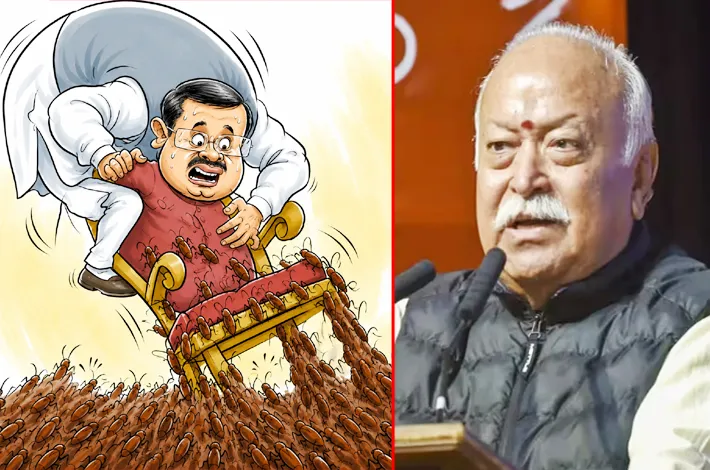
RSS chief Mohan Bhagwat has said that youth need emotional support rather than criticism when they fail and has asserted that values cannot be imposed through lectures but are absorbed by observing the conduct of parents and elders.
"Today's terminology speaks of IQ and EQ. Emotional intelligence is what really matters. Intelligence alone is not enough. We have all seen brilliant people who fail in life because they cannot cope with setbacks," Bhagwat said.
He also urged parents to lead by example in dealing with the influence of social media, saying children imitate what they see at home and develop their character by observing elders.
Addressing a question-and-answer session after his lecture on Yuganukul Matrutva (Contemporary Motherhood) at an event organised by Vishwamangalya Sabha on Friday, Bhagwat said parents should focus on nurturing character during the early years and gradually give children greater freedom as they grow.
"Values cannot be imposed. They are absorbed naturally by observing the conduct of elders. They are not accepted merely because someone says, 'This is good, so do it.' They become part of one's character only through observation and practice," he said.
Referring to the traditional Indian approach to parenting, Bhagwat said, "Our elders used to say that until the age of five, children should be treated like little kings and queens; between the ages of five and sixteen, they should be disciplined appropriately;
after sixteen, they should be treated like friends. This is because, by that stage, youngsters have developed the ability to understand and think independently." He said emotional intelligence is more important than intellectual ability in overcoming setbacks. Children should be reassured instead of being made to feel guilty when they fail.
"If a child fails in an examination, the child already knows that he or she has failed. There is no need to keep repeating it. Instead, the child should feel that someone stands with them. Parents should say, 'Don't worry. We are with you. Next time, you will succeed. Let us see what needs to be done.' That is what children need," he said.
Bhagwat said youth must be encouraged to rise again after failure. "Every child should be taught that even if you fall, you must get up and move forward. That confidence should come from the family. If families provide such support, children will naturally become strong and capable," he said.
Responding to a question on how parents can protect children from the adverse effects of social media and remain emotionally connected with them, Bhagwat said mothers, in particular, possessed a natural ability to build emotional bonds. "The only thing required is to keep communication alive. Through constant dialogue, parents come to understand the minds of their children. "Children should feel so closely connected that they can speak to their parents without reservation," he said.
Referring to the growing influence of social media, Bhagwat said its harmful effects are visible in society but stressed that not everyone succumbed to it. "But we also see that some people remain unaffected by it. It is not true that everyone gets swept away. Many do, but there are also those who consciously stop consuming such content. They reduce their use of social media," he said.