23 October, 2026 | 12:57 PM


Banks reeling under loan defaults!
01-09-2026 12:00:00 AM
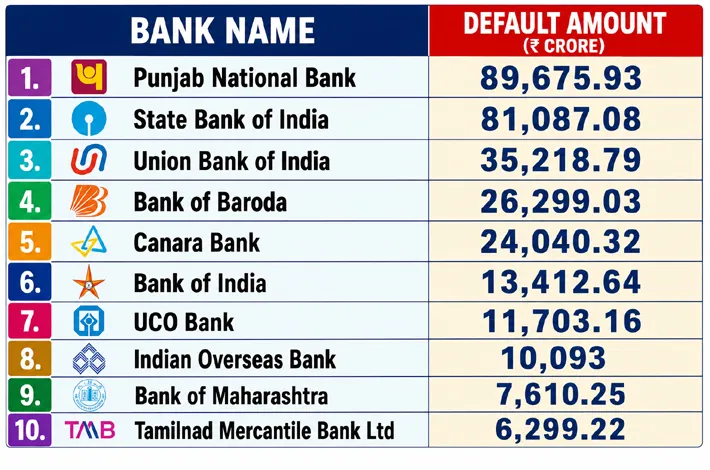
Top 10 banks with wilful default amounts
■ PNB and SBI top the list with defaults exceeding Rs80,000 crore each
■ 23 banks in the list of defaults exceeding Rs 1,000 crore
■ Banks with defaults up to Rs 25 lakh total around Rs 3 lakh crore
metro india news I hyderabad
A nationwide debate is intensifying over loan defaults by big businessmen and industrialists and the burden these defaults place on banks. The issue has gained attention following a recent case involving Zee/Essel Group founder Subhash Chandra, who approached the National Company Law Tribunal (NCLT) as a personal guarantor, citing inability to repay loans of Rs 22,006.57 crore. The matter reportedly ended with a settlement of just Rs 6.5 crore.
According to data published by watchoutinvestors.com, 45 banks had wilful defaults of Rs 100 crore or more as of December 31, 2025. The organisation has also listed banks and financial institutions with defaults of Rs 25 lakh and above.
PNB, SBI Top List
Punjab National Bank (PNB) and State Bank of India (SBI) have the highest reported default amounts at Rs 89,675.93 crore and Rs 81,087.08 crore respectively. Together, the two banks account for more than Rs 1.70 lakh crore.
Union Bank of India ranks third with Rs 35,218.79 crore, followed by Bank of Baroda with Rs 26,299.03 crore, Canara Bank with Rs 24,040.32 crore, Bank of India with Rs 13,412.64 crore, UCO Bank with Rs 11,703.16 crore and Indian Overseas Bank with Rs 10,093 crore.
The combined defaults among banks with outstanding amounts exceeding Rs 100 crore are estimated at around Rs 2.67 lakh crore. Of this, PNB and SBI account for Rs 1.70 lakh crore, while the remaining 43 banks together account for about Rs 97,000 crore.
More than 50 other banks reportedly have defaults below Rs 100 crore. Since the website lists institutions with defaults of Rs 25 lakh and above, the overall figure could approach Rs 3 lakh crore if smaller defaults are included.
Banks Caught in the Net
The figures have renewed concerns over how large corporate borrowers use insolvency proceedings to seek relief from substantial liabilities. Analysts point to the Subhash Chandra case as an example of the wide gap between loan obligations and settlements. Economists and financial observers argue that such defaults ultimately become a burden on banks, which largely operate with public money.
Questions Over Loan Sanctions
Analysts have also raised questions about the role of bank officials in sanctioning large loans. They allege that influential companies and businessmen sometimes use their reputation and political connections to secure substantial credit and subsequently seek relief through insolvency proceedings.
While the circumstances differ from case to case, the growing volume of reported defaults has raised concerns about accountability in lending and recovery. The debate now centres on whether banks and regulators need stronger safeguards to protect public money from the impact of large corporate defaults.