23 October, 2026 | 10:42 AM


Fascinating anecdotes in Science
01-09-2026 12:00:00 AM
science corner
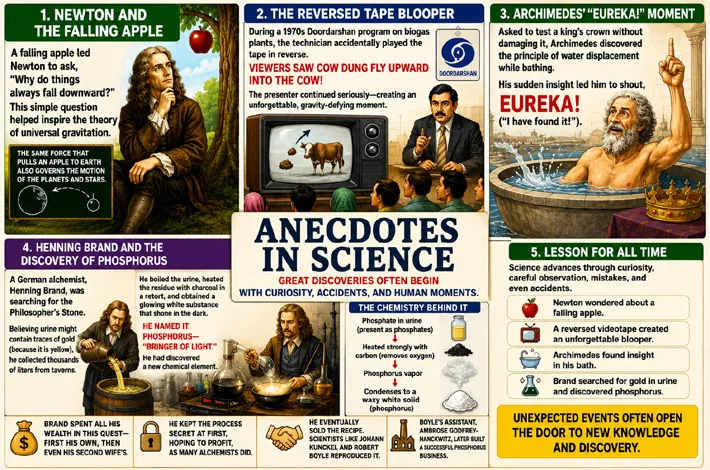
One of the most popular scientific anecdotes is that of Isaac Newton and the falling apple. Observing an apple drop from a tree, it is believed that it led him to ask a simple question: Why do things always fall downward? This curious question contributed to the theory of universal gravitation, explaining that the same force pulling an apple to Earth also governs the motion of celestial bodies.
A more personal anecdote comes from the early days of black-and-white television in India during the 1970s. Television ownership was rare, so community viewing was common. Neighbours would gather around a single set to watch Doordarshan broadcasts. During one farmer-education program demonstrating the use of cow dung in biogas plants, viewers witnessed something extraordinary: the cow dung appeared to defy gravity and fly upward into the cow. The explanation was simple but amusing. The technician had accidentally played part of the recorded tape in reverse while it was being broadcast live. As a result, the viewers saw the entire process running backward.
The presenter, trying to remain serious while discussing the benefits of cow dung, had to continue speaking as this hilarious, gravity-defying scene unfolded on screen. The incident became a memorable example of an unexpected technological blooper.
Another popular anecdote is Archimedes’ “Eureka!” moment. Asked by King Hiero to determine whether a crown was made of pure gold without damaging it, Archimedes reportedly discovered the principle of water displacement while bathing. Realizing that the volume of displaced water could reveal an object's density,
he is said to have run through the streets shouting “Eureka!” (“I have found it!”). Whether fully accurate or not, the story illustrates how scientific insight can emerge during ordinary activities.
Many discoveries arose from accidents. One fascinating example is the discovery of phosphorus by the German alchemist Henning Brand in the seventeenth century. Brand was searching for the mythical Philosopher’s Stone, believed to transform ordinary metals into gold and grant eternal life. Since urine is yellow, he assumed it might contain traces of gold and began experimenting with it.
To pursue his quest, Brand collected thousands of litres of urine from local taverns, allowed it to age, concentrated it by boiling, and then heated the residue strongly in a retort. Instead of producing gold, he obtained a glowing white substance. This remarkable material emitted light in the dark, and Brand named it phosphorus, meaning “bringer of light.” Although he obtained only a small amount, he had unknowingly become the first person to discover a new chemical element through a systematic experimental process unlike his ancestors.
The chemistry behind his discovery involved phosphate compounds present in urine. When heated intensely with carbon-containing materials, oxygen was removed from the phosphate, leaving elemental phosphorus. The phosphorus vapor condensed into a waxy white solid. Though modern production methods use phosphate ores in place of urine, interestingly, the same basic chemical principle remains till today.
Brand devoted all his resources to these experiments. He spent entire fortune inherited through his first wife and later exhausted the wealth of his second wife as well. Initially, he kept the process secret, hoping to profit from it, as many alchemists did. Eventually, he sold the recipe, allowing other scientists, including Johann Kunckel and Robert Boyle, to reproduce the discovery. Boyle’s assistant, Ambrose Godfrey-Hanckwitz, later established a successful phosphorus-manufacturing business.
These stories remind us that science often advances through curiosity, careful observation, technical mishaps, and even accidents. Whether it is Newton contemplating a falling apple, a television technician inadvertently reversing a videotape, Archimedes stepping into a bath, or Brand searching for gold in urine, unexpected events have frequently opened the door to new knowledge and discovery.

Dr Swarnabala Ganti is a seasoned chemist, regulatory affairs specialist and R&D scientist across India, Japan, Taiwan and Iran. She is a researcher & consultant at Swaram Biochem.)