21 September, 2026 | 4:16 PM


INDIA PROTESTS
25-07-2026 12:00:00 AM
- CJP meets Union Minister Nadda, says Pradhan’s resignation non-negotiable
- ■ CJP supporters create 'Wall of Shame' with pictures of police personnel who used brute force on protesters
- ■ CJP will launch website to identify police personnel who used brute force on protesters
- ■ Congress leader Rahul Gandhi on Friday slammed the Delhi University and asked how dare it "threaten" students for exercising their democratic rights.
- metro india news I new delhi
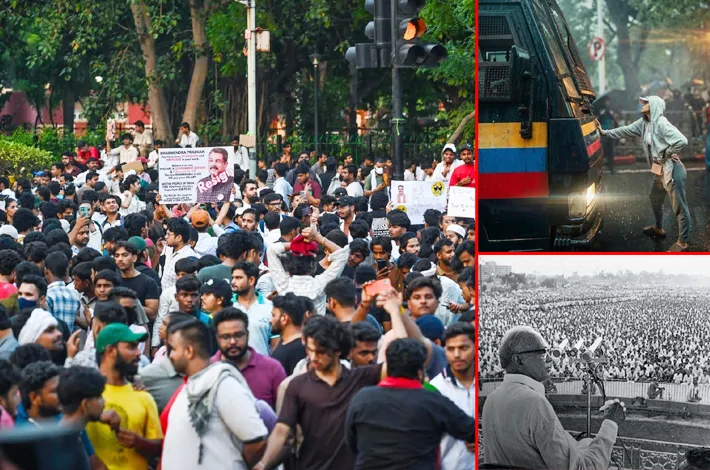
Cockroach Janta Party (CJP) founder Abhijeet Dipke said on Friday, “Physically I’m still feeling weak due to fever, but the fight must go on. Our peaceful protest at Jantar Mantar will continue until Dharmendra Pradhan resigns.” This in a nutshell echoed the spirit of the youth across the country as the protests continued.
The government and Cockroach Janta Party (CJP) held talks on Friday (July 24, 2026) at the Constitution Club of India after the Centre “agreed” to the CJP’s demand that the meeting be held at a neutral venue. Abhijeet Dipke said that the police must take back all the cases it has registered on protesters who joined the Parliament March on July 20.
Answering a question, he said the protest will go on. “Now the entire country has joined us. We will not step back until we get the resignation.” Mr. Dipke said. Even as protestors continued on the fifth day, elsewhere in the country, a wave of coordinated protests were held. Student organisations, civil society groups,
political parties and youth activists staged rallies, marches, sit-ins and public meetings across several states, demanding accountability from the Union Government and immediate corrective measures to restore confidence in the country's examination system.
Public demonstrations were organised in several major cities, with youth leaders emphasising that education should remain free from corruption and administrative failures. Several prominent personalities including former cricketer Sanjay Manjrekar, singer Sonu Nigam also expressed solidarity with the students, highlighting the importance of protecting the aspirations of young Indians.
The protests marked one of the largest nationwide student mobilisations in recent years, with participants accusing the authorities of failing to safeguard the integrity of one of India's most important entrance examinations. Demonstrators sought the resignation of Union Education Minister Dharmendra Pradhan, strict action against those responsible for the alleged leak, comprehensive reforms in the National Testing Agency's functioning and a transparent examination process that protects the interests of students.
The agitation reflected widespread frustration among students and parents over recurring examination controversies that have affected lakhs of aspirants across the country. Protesters argued that repeated irregularities have eroded public confidence in competitive examinations and created uncertainty for deserving candidates.
Student groups asserted that the issue extends beyond a single examination and represents a larger crisis in the management of national level recruitment and entrance tests. Along with calls for accountability, several organisations demanded structural reforms to ensure fairness, transparency and credibility in future examinations.
Protests spread across multiple states
Protests over the NEET controversy spread across Kerala, Andhra Pradesh, Bihar, Maharashtra, Tamil Nadu and Telangana on Friday, with students demanding accountability and reforms in the examination system.
In Kerala, students and youth organisations held marches and public meetings in support of the nationwide campaign. In Andhra Pradesh, police stopped several protest marches, though student groups continued demonstrations seeking justice for aspirants.
In Bihar, protests turned confrontational in some districts, prompting police to resort to baton charges after demonstrators attempted to intensify their agitation. Maharashtra witnessed peaceful rallies, signature campaigns and public meetings calling for accountability and examination reforms.
Tamil Nadu saw some of the largest demonstrations, with protests continuing for the fifth consecutive day. Thousands of students and youth participated in rallies, sit-ins, street plays and public meetings across Chennai, Madurai, Tiruvannamalai, Tiruvarur and other districts. Several organisations reiterated their demand for the abolition of NEET.
In Hyderabad and other parts of Telangana, student organisations held solidarity marches, alleging repeated lapses in national examinations had undermined students' confidence. Protesters demanded a transparent, corruption-free and student-friendly examination system, while police maintained security at major protest venues.
As protests gathered momentum across the country, student organisations maintained that their movement was aimed not merely at addressing the alleged paper leak but at securing lasting reforms in India's examination ecosystem.
In Telangana Students and youth across Telangana on Friday joined nationwide protests over alleged NEET examination irregularities, with educational institutions observing a shutdown in several places. Kakatiya, Osmania, Kaloji Health, Satavahana, Telangana and JNTU universities postponed scheduled examinations.
Student organisations, including SFI, AISF, PDSU and other Left-affiliated groups, led rallies in Hyderabad and other districts, demanding the resignation of Union Education Minister Dharmendra Pradhan.
Hyderabad protests witness brief clashes
Several protests were held across Hyderabad on Friday as political parties and student organisations backed the nationwide movement over alleged NEET irregularities.
Left-affiliated student groups marched from Narayanaguda to Himayatnagar, where tension flared after protesters attempted to burn an effigy of the Union Education Minister. Police intervened, leading to a brief scuffle.
At Adarsh Nagar, Youth Congress leaders led by former MP Anjan Kumar Yadav attempted to march to Dharna Chowk but were stopped by police. Several leaders and workers were detained, triggering another confrontation. The demonstrations reflected growing political support for students demanding transparency and accountability in national examinations.
Youth on the Streets
How Student-Led Revolts Have Reshaped Indian Politics
In post-independence India, the streets have often served as a crucible for political transformation, with the youth—particularly students—acting as the spark. From Gujarat’s Navnirman Andolan to Bihar’s Sampoorna Kranti, Assam’s anti-foreigner agitation, Telangana’s statehood demands, and Tamil Nadu’s anti-Hindi protests, young people taking to the streets have repeatedly forced regime changes, toppled governments, and redrawn the political map.
These movements highlight a recurring pattern: when systemic grievances like corruption, economic hardship, cultural imposition, or regional neglect boil over, student energy translates discontent into decisive political shifts. The Navnirman Andolan (Reconstruction Movement) of 1974 in Gujarat stands as a textbook case.
It began modestly in January 1974 with students at L.D. Engineering College in Ahmedabad protesting a hike in mess fees amid soaring inflation and food shortages following poor monsoons. What started as a campus issue quickly snowballed into a statewide agitation against corruption and misgovernance under Congress Chief Minister Chimanbhai Patel. Led by groups like the Nav Nirman Yuvak Samiti, the protests involved strikes, marches, and widespread participation from the middle class, traders, and unions.
By March 1974, the pressure proved irresistible. Patel resigned, and the state assembly was dissolved, paving the way for fresh elections. The movement claimed dozens of lives in police clashes but achieved its core goals. Historians note its ripple effect: it inspired the broader Bihar Movement and contributed to the political climate leading to the 1975 Emergency.
Gujarat’s experience demonstrated how student protests could unseat an elected government in a matter of months. Emboldened by Gujarat, students in Bihar launched their own agitation in 1974 against corruption, unemployment, and misrule under the Congress government. Jayaprakash Narayan (JP), the veteran socialist leader, provided moral and organizational leadership, transforming localized student protests into the Sampoorna Kranti (Total Revolution) movement.
On June 5, 1974, at Patna’s Gandhi Maidan, JP issued his historic call for comprehensive societal overhaul—political, economic, and social. Students boycotted classes, gheraoed assemblies, and mobilized masses. Clashes with police resulted in deaths, but the movement spread nationally.
It united opposition forces against Prime Minister Indira Gandhi’s Congress, culminating in the Janata Party’s victory in the 1977 elections—the first non-Congress government at the Centre. JP’s call mobilized youth across ideologies, proving student power could challenge authoritarian tendencies and restore democratic accountability. In Assam, the All Assam Students’ Union (AASU), founded in 1967, led one of India’s most sustained student movements from 1979 to 1985.
Sparked by fears of demographic swamping due to illegal immigration (largely from Bangladesh post-1971), AASU, along with the All Assam Gana Sangram Parishad, organized satyagrahas, blockades, and protests. The six-year Assam Agitation demanded detection and deportation of “foreigners.” It turned violent at times, with reports of around 855 martyrs.
The pressure forced the Centre to negotiate. The Assam Accord, signed on August 15, 1985, set March 24, 1971, as the cut-off date for citizenship and promised safeguards for indigenous Assamese identity (Clause 6). AASU leaders like Prafulla Kumar Mahanta formed the Asom Gana Parishad (AGP), which won the 1985 state elections and formed the government. The movement not only altered Assam’s politics but also led to the National Register of Citizens process.
Telangana’s long struggle for statehood similarly underscores student agency. The 1969 agitation erupted over perceived violations of the Gentlemen’s Agreement (1956) that had merged Telangana with Andhra. Students protested job discrimination, resource diversion, and cultural marginalization. A hunger strike by a student in Khammam ignited widespread unrest, with Osmania University as a hotspot. Police firing killed hundreds—estimates suggest around 369 deaths, mostly students. While immediate demands for safeguards were partially met, the movement kept the statehood flame alive.
Renewed student-led agitations in later decades, especially from the 2000s under the Telangana Rashtra Samithi (TRS, now BRS) and groups like the Joint Action Committee, combined with political strategy, culminated in Telangana becoming India’s 29th state in 2014. Students provided the sustained grassroots energy. In Madras State (now Tamil Nadu), Dravidian student activism reshaped southern politics. Roots trace to the 1930s anti-Hindi protests against Congress’s imposition of Hindi in schools, led by Periyar’s Justice Party and Self-Respect Movement. The movement revived powerfully in the 1960s.
As the Centre pushed Hindi as a link language post-1965, students—coordinated by bodies like the Tamil Nadu Students Anti-Hindi Agitation Council—erupted in protests. Black flag demonstrations, self-immolations, and riots followed, with reports of over 500 deaths in some accounts. DMK, under C.N. Annadurai, channeled this resentment. The 1965 agitations discredited Congress, leading to DMK’s landslide victory in the 1967 elections—the first major non-Congress win in a major state.
Dravidian parties have ruled Tamil Nadu ever since, embedding social justice, federalism, and Tamil pride into governance. Student protests against cultural imposition directly facilitated this regime change. These movements share common threads: economic distress or identity threats ignite student action; protests escalate through strikes, marches, and sacrifices; governments initially repress but eventually concede or fall. Data from the era shows spikes in higher education enrollment correlating with activism—youth bulges provided the numbers.
While not every protest succeeds, these cases altered state and national trajectories: dissolution of assemblies, new parties, state formations, and shifts from one-party dominance. In an era of social media and larger youth demographics, the legacy endures. Student power remains a potent democratic force, reminding rulers that when the young take to the streets with conviction, regimes can crumble and new political orders emerge.
India’s history proves that youth revolutions are not mere disruptions—they are instruments of renewal. If the NDA government led by BJP at the Centre, which is in rule in majority of states, does not listen to the ground reality, they will have no option but to face the consequences.