25 September, 2026 | 3:13 PM


Who should lead India’s opposition?
25-02-2026 12:00:00 AM
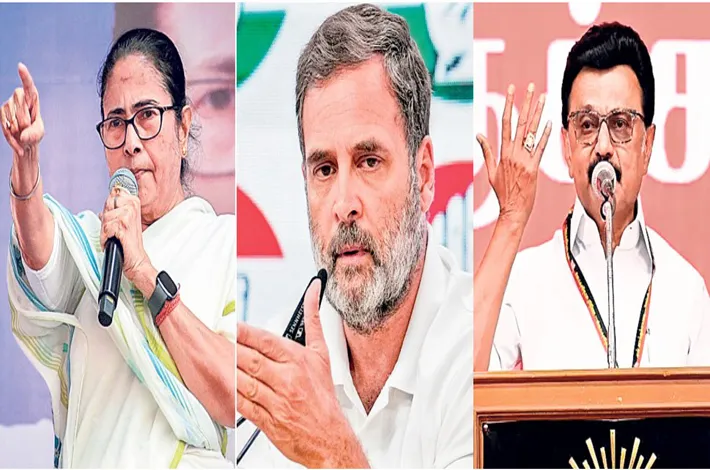
Opposition unity in India has long been more appealing in theory than in practice. Recent remarks by senior Congress leader Mani Shankar Aiyar have reignited debates over who should head the INDIA bloc, the opposition alliance formed to challenge the ruling Bharatiya Janata Party (BJP). Earlier speculation had focused on West Bengal Chief Minister Mamata Banerjee as a potential national face, but new discussions now point to Tamil Nadu Chief Minister MK Stalin.
Whether this buzz reflects genuine political discourse or calculated signalling, it underscores a persistent issue: the unresolved leadership questions surrounding the Congress party nationally and Rahul Gandhi’s role within it. At the core, the dilemma is structural. Congress remains the only opposition party with a pan-India presence, yet Rahul Gandhi’s repeated electoral setbacks and the persistent “dynasty” narrative continue to unsettle regional allies.
The paradox is clear. Many in the alliance favor a federal leadership figure—someone who avoids triggering automatic counter-polarization and presents a tougher target for BJP attacks. Without Congress, however, the bloc risks fragmentation. Regional leaders prioritize safeguarding their turf, consolidating vote banks, and avoiding being overshadowed in their states. Congress, meanwhile, faces an existential challenge: to lead the alliance without alienating partners and to anchor it without dominating it.
The broader question remains—can the INDIA bloc transcend personality clashes to offer a coherent governance alternative? Leadership ambiguity could erode credibility before voters even engage with the alliance’s agenda. In coalition politics, electoral arithmetic is crucial, but optics matter equally. Currently, the bloc appears to be groping for clarity at the top.
Rahul Gandhi’s leadership comes under scrutiny even within Congress and the larger alliance. His repeated poll losses raise doubts about his winnability. Despite being positioned as a “youth face,” Rahul struggles to connect with aspirational young voters shaping India’s political narrative. Incidents like the Banyan protest at an AI summit highlight perceptions that Congress may not fully understand youth sentiments. Public gaffes often overshadow key messaging, diverting attention from sensitive issues like reservations, which remain contentious even within the party.
If the INDIA bloc were to proceed without Congress at the helm, it could shed anti-Congress baggage and state-level legacy rivalries, presenting a fresh federal front. However, it would lose the Congress’s organizational network, risking a disjointed, uncoordinated image. Regional parties could better protect minority vote bases, but projecting a unified national challenger to Prime Minister Narendra Modi becomes harder without a central anchor.
A political observer from Tamil Nadu suggested Stalin’s reluctance stems from avoiding perceptions of over-ambition. He drew historical parallels to coalitions like the United Front or the 2004 UPA supported by communists, arguing that the largest party need not always lead. He emphasized that a leader like Mamata, with a consistent record of defeating the BJP, could build bridges more effectively than Rahul Gandhi, who is burdened by repeated losses.
A TMC-aligned journalist from West Bengal praised Mamata as the opposition’s standout fighter. He cited her landslide victories, bold protests in Delhi, and even her influence on judicial oversight of elections—an unprecedented move in independent India. He stressed the need for unity against the BJP juggernaut, predicting a common minimum program and consensus leadership. He viewed the 2024 results as denting BJP dominance, with allies like TDP and JD(U) now supporting it, and foresaw a stronger opposition coalescence by 2029.
A political analyst leaning towards Congress defended Rahul Gandhi, portraying him as an emerging alternative that even frightens Modi. He criticized the NDA for being anti-farmer and surrendering to U.S. trade deals, questioning why allies support it. Invoking the Gandhi family’s sacrifices and Congress’s historical role, he dismissed doubts, comparing Rahul’s journey to other parties like the BJP, which took decades to rise. He predicted Rahul as the next prime minister, accusing the BJP of avoiding direct fights against regional heavyweights like TMC or RJD.
A BJP spokesperson countered sharply, attributing Congress’s woes to “delusional arrogance” and disconnect from reality. She argued the INDIA alliance never truly existed, pointing to absent state-level pacts in key areas such as West Bengal and Maharashtra. She highlighted Rahul Gandhi’s inability to focus on relevant issues—from vote theft allegations dismissed by the Supreme Court to farmer protests that did not hinder BJP victories in Haryana and Uttar Pradesh post-2020. She criticized Congress narratives, including exaggerated claims of uprisings akin to Bangladesh, as failing to resonate with voters.
Ultimately, the debate circles back to the INDIA bloc’s future. A TMC leader advocated a strategy of converging regional strengths post-victories, with Congress indispensable as a pan-India force. Some political analysts noted historical precedents for non-dominant leadership. Meanwhile, the BJP dismissed the alliance as fractured, while Congress remained optimistic about Rahul Gandhi’s rise.
As the conversation concluded, the core question lingered: can the opposition move beyond personalities to forge a credible challenge? With 2029 on the horizon, clarity at the top remains elusive, but groundwork for leadership decisions must begin now to avoid repeating past ambiguities.