27 September, 2026 | 9:14 AM


Which way is india’s stand in the war?
05-03-2026 12:00:00 AM
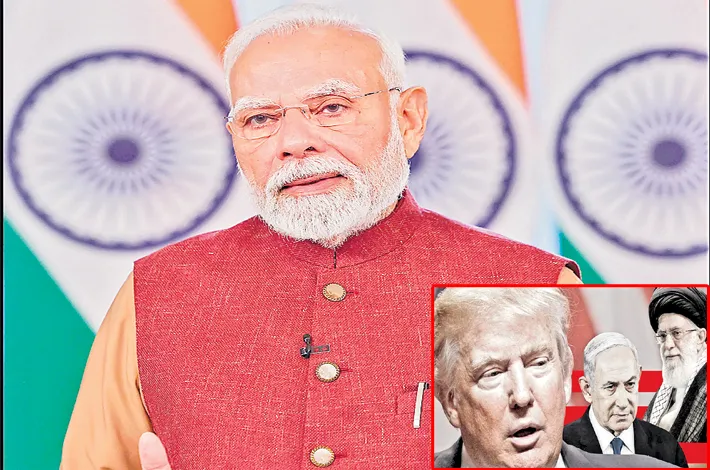
The escalating conflict in the Middle East, involving the United States, Israel, and Iran, has raised urgent questions about whether U.S. President Donald Trump has plunged the world into a prolonged "forever war." Recent reports indicate that joint U.S. and Israeli forces have conducted airstrikes on Iranian targets, including the bombing of an airport and other sites, resulting in the confirmed death of Iran's Supreme Leader Ayatollah Ali Khamenei.
This dramatic development has ignited a broader regional firestorm, with direct confrontations now spanning multiple nations, including strikes extending to Lebanon, retaliatory attacks on Gulf states like Saudi Arabia, the UAE, Kuwait, and even the U.S. embassy in Riyadh targeted by Iranian drones. Trump has declared that the era of negotiations with Iran is over, framing the campaign as an open-ended mission with no fixed timelines, no mercy, and objectives that must be fully achieved.
He has not ruled out deploying ground troops, describing it as a war "without a ticking clock." Iran, in response, has vowed to endure a "long haul," launching drone strikes and threatening to close the Strait of Hormuz—a vital chokepoint for roughly 20% of global oil supplies, including nearly 50% of India's imports—while warning of severe consequences for any vessels attempting to pass.
The theatre of war has widened dramatically, now encompassing at least 13 nations, including Cyprus in Europe. Israeli forces have reportedly inserted ground troops into Lebanon to combat Hezbollah amid ongoing missile exchanges. Global oil markets are in turmoil as fears mount over supply disruptions, with the U.S. firmly stating that the Strait of Hormuz must remain open.
In India, however, the reaction has been sharply divided along political lines. Opposition figures, including Congress leaders like Sonia Gandhi, have criticized Prime Minister Narendra Modi's government for its perceived silence on the U.S.-Israeli strikes and Khamenei's killing. In a recent op-ed, Sonia Gandhi argued that such silence is not neutral but an "abdication" of responsibility, claiming it undermines India's credibility and weakens its defense of global laws and sovereignty. Rahul Gandhi and Priyanka Gandhi Vadra echoed this, reposting the piece and asserting that silence equates to endorsement of actions labelled as genocidal or aggressive.
BJP leaders however hit back reminding that the Congress-led UPA government had stayed silent on Saddam Hussein’s hanging and Muammar Gaddafi’s brutal killing. “Those who did not pick a side even when India faced its worst terror attacks in 2008 are today giving lectures on foreign policy,” a party spokesperson said. He listed India’s vital stakes: 50 per cent of oil imports through the Strait of Hormuz, 54 per cent from five Gulf nations, ten million Indians living in the region, and deep defence ties with Israel. “This is not our war. Why should we be forced to pick a side?” was the argument put forth.
Opposition leaders countered with accusations of blackmail. Somnath Bharti of the Aam Aadmi Party and Ameeque Jamei of the Samajwadi Party making serious allegations that Modi was “dancing to the tunes of America and Israel” because of the Epstein files and other pressures. They demanded India condemn the US strike on Iranian sovereignty as a violation of international law. “If America can kill a supreme leader today, tomorrow they can target anyone,” Bharti warned.
The Modi government, however, maintains that its approach prioritizes dialogue, diplomacy, and India's core interests. The Ministry of External Affairs has reiterated calls for de-escalation while expressing concern for the safety of approximately 10 million Indians in Gulf countries and the security of supply chains. India sources a significant portion of its oil—around 54% from five Gulf nations—and cannot afford to endorse threats to close the Strait of Hormuz.
Deepening defence ties with Israel coexist with longstanding relations with Russia, which has backed Iran in the conflict. Critics of the opposition argue that forcing India to "pick a side" ignores these realities and risks entangling the country in a war not of its making. Senior strategic and defence experts defended the government’s calibrated approach. They pointed out that India’s trade with the Arab world is $200 billion and remittances $45 billion, compared to less than $2 billion with Iran. They out it in plain words-India is simply protecting its own interests – exactly what every previous government, including the UPA, has done.
As the conflict rages with no clear end in sight—Trump has suggested ongoing operations and even openness to talks with surviving Iranian elements—the central question remains: Is this escalation the dawn of another drawn-out confrontation? For India, the answer appears firm: stability, not alignment in a distant war, must guide its path.