17 August, 2026 | 6:27 PM


TS Archives joins Gyan Bharatam Manuscript Mission
07-03-2026 12:00:00 AM
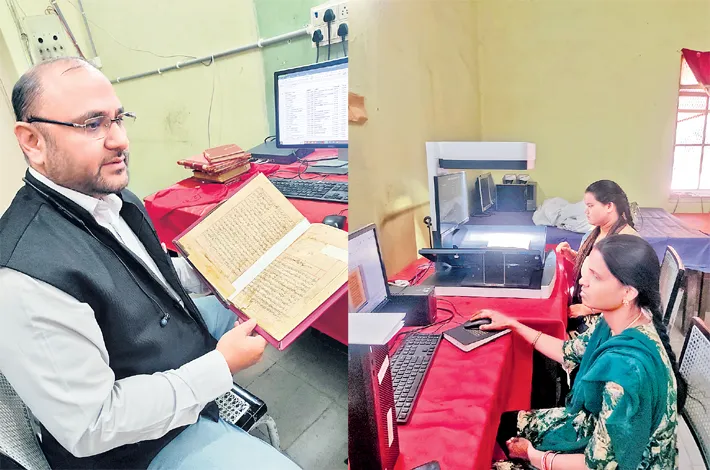
Gyan Bharatam is a flagship programme of the Ministry of Culture designed to identify, document, conserve and digitise manuscripts across the country
It is nearly 5 p.m., and most employees have left the Telangana State Archives and Research Institute (TSARI) during the holy month of Ramzan. But cataloguer Syed Mohammed Ali Abedi remains at his desk, compiling lists of historical documents on his computer. Soon, Director Dr. Zareena Parveen and Assistant Director M. A. Raqeeb will make their daily round to review the day’s work before closing.
The task underway at TSARI is both unique and historically significant. The institute has signed a five-year Memorandum of Understanding (MoU) with the Ministry of Culture (India) to implement the Gyan Bharatam initiative, which aims to preserve, digitise and disseminate India’s vast manuscript heritage.
Gyan Bharatam is a flagship programme of the Ministry of Culture designed to identify, document, conserve and digitise manuscripts across the country. A key component of the initiative is the creation of the National Digital Repository (NDR), a dedicated digital platform that will make India’s manuscript heritage accessible worldwide.
Speaking to Metro India, Dr. Parveen said TSARI has been selected as a cluster centre, making it responsible not only for its own manuscripts but also for coordinating work at other institutions. These include the Dairatul Ma'arif, Oriental Manuscripts Library and Research Institute, Iqbal Academy and Sanskrit Academy.
While the project has begun, finding skilled personnel remains a challenge. “We need people with strong knowledge of Persian, Arabic and Urdu. Only those with a passion for languages and history can truly do justice to this work,” said Raqeeb.
Thousands of manuscripts must be deciphered, catalogued, scanned and uploaded to the digital repository — a process that is both meticulous and time-consuming.
Abedi recently came across a manuscript titled “Inshaye Roshan Kalam”, written in 1844 by Bhupat Raye. The document describes events of the time and includes poetry. “The quality of the paper is remarkable, and the writing in indelible ink is beautiful even today,” he said.
The nationwide project has a budget of Rs. 491.66 crore for the period 2025–2031, but experts say the biggest challenge remains finding qualified scholars to carry forward the work.