30 June, 2026 | 3:34 PM


Government Hospitals struggle under mounting patient load
30-04-2026 12:00:00 AM
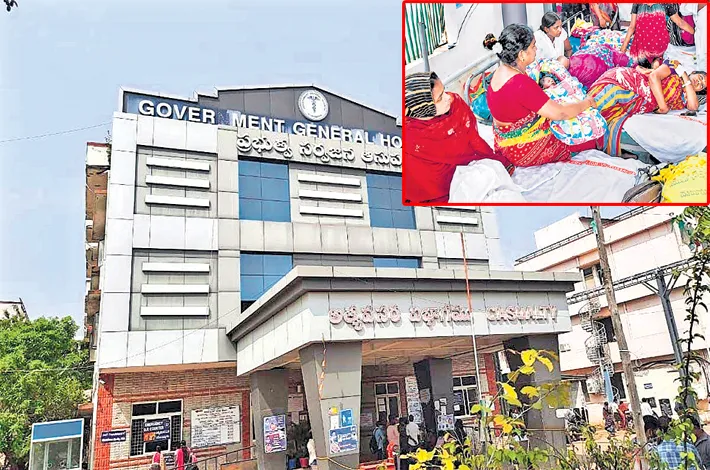
The Numbers Behind the Crisis
- 25 — Total teaching hospitals in Andhra Pradesh
- 12 — Teaching hospitals with OBG departments
- 9,608 — Sanctioned beds across all teaching hospitals
- 13,120 — Actual beds currently in use
- 1,227 — Sanctioned OBG beds
- 2,200+ — Beds currently in use in OBG departments
- 1,000+ — Unofficial additional OBG beds
- 1,020 — Additional beds proposed by DME
Metro India News | AMARAVATI
Andhra Pradesh’s public healthcare system is buckling under pressure, with government hospitals across the state facing a near-collapse in basic infrastructure. Nowhere is this crisis more visible than in the Obstetrics and Gynecology (OBG) departments of teaching hospitals, where two patients sharing a single bed has become routine rather than an exception. What should be a system designed to safeguard maternal health has instead turned into a daily struggle for space, dignity, and care.
Despite repeated representations from hospital administrations, the State government has failed to act on long-pending proposals to increase sanctioned bed strength and expand infrastructure. The result is a widening gap between patient inflow and available facilities, one that is now impossible to ignore.
Ironically, this crisis unfolds even as the State government highlights increased budgetary allocations. The health sector received Rs 19,306 crore in the 2026–27 budget, a 9.5% rise from the previous year. Health Minister Y. Satya Kumar Yadav stated that healthcare now ranks fourth in total allocation, accounting for 5.81% of the State budget, with a focus on strengthening infrastructure and medical education. However, ground realities suggest that these allocations have yet to translate into tangible improvements.
Across the state’s 25 teaching hospitals, only 9,608 beds are officially sanctioned, while the actual number in use has surged to 13,120, an excess of over 3,500 beds, many of them makeshift additions. The situation is particularly dire in the 12 teaching hospitals equipped with OBG departments. Here, against a sanctioned strength of just 1,227 beds, hospitals are forced to operate with over 2,200 beds, including more than 1,000 unapproved additions.
This mismatch is not a recent phenomenon but the result of sustained neglect. Patient inflow has more than doubled over the past few years, driven by improved clinical outcomes, rising trust in government doctors, and the high cost of private healthcare. Yet, not a single additional bed has been formally sanctioned.
At the Old Government General Hospital in Vijayawada, the numbers tell a stark story. The OBG department records over 30 new admissions every day. In 2025 alone, the hospital handled more than 8,500 deliveries, an indication of its growing burden. By April this year, deliveries had already reached 3,489.
Yet, the sanctioned bed strength in the department remains at just 90. In practice, the hospital is operating with around 210 beds, more than double the approved capacity. Even then, overcrowding persists, forcing staff to accommodate multiple patients on a single bed.
Hospital officials admit that the strain extends beyond beds. “Infrastructure expansion depends on the AP Medical Services and Infrastructure Development Corporation and approvals from regulatory authorities. But beds alone are not enough, we also need more doctors, nurses, and support staff,” a senior official said, pointing out that the hospital is effectively functioning with double its sanctioned workload. While hospitals cite space constraints as a major hurdle to expanding bed capacity, the pace of infrastructure development has been sluggish. Over the past four years, only a handful of hospitals have managed to add marginal space, nowhere near what is required to meet current demand.
“Calling tenders and supplying beds can be done within weeks. But without budgetary allocation, the process cannot even begin.” an official of APMSIDC clarified. The consequences of bureaucratic delays are visible in stalled projects. At Vijayawada’s Old GGH, a dedicated Mother and Child Care block announced in 2018 with a budget of Rs 18 crore remains incomplete even after several years.