24 September, 2026 | 8:12 PM


Tragedy at TVK rally casts shadow over Tamil Nadu's pre-election landscape
15-02-2026 12:00:00 AM
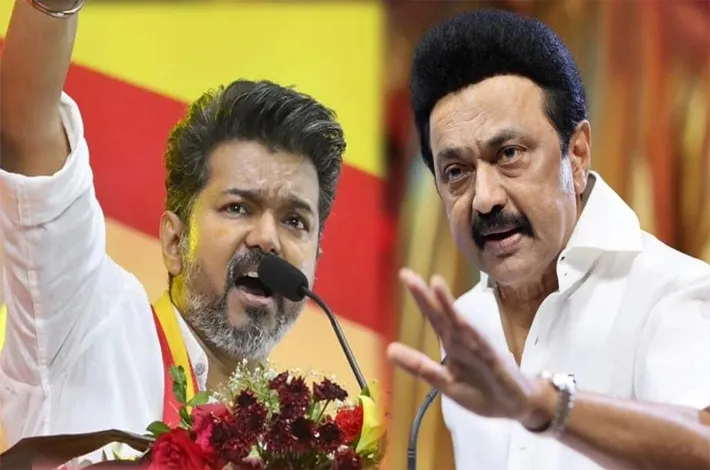
As Tamil Nadu gears up for its assembly elections expected in April or May 2026, the political atmosphere is charged with both tragedy and strategic manoeuvring. Just months after a deadly stampede at a political rally in Kathua claimed over 40 lives, another unfortunate incident has unfolded at a rally organized by the Tamilaga Vettri Kazhagam (TVK), led by actor-turned-politician Vijay. During the event in Salem, a 32-year-old supporter named Suraj collapsed and was later declared dead at a nearby private hospital.
Initial reports from both the police and TVK attribute his death to a pre-existing heart condition, with a postmortem underway to provide further clarity. The incident has quickly escalated into a political flashpoint, drawing sharp criticism from Vijay's rivals across the spectrum. The ruling Dravida Munnetra Kazhagam (DMK) questioned how many more lives would be lost before the elections, highlighting a pattern of mishaps at opposition events. The All India Anna Dravida Munnetra Kazhagam (AIADMK) took a more caustic tone, suggesting that TVK supporters might as well carry their coffins to such rallies.
The Bharatiya Janata Party (BJP) accused Vijay of negligence, arguing that his apparent disregard for public safety undermines any trust voters might place in him during election time. TVK, in response, expressed deep sorrow and emphasized that the death resulted from Suraj's health issues, not rally mismanagement. They pledged to prevent any untoward incidents in the future, but the optics remain challenging for the nascent party amid the high-stakes electoral battle.
DMK's bold cash transfer move-Welfare or electoral gambit?
Shifting focus from the sombre rally news, another major development emerged early on February 13, 2026, when over 1.3 crore women in Tamil Nadu woke up to a surprise: Rs 5,000 credited directly to their bank accounts. Chief Minister MK Stalin's government disbursed a total of Rs 6,550 crore under the Kalaignar Magalir Urimai Thogai scheme, framing it as a "rights grant" to empower women.
This included tripling the regular monthly stipend from Rs 1,000 to Rs 3,000 for the next three months, plus a Rs 2,000 summer bonus. Stalin's social media post underscored his commitment, vowing not to back down despite potential obstacles, and promised to double the monthly amount to Rs 2,000 if the DMK is re-elected. The timing of this rollout—mere hours before a TVK rally—has fueled speculation about its political intent, especially with murmurs of attempts to halt the scheme due to the impending model code of conduct.
Critics, including the BJP and AIADMK, labeled it a desperate poll gimmick, accusing the DMK of dynasty politics and fiscal irresponsibility. One BJP voice described the DMK and AIADMK as the "worst political parties in the country," focused on self-interest rather than public welfare, and predicted the end of DMK's rule. In contrast, supporters hailed it as sound economics, akin to universal basic income, that injects money into local economies and directly benefits women.
A DMK spokesperson defended the initiative as a "masterstroke," pre-empting potential interference from the BJP-AIADMK alliance, which he accused of colluding with the Election Commission. He emphasized the scheme's popularity among women, who have grown accustomed to the monthly aid, and highlighted the DMK's promise to increase it post-elections.
"We understood how the BJP and AIADMK will play dirty," he argued, noting the overwhelming positive response on social media, where women expressed gratitude in tears. He portrayed the decision as driven by genuine concern for beneficiaries, not electoral desperation. A BJP leader countered sharply, dismissing DMK’s fears as baseless and ignorant of legal basics. He insisted that ongoing schemes like this cannot be halted by the Election Commission or courts, drawing parallels to central government programs like Kisan Samman Nidhi.
Raman accused the DMK of fiscal splurging, diverting welfare funds while promoting state-run liquor outlets (TASMAC), which he claimed burdens families financially. "This shows the desperation and fear of MK Stalin," he said, predicting the scheme's ineffectiveness against rising anti-incumbency. He questioned the "summer bonus" rationale, calling it arbitrary, and highlighted the DMK's internal family factions and alliance tensions as signs of weakness.
An AIADMK spokesperson countered sharply, calling the payout a "fear stroke" driven by CM MK Stalin's desperation to secure his son Udhayanidhi's political future. He highlighted the scheme's selective implementation, pointing out that the 2021 poll promise of Rs 1,000 monthly to 3.24 crore women was delayed by 28 months, with eligibility criteria excluding 2.24 crore women initially.
"Suddenly, after 55 months and on the eve of elections, 30 lakh more women get entitled? This is blatant lies and conspiracy theories to paint AIADMK and BJP as villains," he said. He further accused the DMK of mismanagement, noting the state's debt surpassing Rs 10 lakh crore and the diversion of funds from budgets for downtrodden and scheduled tribes, labelling the government as opaque and filled with "fake promises and narratives."
A journalist provided a balanced perspective, noting the announcement's early-morning timing as a sign of anxiety amid evolving electoral dynamics. He pointed out the scheme's delayed rollout post-2021 promise due to fiscal strains and its expansion to 1.3 crore beneficiaries. He highlighted strains in the DMK-Congress alliance, with unresolved seat-sharing talks and Rahul Gandhi's unpredictability adding pressure.
"The DMK alliance, once formidable, is under severe strain," he observed, while acknowledging ground-level anti-incumbency, including agitations by government workers and demands for younger DMK cadres. He questioned the altruism of such moves, suggesting they blend welfare with electoral dividends.
Ultimately, the debate underscores a broader national question: Are these cash transfers tools for genuine empowerment or cynical vote-buying exercises? While the DMK insists on its scheme's sustainability and local economic benefits, opponents decry the timing and fiscal irresponsibility. As similar strategies prove game-changers in other states, whether this "summer bonanza" sways women voters or backfires remains a pivotal uncertainty in Tamil Nadu's political arena.