28 June, 2026 | 8:07 PM


Salary cuts rock engineering colleges
03-05-2026 12:00:00 AM
metro india news I hyderabad
The impact of delayed fee reimbursement is no longer limited to students alone. It is now hitting faculty and staff working in private engineering colleges across the state. Several institutions are reportedly using pending government fee reimbursement dues as a reason to cut salaries, delay payments for months, and reduce workforce strength, even as they continue to collect lakhs of rupees in fees from students without any reduction.
According to reports, many engineering colleges have started implementing salary cuts, with some institutions paying only 50 percent of salaries since December. Faculty unions allege that even top colleges, which charge substantial fees, have reduced pay for teaching staff. Meanwhile, medium and smaller colleges are said to have kept salaries pending for three to six months. In a few cases, salaries are being paid only once every one or two months, creating severe financial distress for employees.
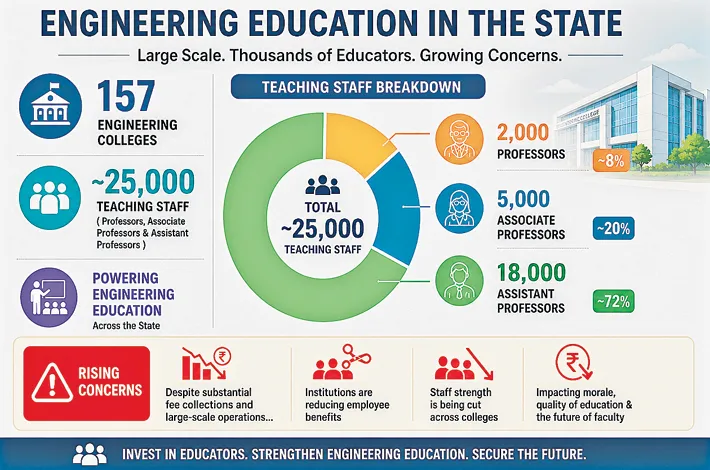
The state currently has 157 engineering colleges, employing nearly 25,000 teaching staff, including professors, associate professors, and assistant professors. Of these, around 2,000 are professors, nearly 5,000 are associate professors, and the remaining 18,000 are assistant professors. Despite the scale of operations and fee collections, institutions are reportedly reducing employee benefits and cutting staff strength.
Reports indicate that nearly 3,000 to 4,000 faculty members have either been removed or forced out from private colleges across the state. Some institutions are directly terminating staff to reduce operational burden, while in others, irregular salary payments are pushing faculty members to resign on their own. In certain colleges, managements are allegedly planning to reduce staff strength by as much as half.
Another major concern is linked to inspections for the 2026 academic year. JNTU has begun institutional inspections, and allegations have surfaced that colleges temporarily show sufficient faculty strength only until inspections are completed, after which many staff members are removed. Critics claim that these inspections are being conducted in a superficial manner, allowing such practices to continue unchecked. Faculty associations say this is not the first time colleges have created such difficult conditions for employees. During the COVID-19 period as well, many institutions reportedly failed to pay salaries properly. At that time, protests and demonstrations by teaching staff led managements to promise that dues would be cleared later. However, according to TSTCEA State President A. Santosh Kumar, many colleges have still not cleared those pending payments.
Now, with fee reimbursement funds yet to be released by the government, colleges are again citing financial strain as the reason for withholding salaries. Faculty members say the situation has left them struggling to pay children’s fees, EMIs, and loan installments. Many are finding it difficult even to manage basic monthly household expenses.
The growing crisis has raised serious questions over accountability in private educational institutions, where high student fees continue to be collected while staff welfare is being compromised. The issue has once again brought attention to the urgent need for transparent financial practices and timely government reimbursements to prevent further distress in the higher education sector.