27 September, 2026 | 3:43 PM


Protocol row- Was President willfully disrespected?
09-03-2026 12:00:00 AM
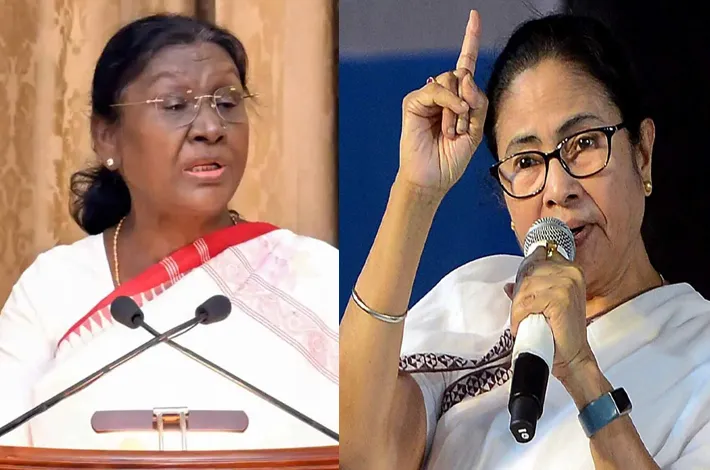
The political atmosphere in West Bengal has intensified following a controversy surrounding President Droupadi Murmu's visit to North Bengal for the International Santhali Conclave (also referred to as an Adivasi or tribal conference). The event, part of the 9th International Santhal Conference, was originally planned for Bidhannagar in Darjeeling district but was relocated by state authorities to a smaller venue in Goshaipur near Bagdogra Airport, reportedly due to congestion concerns.
President Murmu publicly expressed strong displeasure over the change, noting that she later visited the original site and found the field spacious enough to accommodate up to five lakh people. She highlighted protocol lapses, including the absence of Chief Minister Mamata Banerjee and other state ministers to receive her, as required under established Raj Bhavan guidelines.
These protocols mandate a ceremonial reception involving the governor, chief minister, chief secretary, and director general of police, along with adherence to approved schedules and invitee lists. Despite her criticisms, the President referred to Mamata Banerjee as her "younger sister" and emphasized that she held no personal grudges, while expressing sadness over limited tribal participation and development in the region.
The incident quickly escalated into a major political flashpoint, especially with assembly elections approaching in the state. Prime Minister Narendra Modi condemned the developments in strong terms, describing them as "shameful and unprecedented." He accused the Trinamool Congress (TMC) government of crossing all limits, holding their administration responsible for the insult to the President, and stated that it disheartened those who value democracy and tribal empowerment. The office of the President, he stressed, stands above politics and deserves unwavering respect.
In response, Chief Minister Mamata Banerjee did not offer an apology. Instead, she sharply countered by claiming the President had been "trapped by the BJP" and was acting on the party's instructions to advance its political agenda, especially during election season. She urged the President not to "play politics" and emphasized respect for the office while questioning why similar concerns were not raised about alleged atrocities against tribals in BJP-ruled states like Madhya Pradesh, Uttar Pradesh, or Chhattisgarh.
A BJP spokesperson strongly condemned the TMC, calling the treatment of President Murmu "despicable" and a "shame" that undermined the constitutional office under Article 53. She highlighted Murmu's restrained demeanour—she described Banerjee as a sister and avoided harsh language—while accusing the TMC of brazen thuggery. She argued that insulting the President also insulted tribal communities (including 53 lakh Santhals in Bengal), women, the armed forces, and democratic ethos.
TMC national spokesperson Dr. Riju Dutta expressed disappointment but blamed the BJP for using the President's office to push a "dirty political agenda" just before elections. He dismissed certain protocol expectations as "nonsense" amid the TMC's ongoing "war" against alleged voter list deletions (names struck off during the Special Intensive Revision exercise) and identity threats labelling Bengalis as outsiders. He questioned Murmu's silence on tribal issues in BJP-ruled states and accused her team of failing to account for the Chief Minister's unavailability due to protests.
A senior political analyst criticized the TMC's attitude, arguing that protocol transcends political differences and is upheld in other opposition-ruled states like Punjab, Himachal Pradesh, Tamil Nadu, and Karnataka. He accused Banerjee of simply not caring about conventions and noted that West Bengal Police and Rashtrapati Bhavan coordinate such visits, making ignorance implausible.
Another political analyst, acknowledged possible administrative lapses by the state but pointed out that the Prime Minister politicized the issue by labeling it an "insult" and naming the TMC, prompting retaliation. He disagreed with calling protocol "nonsense" but highlighted perceived inconsistencies, such as BJP dismissing opposition demands for protocol as entitlement in other contexts (e.g., opposition leaders' seating at events).
TMC national general secretary Abhishek Banerjee amplified the party's stance on X, framing the situation as "Bengal versus the entire establishment." He listed the BJP, Election Commission of India (ECI), Enforcement Directorate (ED), Income Tax (IT), CBI, NIA, CAPF, the governor, multiple union ministers, chief ministers, the Prime Minister, and even the media as aligned against the state and its people.
This episode underscores the deepening rift between the TMC and the BJP-led central establishment in West Bengal, transforming a protocol and event management issue into a charged electoral battleground involving the sanctity of the President's office, tribal empowerment and state versus centre dynamics.