24 August, 2026 | 2:31 PM


Propaganda as weapon in emergency season
26-06-2026 12:00:00 AM
Metro India News | Hyderabad
Come Emergency season, it is commonplace to see archaic stuff dished out on social media platforms, primarily aimed at vilification and character-assassination of Indira Gandhi. Proverbially, public memory is so short that advantage is taken of it, to the hilt, to circulate patently false or fictitious stories.
A case in point is the tale of Prime Minister Indira Gandhi, at the height of Emergency in 1975, entering Jawaharlal Nehru University (JNU) hostel premises, along with police, to force the then JNUSU President Sitaram Yechury to resign from the post. Ridiculous on the face of it, it so brazenly tampers with facts, making it a travesty of truth.
Late CPM General Secretary Sitaram Yechury, protagonist of this narrative, is on record in his latter-day interviews to media to assert that during Emergency, there was no instance of police entering JNU or its hostel premises. Yechury admits protests broke out against Emergency in JNU on the very day of its imposition.
In Emergency, Yechury was not in JNU Hostel, but had gone underground to evade arrest. Finally, Yechury was arrested from his residence, where he was with his parents the previous night. So the part of Yechury being picked and trashed in JNU Hostel is far removed from facts.
More fundamentally, Sitaram Yechury was JNUSU President, not in 1975, but in 1977. Obviously, Indira Gandhi could not have marched with the police into JNU to demand Sitaram Yechury's resignation two years in advance, in anticipation of his election, in the future, as JNUSU President.
Above all, common sense suggests, a Prime Minister, at the height of Emergency, does not have to personally lead a posse of policemen into University Hostel, whatever the purpose. When given orders, police does the job better, on its own. In this case nothing of the sort had happened, of Yechury being trashed, when he was not at time in JNU Hostel.
Another factor in favour of Indira Gandhi is that she did not resist Left takeover of her dream project of JNU. Significantly, JNU was not set up as Leftist educational institution. The Left characterized Pandit Jawaharlal Nehru as the running dog of the Imperialists. Indira Gandhi could not have gifted JNU on a platter to Left.
Far from it, five years after the demise of Pandit Jawaharlal Nehru on May 27, 1964, JNU was set up as a novel centre for higher education and research. Quest was for creating an academic institution to cherish and lend legitimacy to the Nehruvian perspective on anti-Imperialist and anti-Colonial narrative of the Indian Freedom Struggle.
Idea was also to focus on the way Pandit Jawaharlal Nehru articulated Indian Foreign Policy. Nehru offered Panchsheel, formulated in the Sino-Indian context in 1954 as the template for the New World Order. At the height of the Cold War, Nehru sought to maintain Indian strategic autonomy in decision-making and not get tied down to either of the two Power Blocs, one headed by the United States and the other by the erstwhile Soviet Union.
Given the academic autonomy in JNU, Indira Gandhi refused to be drawn into running of the setup, started in 1969. That would defeat the very purpose of setting up such an institution. Eventually, cadre-based parties, initially of the Left, and later of the Right, did manage to capture the JNU; but the founder of JNU, Indira Gandhi stayed away from making any such attempts.
Indira Gandhi was both Prime Minister and Chancellor of Jawaharlal Nehru University. At the height of Emergency, Indira Gandhi steered clear of dabbling in JNU. She was convinced that her interference would undermine the institution that she had so assiduously built up; which speaks volumes of her commitment to academic excellence and freedom.
Results of the General Election in March, 1977, spoke volumes of her sincerity and honesty. This may sound shocking and surprising in times like the present. Indira Gandhi lost her own parliamentary seat of Rae Bareli by a margin of over 55,000 votes; her party was wiped out in the largest Hindi-heartland State of Uttar Pradesh; the Congress lost heavily in the entire North India; and, as a result, the Congress lost power at the Centre in 1977, for the first time since Independence in 1947.
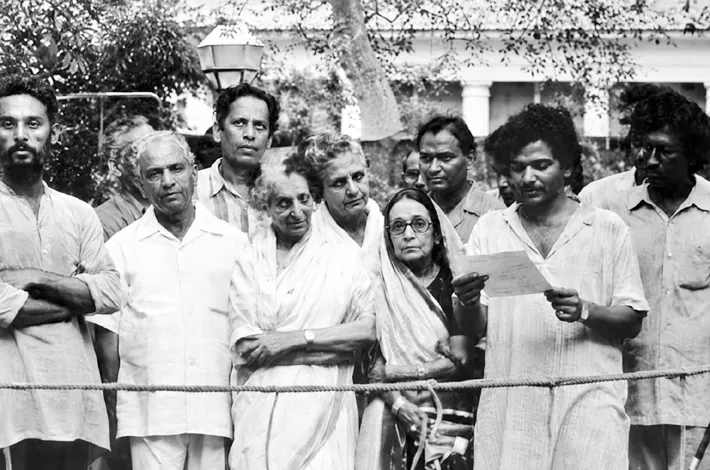
Far from Indira Gandhi going after Sitaram Yechury to forcibly enter JNU Hostel, it was Sitaram Yechury who, at the head of 500-strong protestors, laid a siege to her residence in October, 1977. Yechury was told a five-member delegation could go inside her house to meet Indira Gandhi. Yechury refused the offer. Indira Gandhi came out to meet the protestors. Yechury read out the memorandum demanding her resignation as JNU Chancellor. Later, she took the memorandum and had gone back into her house.
Shortly after, Indira Gandhi resigned as Chancellor of Jawaharlal Nehru University. In fact, Jawaharlal Nehru University Act, passed by Parliament, stipulates that the President, as Vistor, appoints JNU Chancellor. Indira Gandhi was the obvious choice for the post of JNU Chancellor, not in her capacity as Prime Minister, but for her abiding role in building of this great institution of excellence that earned great name, fame and reputation. She was not required to step down as Chancellor, after losing office of Prime Minister.
Yet, that was Indira Gandhi, who stepped down, because some protestors demanded her resignation. Nothing better illustrates her essential democratic credentials.
(Venkat Parsa is a senior journalist)
Democrat to the core
Democrat to the core, Indira Gandhi resorted to the extreme measure of declaring Emergency, only in response to an extraordinary situation, arising out of the grave internal warlike situation on June 25, 1975. A series of calamitous events, like the tragic assassination of Union Railway Minister Lalit Narain Mishra; the horrendous attempt on the life of Chief Justice of India Justice A N Ray; move to lay siege to Prime Minister Indira Gandhi's residence, so that she cannot move out or enter her house, with a view to paralyze national governance; and the call to Army and Police to mutiny, by disobeying orders of the Government, forced her hand to invoke the extraordinary measure of Emergency.
Soon after her return from the Indian Youth Congress Convention in Guwahati in Assam in November, 1976, Indira Gandhi decided to hold General Election, irrespective of the electoral outcome. No one could dissuade her, or make her change her resolve to go ahead to seek a fresh mandate from the people, ultimate masters in a democracy.
On January 18, 1977, Indira Gandhi announced her decision, on her own free will and volition, and not as a result of any protests, to hold fresh elections in the country. Of her own accord, she relaxed Emergency, released political prisoners and created an ecosystem of free and fair elections. Brutally honest, Indira Gandhi stuck to free and fair elections, refusing to influence the election process.