22 September, 2026 | 5:42 PM


GenZ revolts
22-07-2026 12:00:00 AM
Jantar Mantar boos echo youth frustration over biased coverage
metro india news I new delhi
At Delhi’s historic Jantar Mantar, a sea of young faces wearing cockroach masks and waving satirical placards delivered a message louder than their chants: country’s mainstream television media is out of touch. As the Cockroach Janta Party (CJP) staged its first major offline protest against exam paper leaks, systemic unemployment, and perceived government apathy, sections of the traditional press found themselves not as observers but as targets of Gen Z’s raw anger. What began as an online satirical movement mocking a reported judicial remark comparing unemployed youth to “cockroaches” quickly morphed into a physical gathering.
Thousands of students, many in their late teens and early twenties, descended on the protest site, carrying chemistry books, Tricolours, flowers, and memes. Their demands were clear: the resignation of Union Education Minister Dharmendra Pradhan over repeated irregularities in NEET-UG and other exams, accountability for joblessness, and broader systemic reform. Yet alongside these grievances, a parallel narrative unfolded — one of deep-seated distrust toward mainstream media.
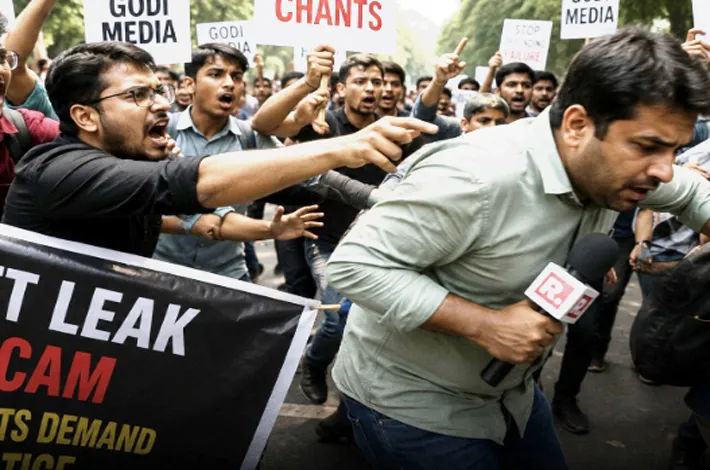
Protesters repeatedly raised slogans like “Godi Media Hai Hai,” “Go Back Godi Media,” and “Media-walon bahar niklo.” Television crews from prominent channels faced heckling, with some demonstrators refusing interviews and others actively shooing reporters away. “Hum Godi Media se baat nahi karenge,” became a recurring refrain. Independent observers and digital journalists noted the hostility was not universal but targeted at outlets perceived as overly sympathetic to the establishment.
Roots of the Rage
For many young protesters, the booing stemmed from a perception that large sections of mainstream television news have become echo chambers for the ruling dispensation, sidelining the everyday struggles of ordinary citizens. While social media platforms like Instagram, X, and YouTube overflowed with live videos, drone shots, and personal stories from Jantar Mantar, several national TV channels appeared to prioritize other stories — Karnataka politics, general education debates without ground reports, or unrelated segments. A young protester from Faridabad, Sameeksha, clutching her chemistry textbook, told reporters on the side-lines (before the boos intensified): “Gen Z can do anything.
Social media is keeping us united. But TV media? They only show what the government wants. They ignore our pain — the suicides, the lost years, the broken dreams after paper leaks.” Her sentiment resonated across the crowd. Many cited India’s declining ranking on the World Press Freedom Index and accused channels of acting as “chor” (thieves) by distorting or omitting narratives that challenge official lines.
This isn’t isolated frustration. Years of polarized coverage — where critics label compliant outlets “Godi Media” (lapdog media) — have eroded trust among digital natives who consume news via algorithms rather than prime-time anchors. At Jantar Mantar, this boiled over. CJP spokespersons occasionally intervened to calm sections of the crowd, distinguishing between “truly biased” crews who allegedly left after labeling protesters “anti-national” and others trying to report fairly. Still the damage to perception was evident.
A Generational Shift
The CJP protest highlighted a broader media ecosystem fracture. Traditional television, once the gatekeeper of public discourse, now competes with decentralized, youth-driven content. Influencers, YouTubers, and independent journalists thrived at the site, capturing unfiltered moments: cockroach-masked students banging plates with spoons in symbolic protest, Urdu poetry on placards, and memes blending Bollywood with political satire. One organizer noted the irony: while mainstream channels debated whether Gen Z “wanted change,” Gen Z was actively creating it on the streets.
The protest drew participants from across states — Bihar, Madhya Pradesh, Maharashtra — many attending their first demonstration. Concerns extended beyond NEET leaks to inflation, job scarcity in IT and formal sectors, and a feeling that governance prioritizes optics over outcomes. Critics of the protesters argue the movement risks being co-opted or exaggerated for political gain, and that not all media is biased — some outlets did cover the event, albeit with varying emphasis. Supporters counter that selective blackout or downplaying of youth discontent exemplifies the very problem. As one placard wryly observed, echoing public frustration: the media’s pulse seems disconnected from the people’s.
Beyond the Boos
By evening on key protest days, CJP founder Abhijeet Dipke, who returned from the US, addressed the gathering, emphasizing resilience: “You can delete our posts, but not erase us.” Activist Sonam Wangchuk’s later involvement and hunger strikes amplified the movement’s visibility. Protests continued in waves, with overnight dharnas and renewed calls for accountability. The booing of media personnel, while uncomfortable, underscores a democratic signal. In an era of fragmented attention, Gen Z is voting with its voice — and its feeds. Whether this translates into sustained political impact remains uncertain.
A growing generational assertion
Ignore the people’s pulse at your peril, or risk being called out in real time. As Delhi’s summer heat lingers and exam seasons loom again, Jantar Mantar stands as more than a protest site. It’s a mirror reflecting both youth aspirations and institutional disconnects — in governance and in the fourth estate. For mainstream media, the message from Gen Z is blunt: Report the reality on the ground, or prepare to be tuned out.