22 September, 2026 | 12:31 AM


The “infiltrator” case for SIR does not stand
22-09-2026 12:00:00 AM
One of the key public justifications offered for the Special Intensive Revision (SIR) of electoral rolls is the removal of foreign illegal immigrants, or “infiltrators.” However, this justification faces questions on two separate grounds: the legal framework and the available evidence
One of the main public justifications for the Special Intensive Revision (SIR) of electoral rolls is that it is needed to remove foreign illegal immigrants—“infiltrators.” That claim fails on two independent tests: law and evidence. In law, the Election Commission cannot decide citizenship. That power belongs to the Union Government under the Citizenship Act, 1955. In Association for Democratic Reforms v. Election Commission of India (27 May 2026), a Constitution Bench upheld the Commission’s authority to conduct SIR, but drew a hard line: An Electoral Registration Officer who suspects a person is not a citizen must refer the case within four weeks to the competent authority under the Citizenship Act.
At the one-year mark the deletions were about six crore; by September 2026, with a larger third phase covering some thirty-six crore electors, independent tallies put the total near twelve crore. Political estimates have swung from two crore to five crore; the higher figure has been traced to a 2004 Home Ministry estimate later admitted to rest on hearsay. In December 2025 the Ministry of Home Affairs said data on visa over stayers was “not centrally available.” The Government has, in effect, conceded the point. In late May 2026 it constituted a High-Level Committee on Demographic Changes, chaired by a retired Supreme Court judge, to recommend “a permanent and well-organized system” for identifying, detaining and deporting illegal immigrants, with a year to report.
A permanent system cannot both already be operating through SIR and still need to be designed from first principles. India has tried a citizenship-linked identity project before. After Kargil, the Multipurpose National Identity Card pilot aimed at a National Register of Indian Citizens. It was wound up in 2009 after enumerating about 31 lakh people and issuing cards to barely 40 per cent. Effort then shifted to Aadhaar—residence and identity, not citizenship. Assam, which has already run the country’s most rigorous citizenship verification through the NRC, was spared the intensive SIR ahead of its 2026 election and given a milder revision.
The 2019 NRC excluded about 19 lakh people; exclusion is not a finding of foreign nationality. A disclosed religion-wise break-up of exclusions included large numbers of Hindus, Gorkhas and others with no colourable claim to foreign origin—swept up by documentary defects that afflict the poor everywhere. In Karnataka, more than 43 lakh electors were flagged for individual verification while hearings lagged far behind the deadline. “Zero appeals” in completed states is more plausibly a measure of barriers to appeal than of accuracy. Former commissioners and others have asked the same narrow question: how many suspected foreigners has SIR referred for adjudication?
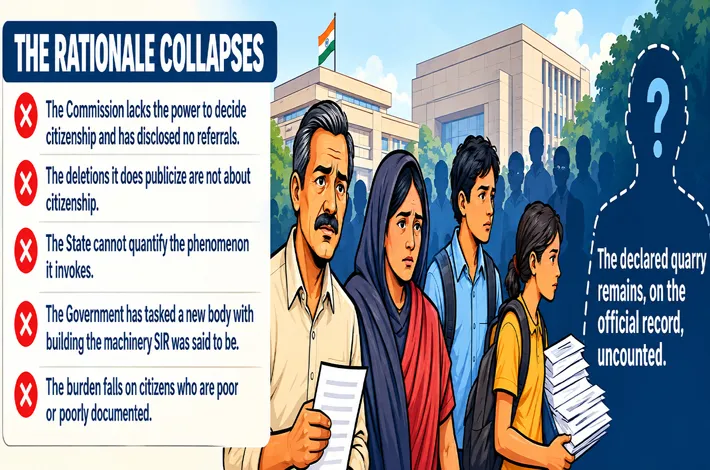
West Bengal went to the polls in April 2026 with SIR as a campaign issue and large deletions; the number of adjudicated non-citizens still has not been published. Measured against its own purpose, the rationale collapses. The Commission lacks the power to decide citizenship and has disclosed no referrals. The deletions it does publicize are not about citizenship. The State cannot quantify the phenomenon it invokes. The Government has tasked a new body with building the machinery SIR was said to be. The burden falls on citizens who are poor or poorly documented. The declared quarry remains, on the official record, uncounted.
(R S Sharma,
Founding director, Aadhaar project UIDAI)