23 October, 2026 | 3:50 AM


Crorepati Public Servants
07-09-2026 12:00:00 AM
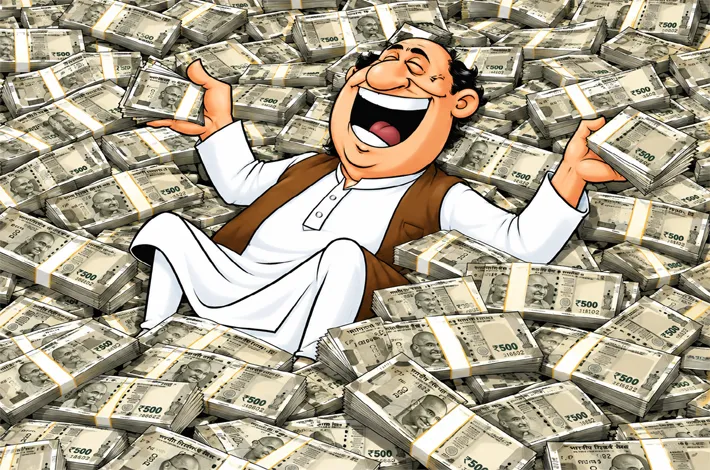
How India’s Lawmakers Amassed Over Rs 1.3 L Cr in Declared Assets
metro india news I hyderabad
India’s elected representatives continue to present a striking paradox. They describe themselves as public servants dedicated to the aam aadmi still their collective declared net worth runs into astronomical figures that dwarf their official salaries many times over.
Recent data compiled from election affidavits and analyses by organisations such as the Association for Democratic Reforms (ADR) paints a clear picture: the total declared assets of Lok Sabha MPs, Rajya Sabha MPs and MLAs across the country exceed Rs 1.30 lakh crore—figures that exclude any unaccounted or black money.
According to the figures, 543 Lok Sabha MPs hold combined assets of approximately Rs 25,160 crore, averaging about Rs 46 crore per MP. This aligns closely with ADR’s analysis of the 2024 general election winners, where the average assets of successful candidates stood at Rs 46.3 crore, with 93 per cent of them (504 out of 543) qualifying as crorepatis—up from 88 per cent in 2019 and 82 per cent in 2014.
In the Rajya Sabha, 226 members account for roughly Rs 27,600 crore in total assets, or about Rs 118 crore on average. ADR reports from 2026 put the total for around 226 sitting Rajya Sabha MPs at approximately Rs 26,047 crore with an average of Rs 115.25 crore, confirming the scale.
Meanwhile, India’s roughly 4,123 MLAs (or about 4,092 in recent snapshots) declare a collective Rs 73,400 crore, averaging around Rs 16–18 crore per legislator. One 2025 ADR analysis of sitting MLAs put the total near Rs 73,348 crore.These are not marginal sums. The combined declared wealth of these legislators exceeds the annual budgets of several smaller states. Still the official compensation remains modest by comparison.
An MP’s basic salary is currently around Rs 1.24 lakh per month (after a 24 per cent hike notified with effect from 2023), supplemented by constituency allowance (Rs 87,000), office expenses and other perks that can push the effective monthly package towards Rs 2.5–2.8 lakh or more, excluding daily allowances and facilities. MLA salaries vary widely by state—often in the range of Rs 1–2.5 lakh including allowances—but rarely approach levels that could independently generate multi-crore fortunes within a few terms.
So how do the numbers climb into the crores? Several factors explain the gap between salary and net worth. Many politicians enter public life already wealthy. A significant proportion come from business families, professional backgrounds (doctors, lawyers, industrialists), or landed gentry. Inheritance, pre-political careers, and successful enterprises account for a large share of declared assets.
Real estate, shares, agricultural land, and business interests feature prominently in affidavits. In the 2024 Lok Sabha, the richest winner declared assets exceeding Rs 5,700 crore; several others crossed Rs 1,000 crore. In the Rajya Sabha, individuals have declared holdings of Rs 5,000 crore-plus.
Asset growth during successive terms is another documented pattern. An ADR analysis of 102 MPs re-elected across the 2014, 2019 and 2024 Lok Sabha elections found their average assets rose 110 per cent—from about Rs 15.8 crore in 2014 to Rs 33.13 crore in 2024, an average absolute increase of roughly Rs 17.3 crore. Some individual rises were far steeper.
This growth can stem from legitimate sources: appreciation in property values, business expansion, investment returns, or spousal/family income. India has seen strong real-estate and equity market performance over the past decade, which would naturally inflate asset values for those already holding such holdings. Critics, however, point to the speed and scale of increases as raising legitimate questions about the interplay of political power, access, and wealth accumulation.
Declarations are self-sworn and subject to limited scrutiny; under-reporting or creative accounting remains a concern, though the user data explicitly notes these figures exclude black money. The rising proportion of crorepati legislators also reflects a structural shift: politics has become an expensive profession requiring substantial resources for campaigning, and parties increasingly field candidates with deep pockets or strong financial networks. The “public servant” label sits uneasily against these numbers.
In a country where the median urban household’s assets are a tiny fraction of an average MP’s declared wealth, and where millions struggle with basic economic security, the concentration of affluence among lawmakers fuels perceptions of a disconnect. Representation matters. When nearly all elected representatives belong to the economic elite, policy priorities risk tilting toward the interests of capital and property rather than labour or the informal sector. At the same time, it is neither illegal nor inherently improper for successful professionals or businesspeople to enter politics; many democracies feature wealthy legislators.
The issue is less the existence of wealth than transparency, accountability, and the pace of enrichment while holding office.ADR and similar groups have long argued for stronger disclosure norms, independent verification of affidavits, and greater scrutiny of asset growth between elections. Voters, for their part, continue to elect candidates with substantial means—suggesting that money, organisational strength, and local influence often outweigh pure economic modesty at the ballot box.
The Rs 1.3 lakh crore figure is ultimately a snapshot of declared wealth, not a complete accounting of influence or undeclared holdings. It does, however, crystallise a central tension in contemporary Indian democracy: those who claim to serve the public accumulate fortunes that place them firmly among the country’s economic elite. Whether this is primarily a story of entrepreneurial success, market appreciation, or the privileges of power remains a matter of ongoing debate—and one that deserves continued public examination through better data, stricter compliance, and informed electoral choices.