24 June, 2026 | 12:54 PM


Bengal Tiger march kore!
08-05-2026 12:00:00 AM
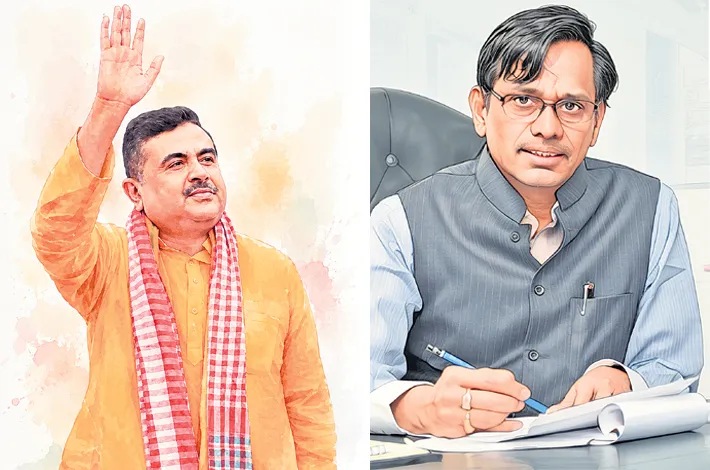
Suvendu’s Sonar Bangla
This was no meteoric ascent born of privilege alone, but a hard-fought odyssey marked by loyalty, betrayal, and an indomitable spirit that echoes the timeless words of Gurudev Rabindranath Tagore: “Let me not pray to be sheltered from dangers, but to be fearless in facing them. Let me not beg for the stilling of my pain, but for the heart to conquer it.”
Suvendu’s political innings began not in the glare of spotlights, but in the grassroots of Kanthi Municipality. In 1995, as a young councillor with the Congress, he stepped into public life. By 1998, he joined the nascent Trinamool Congress (TMC), drawn to Mamata Banerjee’s fiery call for change against the long-entrenched Left Front. Those were the days of building a party from the ground up. Suvendu emerged as a tireless organizer, strengthening TMC’s rural base in East Midnapore. His moment of reckoning came during the historic Nandigram movement against land acquisition in 2006-2007. As the face of resistance, he stood shoulder to shoulder with farmers, turning a local struggle into a symbol of Bengal’s defiance against forceful industrialization. “Ebar poriborton chai” (We want change now) was not just a slogan; for Suvendu, it was a lived commitment.
He entered the West Bengal Legislative Assembly in 2006 from Nandigram and rose steadily. Over the years, he held key portfolios, including Transport, Irrigation, and Waterways. His administrative reach extended to organizations like the Hooghly River Bridge Commissioners. Loyal to Didi (as Mamata is affectionately called), he was seen as one of her most trusted lieutenants, a mass leader who delivered in crucial districts. His family’s political legacy—father Sisir Adhikari’s service in assembly and Lok Sabha—added depth to his roots in the region. Still, beneath the surface of apparent harmony, fault lines were forming.
By late 2020, the TMC that Suvendu had helped build felt increasingly like a “private limited company,” as he later described it—centralized around family. The grooming of Mamata’s nephew Abhishek Banerjee as the de facto second-in-command created irreconcilable rifts. Suvendu, who had held significant influence, found himself sidelined. Reports of growing disillusionment with alleged “cut-money” (extortion), violence, and dynastic tendencies surfaced. On November 27, 2020, he resigned as Transport Minister. Soon after, he quit as MLA and left the primary membership of TMC on December 17. “I will make Mamata Banerjee a former Chief Minister of Bengal,” he reportedly confided to associates. On December 19, he joined the Bharatiya Janata Party (BJP) in the presence of Amit Shah, marking a seismic shift in Bengal’s politics.
The departure was not without cost. It invited personal and political attacks, legal battles, and questions about loyalty. But Suvendu embraced the role of a fighter. In the 2021 Assembly polls, he contested from Nandigram against Mamata Banerjee herself—a symbolic David-versus-Goliath battle in his home turf. He emerged victorious, defeating the sitting Chief Minister and becoming the Leader of Opposition. This was no ordinary win; it was a statement that the winds of change were stirring in Bengal’s heartland. For the next five years, as LoP, he relentlessly highlighted governance issues, championed development, and positioned himself as a bridge between local aspirations and national vision. He spoke of “nationalist Muslims” and focused on curbing infiltration concerns while addressing the aspirations of the aam aadmi.
The just-concluded 2026 Assembly elections tested his mettle like never before. Leading from the front like a Bangla Bagh—Bengal Tiger—Suvendu orchestrated a campaign that resonated deeply. BJP swept Purba Medinipur, winning all 16 seats, a testament to his organizational grip. He defeated Mamata Banerjee once again, this time from Bhabanipur by a significant margin. The party crossed the majority mark handsomely, ending TMC’s 15-year rule amid public fatigue with alleged corruption, violence, and unfulfilled promises. The victory was resounding, built on tireless booth-level work, alliances, and a narrative of poriborton (change) that addressed Bengal’s economic and cultural pride.
This rise evokes lines from Tagore’s Gitanjali and his vision of a Bengal where “the mind is without fear and the head is held high.” Suvendu’s journey mirrors the poet’s call for resilience amid adversity. It is not without complexities—transitions invite scrutiny, and political battles are rarely pristine. Still, facts stand: from a TMC architect in anti-land movements to a BJP stalwart who delivered a historic mandate. His leadership draws from Bengal’s literary soul—think of Bankim Chandra Chattopadhyay’s Anandamath and its invocation of Vande Mataram, a spirit of awakening that refuses subjugation.
One would hope this son of the soil steps into key leadership, ready to script a new era where * Sonar Bangla*—Golden Bengal—shines brighter, rooted in its eternal ethos of courage, culture, and compassion. The journey continues, tiger-like, with the heart of a true Bengali.