23 September, 2026 | 6:15 PM


‘Alcohol for Bahujans, wealth for elite: Is this what we dreamed of?’
14-07-2026 12:00:00 AM

Metro India News | Hyderabad
"If I were appointed the dictator of India for one hour, the first thing I would do would be to close all liquor shops without paying any compensation."
— Mahatma Gandhi, Young India, 25 June 1931
More than a decade after the formation of Telangana, a growing public policy debate has emerged over whether the state's development model has become increasingly dependent on alcohol consumption and liquor-related revenues. While Telangana has achieved rapid economic growth and ranks among India's leading states in per capita income, critics argue that rising alcohol consumption and the government's growing reliance on excise revenue raise serious concerns about public health, family welfare, and human development.
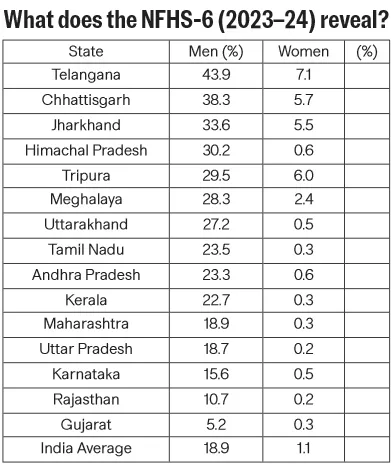
The debate has gained momentum following the release of data from the National Family Health Survey (NFHS-6, 2023-24), which shows that Telangana has the highest prevalence of alcohol consumption among men in India. According to the survey, 43.9% of men in Telangana consume alcohol, compared with the national average of 18.9%. Among women, the survey recorded alcohol consumption at 7.1% in Telangana, significantly higher than the national average of 1.1% and the highest among major Indian states. The figures also place Telangana well ahead of neighbouring southern states.
Social activists and Bahujan organisations argue that this trend has created a deep structural contradiction. They contend that while the majority of alcohol consumers belong to Bahujan communities—including Scheduled Castes, Scheduled Tribes, Backward Classes and other working-class groups—the ownership of distilleries, breweries, wholesale distribution networks and liquor businesses remains concentrated among relatively affluent and economically dominant sections.They argue that alcohol expenditure reduces family savings, contributes to indebtedness, disrupts children's education, worsens health outcomes and increases domestic violence, road accidents and crime.
The liquor industry has become one of the largest sectors in Telangana's economy. Industry estimates place the annual liquor market at between Rs 70,000 crore and Rs 75,000 crore, representing roughly 3.5% to 4% of the state's Gross State Domestic Product (GSDP). Government finances have also become increasingly linked to alcohol sales. According to the Telangana Budget for 2026-27, the state generated approximately Rs 40,209 crore from liquor during the 2025-26 financial year through excise duties and value-added tax (VAT). Together, alcohol-related taxes accounted for nearly one-fourth of the state's total tax revenue of Rs 1,63,490.77 crore.
Telangana currently has an extensive liquor distribution network comprising 2,623 Indian Made Foreign Liquor (IMFL) retail outlets, 1,017 bars and pubs, 80 elite liquor shops, 18 distilleries, one winery and six breweries. Observers point to several reasons for rising alcohol consumption, including government revenue policies, annual increases in excise targets, weak enforcement of alcohol-control regulations, distribution of liquor during elections, changing social attitudes and the portrayal of alcohol as a symbol of modern lifestyles in films, web series and social media.
Despite ranking third among Indian states in per capita income, Telangana reportedly ranks only 15th among larger states on the Human Development Index (HDI). Some analysts argue that high household spending on alcohol diverts resources away from education, nutrition, healthcare and savings, thereby affecting long-term human development outcomes. Critics have called on the Telangana government to publish a comprehensive white paper estimating the full social and economic costs of alcohol consumption, including its impact on poverty, school dropout rates, domestic violence, disease burden, road accidents and premature deaths.
Among the policy measures being suggested are stricter enforcement against illegal liquor outlets and adulterated alcohol, expansion of de-addiction and rehabilitation centers, alcohol awareness programs in schools and colleges, tighter regulation of alcohol advertising, allocation of a portion of liquor revenue to public health programs, stronger action against the distribution of liquor during elections, and greater involvement of women's self-help groups in community awareness campaigns.
The broader question, analysts say, is whether economic progress should be measured primarily through government revenues or through improvements in public health, education, family welfare and human development. While liquor continues to contribute substantially to Telangana's finances, critics argue that sustainable development requires balancing fiscal needs with the long-term well-being of citizens.
- T Chiranjeevulu
The author is retired IAS officer and Chairman of BC Intellectuals Forum Hyderabad