31 October, 2026 | 12:48 AM


When Indira Gandhi Stood Up to Nixon
31-10-2026 12:00:00 AM
Venkat Parsa I hyderabad
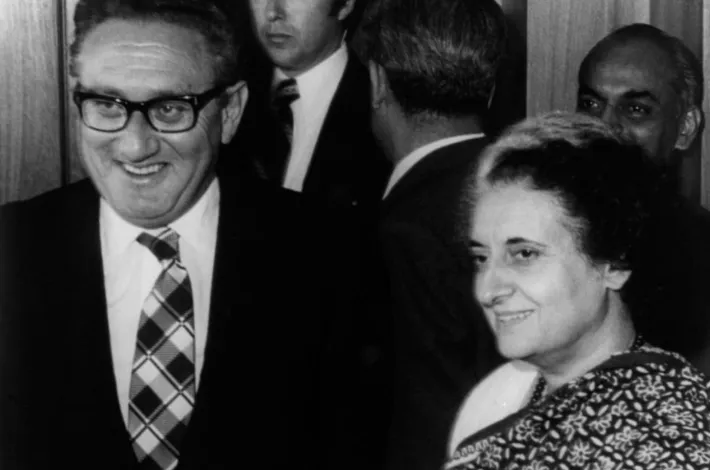
On Indira Gandhi's martyrdom anniversary, a grateful nation remembers the way she stood up to United States President Richard M Nixon in the run up to the Bangladesh Liberation War from December 3-16, 1971. India was neither an economic, nor a military, power. Perhaps what really mattered was the moral fibre of Indira Gandhi, who refused to back down, even as the Richard Nixon-Henry Kissinger duo tried to browbeat her.
US President Nixon held out threats to Indira Gandhi, dispatching US National Security Adviser Henry Kissinger to India on July 7, 1971; and immediately Kissinger travelled to Pakistan, from where he made a secret visit to China from July 8-11, 1971. Neither the threat of the United States-Pakistan-China Axis looming large, nor the deployment of the US Seventh Fleet in the Bay of Bengal to intimidate Indira Gandhi seemed to serve their purpose.
For the first time, a Super-Power looked openly so helpless, as none of its machinations seemed to work. Unfazed by US President Nixon's pressures and threats, Indira Gandhi showed foresight in formulating a strategy to effectively counter it.
India, Soviet Union Treaty of Peace, Friendship and Cooperation, on August 9, 1971, was an effective counter; she never renewed the Pact with Soviet Russia after expiry in 1981, even her return to power in 1980. In November, 1971, she undertook a Six-Nation tour of the United States, Britain, France, Germany, Austria and Belgium to build international opinion on the need for political settlement of the crisis triggered by Pakistan overturning electoral verdict and jailing Sheikh Mujibur Rehman, won the mandate to be the Prime Minister of Pakistan.
A desperate Pakistan that had embarked upon the worst-ever genocide in what was East Pakistan that became Bangladesh, got on to yet another misadventure of attacking India. Pakistan chose a moment to strike, when top leaders were away from the Capital on December 3, 1971. Indira Gandhi was away in Kolkata, Defence Minister in Patna and Finance Minister in Mumbai, when Pakistan launched a massive attack by bombing Indian airfields in Amritsar, Pathankot, Srinagar, Avantipur, Uttarlai, Jodhpur, Ambala and Agra in broad daylight. Rushing back to the Capital by late evening, a calm, collected Indira Gandhi took charge, to deal with the situation.
Indira Gandhi was quick to point out that Pakistani intransigence was aided and abetted by the blind support lent by the United States. In a letter to US President Richard M Nixon on December 15, 1971, Indira Gandhi went on to question Nixon, saying, "Mr President, may I ask you in all sincerity: Was the release, or even secret negotiations with a single human being, namely Sheikh Mujibur Rehman, more disastrous than the waging of war?
The fact of the matter is that the rulers of West Pakistan got away with the impression that they could do what they liked because no one, not even the United States, would choose to take a public position that while Pakistan's integrity was certainly sacrosanct, human rights, liberty were no less so and that there was a necessary interconnection between the inviolability of States and the contentment of the people."
Invoking the American Declaration of Independence to the US President, Indira Gandhi told Nixon that whenever any form of Government becomes destructive of man's inalienable rights to life, liberty and pursuit of happiness, it was the right of the people to alter or abolish it.
All unprejudiced persons, she said, objectively surveying the grim events from March 25, 1971, in Bangladesh, when Pakistani military crackdown began, recognized the revolt of 75 million people, who did not have rights to their life and liberty, not to speak of the possibility of pursuit of happiness.
Concluding her letter on a sombre note, Indira Gandhi said, "Be that as it may, it is my earnest and sincere hope that with all the knowledge and deep understanding of human affairs, you, as President of the United States and reflecting the will, the aspirations and idealism of the great American people, will at least let me know where precisely we have gone wrong, before your representatives or spokesmen deal with us with such harshness of language."
Hostility of the United States towards India has always been pronounced. Soon after becoming Prime Minister on January 24, 1966, Indira Gandhi visited the United States on March 27, 1966. US President Lyndon B Johnson was far from sympathetic to the food grains shortage in India, following severe drought; and she speeded up work on Green Revolution, soon after returning from the US. On the other hand, Lyndon Johnson tried to pressurize Indira Gandhi into improving relations with Pakistan, soon after the latter attacking India in September, 1965. Nixon, too, followed the same track.
Indira Gandhi was quick to realize the United States reliance on Pakistan, to the point that it cannot change its position. She never visited Pakistan during her long tenure as Prime Minister. It is a matter of recorded history that each time Pandit Jawaharlal Nehru and Indira Gandhi offered Pact of Non-Aggression, Pakistan rejected it out of hand.
(Venkat Parsa is a senior journalist)