31 October, 2026 | 1:37 AM


Does starting again make you a better founder?
31-10-2026 12:00:00 AM
STARTUPS, ON SATURDAY
Being a ‘second time founder’ is a thing when it comes to raising capital. CapTables fill faster, valuations start higher. In 2015, Kunal Shah, the Founder of Freecharge sold that business to Snapdeal. Three years later he started CRED.
The funding came early and was generous. I wrote last week about alumni of successful startups building businesses of their own. Many of those people were starting up for the first time. Today, I want to write about Founders who exited and start again. Therein lies a point to ponder – Does starting again actually make one a better Founder?
I will use the biblical story of the Magi as a metaphor. There are three gifts and a trap involved.
First gift is Gold. In the startup world, time is money. Time is gold. First time founders have to learn many complex interconnected aspects of company building. Signing up customers, writing contracts, hiring people, setting up payroll, winning investor mindshare, running a board meeting. For a second time founder, this is an afternoon checklist on a working day. He or she knows the difference between an investor who is digging for information and the one who is willing to write a check. That time saved is time invested in company-building.
Second gift is Frankincense. This represented divinity or priesthood. In a start-up world this is attractiveness of the Founder. Not in a physical sense, but the ability to attract talent. Hiring is the toughest part of starting up. A repeat founder (especially one with some aura) is more effective at hiring than a first timer. He is so much more adept at storytelling that resonates with employees and investors alike. Money and talent arrive sooner.
Third gift is Myrrh. This represented suffering. Elon musk described company building as “Staring into the abyss and chewing glass”. A serial entrepreneur has muscle memory that helps bear the pain threshold. He knows a bad quarter will pass by and focus on process.
And then there is the trap. In the biblical story the magi were sent to spy on the child by King Herod. The magi avoided the trap by returning on a different route. What worked in 2006 for a startup may not work in 2026. The old playbooks may need versioning with a different take. Unlearning the old route may be just as important (and harder) than learning a new one. Scar tissue by itself does not result in wisdom. Wisdom is nurtured by reflection.
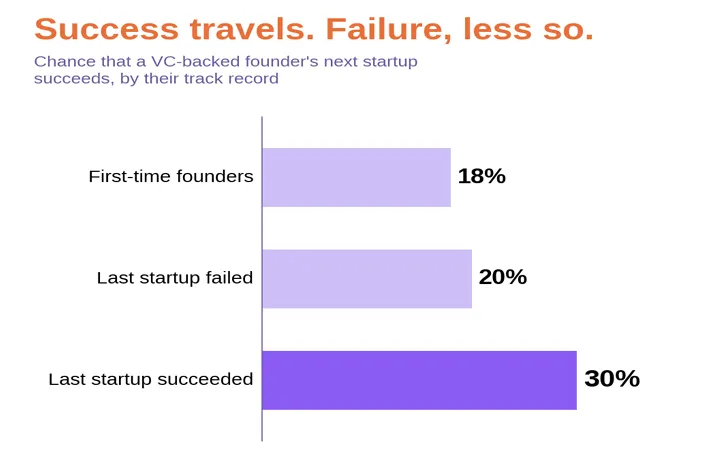
This topic has been a subject for research too. A Harvard study that looked at thousands of venture funded entrepreneurs in the US found that previously successful repeat Founders succeeded 30% of the time. This is much higher than the success rates of first time founders (18%) which is quite close to founders who failed the first time (20%). Another study found that companies run by serial entrepreneurs were 40% more productive. The pace of learning wasn’t too different. The starting point was further ahead.
I am not a serial entrepreneur but I would hire a former entrepreneur without too much hesitation. “Doing” is a muscle. It is karma yoga. That is a topic for another day.
Why it matters: Experience does not remove the risk of building something new. At its best, it gives a solid headstart, so the founder can face the big obstacles with clear eyes. Re-start & Start ahead.
(Ravi Ravulaparthi is the CEO & Cofounder of Qapita.)