23 September, 2026 | 5:27 AM


The Palanquin Dignity of Shankaracharya and protection of dharma by Peshwas
07-02-2026 12:00:00 AM
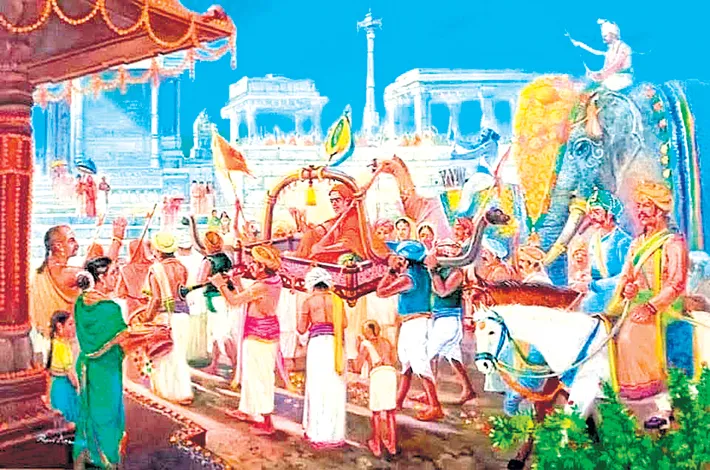
In the 18th century, when Mughal power was at its peak of inertia and fanaticism, they made nefarious attempts to undermine the royal dignity of Hindu religious leaders
The dignity of the four Amnaya Peethas, including the Uttaramnaya Jyotishpeeth established by Adi Shankaracharya, forms the foundation of the integrity of Sanatan Dharma. Here, the 'palanquin' (especially the horizontal palanquin), umbrella, and fly-whisk are not merely symbols of royal splendor but represent the sovereignty of that religious authority which the Mughals attempted to undermine, only to have it restored through the valor of the Peshwas.
If we examine the depth of this matter from a chronological perspective, the mid-18th century was a golden era for the revival of Sanatan Dharma. In February 1735 CE, when Peshwa Bajirao I's mother, Radhabai, embarked on a pilgrimage to northern India, the Peshwas sent a clear message to the Mughal emperor and local nawabs that any interference, even momentary, in the dignity of Hindu religious leaders would not be tolerated by the Maratha Empire.
This marked the beginning of a historical thread of protection that grew stronger over time. The Victory of 1751 and the Liberation of PrayagThe most significant link in this chain was added in May 1751 CE, when Peshwa Nana Saheb (Balaji Bajirao) used his military might to defeat Farrukhabad's Nawab Ahmad Khan Bangash. The treaty that followed this victory freed Prayag and Kashi from the clutches of Mughal subedars.
At this time, a historic 'sanad' (decree) was issued, which provided a written assurance to preserve the 'palanquin dignity' of the Jyotishpeeth Acharyas intact. It explicitly stated that the Jagadguru's procession would proceed according to ancient customs, and no Yavana (Muslim) official would interfere.
Antaji Mankeshwar- The guardian of dignity at Delhi court
Around July 1754 CE, in Delhi, Peshwa's chief general and diplomat Antaji Mankeshwar scripted a new chapter in the protection of dharma. When Mughal officials objected to the sannyasis' 'umbrella-fly-whisk' and 'horizontal palanquin,' Antaji employed military diplomacy in such a way that the Mughal court was forced to yield. According to SPD Vol. 21, Letter No. 61, Antaji issued a stern warning: "Insult to the Jagadguru's palanquin will be considered an insult to the Peshwa himself." Antaji's approach clearly embodied 'shasu anushishtau' (to discipline), where he compelled the royal authority to remain under the discipline of religious authority.
Mughal obstructions attacks on dignity
In the 18th century, when Mughal power was at its peak of inertia and fanaticism, they made nefarious attempts to undermine the royal dignity of Hindu religious leaders. At the Prayag confluence, Hindus were subjected to an insulting tax akin to jizya for bathing. Mughal officials imposed bans on the Jyotishpeeth Shankaracharya's 'horizontal palanquin' and the display of 'umbrella-fly-whisk.' Their aim was to portray religious authority as subordinate to royal power.
Historical documents and sanad
From the perspective of 'kal sankhyane' (chronological calculation) in the language of evidence, the Pune 'Peshwa Daftar' (SPD) contains numerous letters that substantiate this dignity. SPD Vol. 2, Letter No. 66 describes Peshwa's mother Radhabai's journey to northern India and efforts to abolish the 'pilgrimage tax' in Prayag-Kashi.In the sanad of 1751 CE, after defeating Ahmad Khan Bangash, the Peshwa's treaty freed Prayag from the grip of Mughal subedars.
This sanad explicitly states: "Jagadgurunchi palakhi va lavajama yanchi maryada prachin ritipramane chalavi" (The dignity of the Jagadguru's palanquin and lavajama should proceed according to ancient customs).In Marathi terminology, the word 'lavajama' is used in extremely broad and honorable senses. It is a corruption of the Arabic word 'lavazim,' meaning 'essential items' or 'necessary equipment.'
Importance of lavajama in historical sanad
As discussed, the mention in the May 1751 CE sanad—"Jagadgurunchi palakhi va lavajama"—meant that the Peshwas made it clear to the Mughals that every person and every royal symbol (umbrella-fly-whisk, etc.) accompanying the Shankaracharya would remain fully protected and honored. As discussed, the mention in the May 1751 CE sanad—"Jagadgurunchi palakhi va lavajama"—meant that the Peshwas made it clear to the Mughals that every person and every royal symbol (umbrella-fly-whisk, etc.) accompanying the Shankaracharya would remain fully protected and honored.
The historical 'Sahaj Snan' at Prayag and Antaji's role
When Mughal officials at Prayag's ghats dared to stop the Jyotishpeeth Shankaracharya's palanquin, Antaji Mankeshwar gave clear orders to his army. According to Antaji's letters: "We did not bow before the Delhi throne, so how can we tolerate insult to the Jagadguru's palanquin? The palanquin will reach the confluence unobstructed, otherwise the sword will speak." (Meaning: We did not bow before Delhi's throne, so how can we endure insult to the Jagadguru's palanquin? The palanquin will go to the confluence without hindrance, or else the sword will speak.)
The Mughal officials, who were talking about taxes and protocols, could not muster the courage to stand for even a moment in front of Maratha cannons. Antaji ensured that the Jyotishpeeth Shankaracharya reached the waters of the confluence with full dignity (palanquin, umbrella, fly-whisk). This 'sahaj snan' was a declaration of Sanatan's sovereignty. (During the 1750-60 decade)During this period, when the then Jyotishpeeth Shankaracharya Swami Ramakrishna Tirth Ji arrived for the Prayag confluence bath, Mughal subedars cunningly tried to stop his palanquin.
At that time, on the Peshwa's orders, Dattaji Shinde and Malharrao Holkar deployed their armed contingents at the confluence banks. Fearing the Maratha artillery, the Mughal soldiers retreated, and the Jyotishpeeth Shankaracharya entered the confluence with full royal splendor, horizontal palanquin, and umbrella-fly-whisk. This incident is known in history as 'sahaj snan,' which remains proof of Jyotishpeeth's supremacy even today.In the current context, the protection of dignity by 'Parmaradhya' is a reawakening of that same historical consciousness.
The principle is that history repeats itself. Presently, when the administration obstructs the ancient dignities and palanquin protocols of Jyotishpeeth, the resolute stance of Parmaradhya Paramdharmadheesh Uttaramnaya Jyotishpeethadheeshwar Jagadguru Shankaracharya Swamishri: Avimukteshwaranand: Saraswati '1008' is a living embodiment of that 18th-century Peshwa-era consciousness.
Just as Antaji Mankeshwar supported the scriptural dignity with arms at the Delhi court, today Parmaradhya is keeping the same 'horizontal palanquin' and 'umbrella dignity' alive through his tapas and satyagraha. It is clear that protecting the Jyotishpeeth palanquin is not merely observing a tradition but safeguarding the sovereignty and dignity of Sanatan Dharma. Just as the Peshwas shattered the ban imposed by the Mughals, upholding that dignity intact today is the supreme duty of every Sanatan follower.
If we do not rise to protect this dignity, it will be established that the palanquin dignity which the Mughals could not break was shattered in a so-called Hindu state, and the valor of true Sanatans remained dormant. That would be a stain.This article bears witness that the Jyotishpeeth palanquin is no ordinary conveyance but the identity of an 'unbroken religious empire.' The ban imposed by the Mughals was adharma then, and today's obstacles are an extension of that same mentality.