8 October, 2026 | 12:45 AM


Telangana Can Become India’s Prevention State
08-10-2026 12:00:00 AM
Its next health reform begins before the hospital
Dr M Vaman Rao :
For a 48-year-old auto-rickshaw driver in a village near Sangareddy, a visit to a government health centre could have been the moment his future changed. His blood sugar was high. So was his blood pressure. He received medicines and was asked to return for a review.
But the review never happened.
The reasons would be familiar to millions of working people: a long journey, a day’s earnings lost and, most importantly, no pain or visible symptom to force him back. When the tablets ran out, there was no reminder and no health worker at the door.
Years later, the consequences could be devastating. Diabetes and hypertension, particularly when they occur together, are major contributors to chronic kidney disease and kidney failure. By then, the patient may need haemodialysis three times a week, roughly four hours per session. He can no longer drive for a full day, his family income falls and medical expenses rise.
The government may pay for dialysis. But prevention would have been far cheaper.
That is the central challenge before Telangana’s health system: how to ensure that a patient does not disappear between the screening table and the hospital bed.
Telangana already has many of the pieces
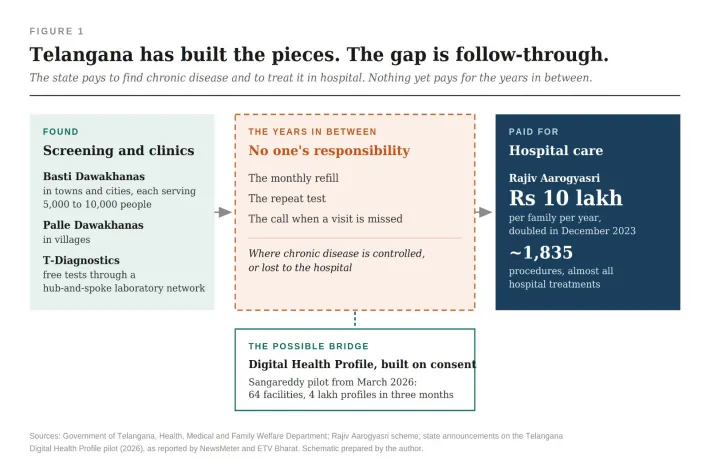
Telangana is not starting from scratch. It has already built several pillars of preventive healthcare. Rajiv Aarogyasri offers eligible families cashless treatment, with coverage increased from Rs 5 lakh to Rs 10 lakh in December 2023 and 1,835 procedures covered. Basti and Palle Dawakhanas provide consultations, medicines, diagnostics and NCD screening. Telangana Diagnostics adds free tests. In March 2026, Sangareddy began piloting digital health profiles across 64 government facilities, linking patient records across the public-health system.
A digital record, however, is useful only if it leads to action.
The warning in the numbers
NFHS-6 offers Telangana both encouragement and a warning.
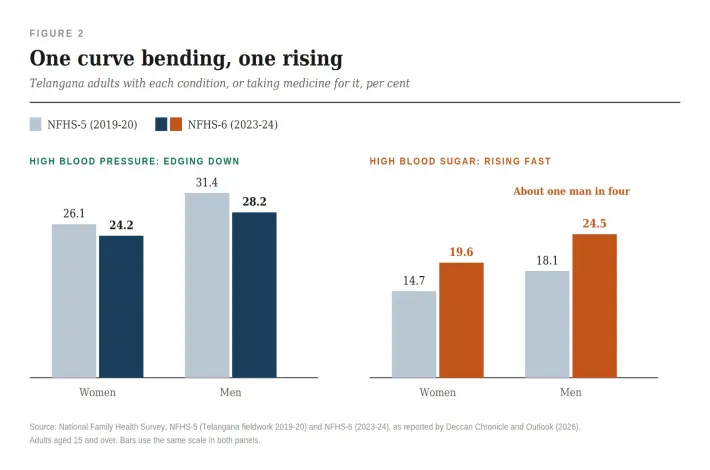
Elevated blood pressure or use of hypertension medication fell from 26.1% to 24.2% among women and from 31.4% to 28.2% among men between NFHS-5 and NFHS-6.
Diabetes, however, moved sharply in the opposite direction.
The proportion of women with high or very high blood sugar, or taking medicines for diabetes, rose from 14.7% to 19.6%. Among men it increased from 18.1% to 24.5% almost one in four. Obesity is rising too. Among women aged 15-49, the share who were overweight or obese increased from 30.1% to 36.3%; among men it rose from 32.4% to 35.5%. These are not merely statistics for health reports. They are early warnings of future kidney disease, heart attacks, strokes and other expensive complications.
Prevention costs less than rescue
The economic argument is equally compelling.
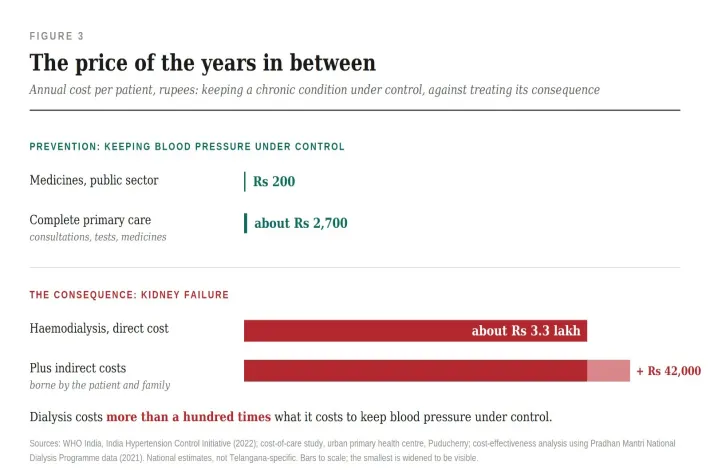
WHO’s account of the India Hypertension Control Initiative found that standardized treatment for hypertension in the public sector could cost as little as Rs 200 per patient per year. A separate cost-of-illness estimate has put monthly direct hypertension-care costs in primary-care settings at around Rs 223.
Dialysis is a different proposition. A cost-effectiveness study estimated annual direct costs of haemodialysis at about Rs 3.32 lakh, with indirect costs of roughly Rs 41,743 for a patient without complications.
The national dialysis programme itself notes that India adds about 2.2 lakh new end-stage renal disease patients every year and faces demand for around 3.4 crore dialysis sessions annually.
The lesson is straightforward: the cheapest time to intervene is before the disease becomes a crisis.
The missing link is follow-up
Tamil Nadu’s Makkalai Thedi Maruthuvam brings screening, medicines and continuing chronic-care services to people’s homes. By August 2024, over 1.86 crore people had benefited, and the programme won the 2024 UN Inter-Agency Task Force Award. Kerala’s Shaili app supports household screening, while its e-health system connects records and consent. Telangana can combine both approaches: personal follow-up with digitally linked care.
Five changes can make the difference
First, Telangana should publish district-wise targets for control of hypertension and diabetes, not merely screening numbers.
Second, every person diagnosed with a chronic condition should be assigned to a named health team responsible for refills, repeat tests and follow-up calls, with home visits where necessary.
Third, health facilities should be rewarded for keeping patients’ blood pressure and blood sugar under control not simply for detecting disease.
Fourth, the digital health profile must be built around trust. Citizens should be able to see their records, understand who can access them and withdraw consent. India’s digital-health framework already emphasizes informed, voluntary consent and privacy.
Finally, Telangana should measure prevention by what it avoids: fewer cases progressing to dialysis, cardiac surgery, stroke care and other high-cost hospital treatment.
Aarogyasri will remain essential. Hospitals will always be essential. But a strong health system cannot be judged only by how effectively it treats people after they become seriously ill.
Telangana now has an opportunity to build something more ambitious. Its next major health reform should not begin in an operating theatre. It should begin with a phone call to the auto driver whose tablets have run out.
Dr. M. Vaman Rao (MS, PhD) , a Boston-based scientist, serial entrepreneur, innovator and investor, works across seven geographies. His University of Hyderabad doctoral research developed a novel mupirocin synthesis process. At King’s College London, he pioneered gene synthesis, later leading a global gene synthesis and sequencing business contributing to the Human Genome Project before its exit.