27 September, 2026 | 4:39 AM


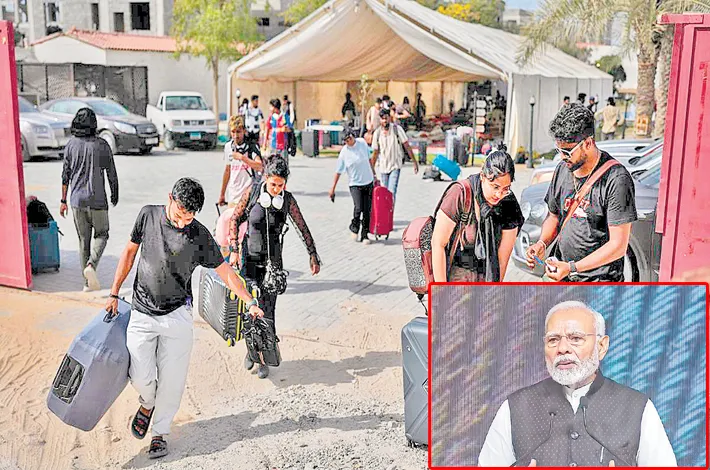
Over 3.75 lakh Indians brought back from war zone
26-03-2026 12:00:00 AM
Is mediation next in line for India?
Addressing the nation and Parliament, PM Modi highlighted that since the outbreak of hostilities, he has personally engaged in multiple phone calls with leaders across the region. India, he said, remains actively engaged with all stakeholders, including Gulf countries, Iran, Israel, and the United States. The Prime Minister stressed that in times of crisis, the safety and security of Indian citizens — both at home and abroad — remains the government’s top priority.
The scale of the challenge is reflected in the massive evacuation effort underway. According to the Prime Minister, over 3.75 lakh Indians have been safely brought back so far, including more than 1,000 from Iran. The operation, coordinated by the Ministry of External Affairs and Indian missions in the region, has been both logistical and deeply humanitarian. Embassies and consulates have run 24/7 helplines, providing assistance with transport, documentation, and on-ground support to students, workers, and short-term travellers caught in the turmoil.
In a significant diplomatic move, US President Donald Trump spoke with Prime Minister Narendra Modi amid rising tensions in West Asia. The conversation focused on the ongoing situation in the Middle East, with both leaders emphasising the critical need to keep the Strait of Hormuz open for international shipping. US Ambassador to India, Sergio Gore, confirmed the call on social media platform X, noting that the two leaders discussed the Middle East situation and “the importance of keeping the Strait of Hormuz open.”
Prime Minister Modi later posted his own statement, describing the exchange as “a useful exchange of views.” He reiterated India’s strong support for de-escalation and the earliest restoration of peace, while underscoring that ensuring the Strait of Hormuz remains “open, secure, and accessible is essential for the whole world.” Both sides agreed to remain in touch on efforts towards peace and stability.
A retired Major General described the call as “expected,” pointing out that India is the only major nation maintaining direct communication and good relations with all key players — the US, Russia, Israel, Iran, European countries, and others. He argued that the United States appears to be looking for an “off-ramp” from the conflict. According to him, control or shared oversight of the Strait of Hormuz could give President Trump a sense of victory and a face-saving exit.
The Major General stressed that the Strait of Hormuz is an international waterway and trade route that cannot be controlled or choked by any single country. He noted that while norms have sometimes been ignored by major powers elsewhere, India would continue diplomatic efforts to ensure the strait remains open for global traffic. He praised India’s diplomatic standing, calling the Trump-Modi conversation “yet another victory” for Indian diplomacy. A former diplomat noted that communication channels between India and the US were already active, with External Affairs Minister engaging multiple sides. He suggested President Trump called PM Modi to brief India and rope it into the search for a negotiated closure on American terms. The Ambassador highlighted India’s consistent message: war is not a solution; dialogue is the only way forward.
He observed that while Pakistan has been visibly trying to insert itself as a player, quieter but significant backchannel efforts appear to involve countries like Egypt. A temporary five-day reprieve announced by Trump on attacks on Iranian energy infrastructure was likely facilitated through such intermediaries. Both Iran and Israel, he said, are continuing attacks on the ground even as a window for negotiations has opened. The Ambassador cautioned that any public talk of mediation by India could raise unrealistic expectations and complicate sensitive diplomacy.
A foreign affairs expert pointed out that India enjoys special strategic partnerships with both the US and Israel while maintaining strong communication with every GCC country. India has consistently condemned attacks on civilian infrastructure and the closure of the Strait of Hormuz as violations of international law, yet it has still managed to ensure the safe passage of its own oil tankers. She argued that Trump may be seeking Indian support — possibly even military involvement in patrolling the strait — similar to approaches made to Japan. However, India is unlikely to accept such a role given its proximity to Iran. Instead, she suggested India’s real value lies in offering itself as a neutral, non-aligned platform where conflicting parties can meet without pressure.
She warned against India taking on an active mediation role, citing recent examples where ceasefires or announcements by Trump were quickly followed by continued attacks from Israel or Iran. Any violation of a ceasefire brokered with Indian involvement, she said, could damage India’s credibility and give ammunition to its critics. India should limit itself to providing a safe space for dialogue rather than becoming the mediator.
Iran rejects Pak’s mediation offer - Sign of changing equations?
In a dramatic diplomatic move that has raised eyebrows across the region, Pakistan has offered to mediate and host direct talks between the United States and Iran to help end the ongoing war in West Asia. Prime Minister Shehbaz Sharif declared that Islamabad is “ready and honored” to facilitate meaningful dialogue, citing its longstanding ties with both Washington and Tehran. Reports suggest back-channel efforts are already underway, with the possibility of a high-level meeting taking place in Pakistan within days.
The peace pitch, however, comes just nine days after Pakistani airstrikes targeted Kabul. Afghanistan’s Taliban government claims the strikes destroyed a major drug rehabilitation hospital, killing over 400 people and injuring hundreds more. Pakistan has strongly denied hitting civilian infrastructure, insisting its forces struck only terrorist and military targets. The episode underscores Pakistan’s complex dual role—assertive and combative on its western border with Afghanistan while simultaneously positioning itself as a diplomatic bridge in the larger Middle East conflict.
The sequence of events unfolded rapidly. On 23 March 2026, Pakistan’s Army Chief General Asim Munir personally called US President Donald Trump, pitching Islamabad as the ideal host for US-Iran negotiations. The following day, Prime Minister Shehbaz Sharif took to social media platform X publicly welcoming efforts to pursue dialogue and offering Pakistan as the venue for “meaningful and conclusive talks” aimed at a comprehensive settlement. President Trump reposted the message without adding any personal comment, sparking speculation but providing no clear endorsement.
Iran’s response was swift and unambiguous. On 25 March, Tehran dismissed reports of any ongoing negotiations with the US as “fake news” and stated outright that it had no interest in talks. In a further sign of displeasure, the Iranian Revolutionary Guard Corps (IRGC) blocked a Pakistan-bound vessel in the Strait of Hormuz, turning back the ship and citing lack of proper authorization. Iranian officials made it clear that even Pakistan-bound traffic would now require explicit clearance, raising fresh doubts about Islamabad’s credibility as a would-be mediator.
A retired Major General questioned the very premise of Pakistan’s involvement. He pointed out that Iran’s core demands—permanent security guarantees, the closure of US bases in the Middle East, and reparations—were nowhere addressed in the proposals floated so far. “We are putting the horse before the cart,” he argued, warning that past instances in which Iran was attacked even while talks were underway had destroyed any remaining trust. He suggested more credible mediators such as Oman would have been far more appropriate than a nation he described as having “blood on its hands.”
Another retired Ambassador was equally blunt about Pakistan’s credentials. He highlighted Islamabad’s documented role in promoting terrorism, its mutual defence pact with Saudi Arabia, and its ongoing border war with Afghanistan. “A country that has signed a defence pact with Saudi Arabia cannot possibly mediate with Iran,” he stated.