23 July, 2026 | 9:52 AM


RTC Unions against privatisation moves
27-03-2026 12:00:00 AM
metro india news I hyderabad
RTC unions and employee groups have strongly voiced their opposition to the government’s approach towards the Telangana State Road Transport Corporation (TSRTC), declaring that they will firmly resist any attempt at privatization. They have appealed to the central and state governments to grant TSRTC the authority to purchase buses directly instead of allowing private corporations to control the assets. If discussions under the labor department fail, unions are prepared to escalate the situation to a full-fledged strike.
Employees argue that for workers to thrive, employment must be secure, and for employment to be secure, the organization must be strong. Telangana’s public transport system, providing jobs to over fifty thousand people and safely transporting 60 to 70 lakh passengers daily, is currently in a state that demoralizes its workers. The attitude of the central and state governments towards RTC is causing concern among employees, fuelling anxiety over the organization’s future.
The RTC, a system trusted by the people for decades, now faces uncertainty. Decisions by the government on various issues are perceived by workers as damaging to the institution. Privatization fears have escalated as the government reportedly deals with corporate companies, handing over RTC assets and divisions piece by piece. Until now, RTC unions worked independently, but recognizing the looming threat, they have united to take collective action.
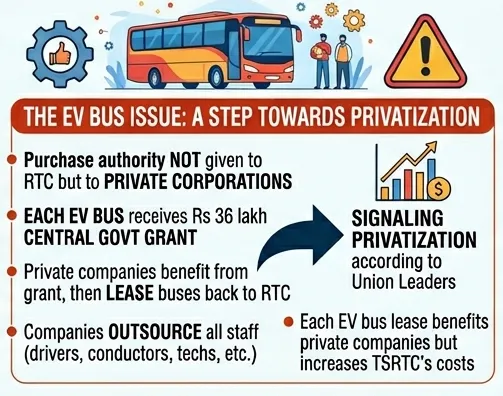
Unions particularly highlight the EV bus issue as a starting point for privatization. From the beginning, the authority to purchase EV buses has not been given to RTC but to private corporations. Each EV bus receives a Rs 36 lakh grant from the central government, which benefits private companies, who then lease the buses back to RTC. Moreover, these companies outsource drivers, conductors, technicians, supervisors, and officers, further signaling a step toward privatization, according to union leaders.
Facing this threat, unions have come together, forming the RTC United Action Committee (JAC) to tackle core issues, including recognition as government employees, pending dues, job recruitments, and preventing the handover of RTC assets to private entities. They issued the strike notice on March 13, signaling that if discussions fail under the labor department, a full-scale strike is imminent. The unions stress that protecting RTC from corporate and political interference is crucial for their livelihood and the public transport system.
Maramreddy Thomas Reddy, TMU General Secretary and JAC Vice Chairman, emphasized that RTC has assets worth thousands of crores, all at risk of privatization. The government’s plan to have private companies manufacture EV buses and lease them to RTC, along with outsourcing charging station management, raises strong privatization concerns.
AR Reddy, TMU President, added that RTC has the capacity to convert existing diesel buses to EV buses with minimal training, reducing dependency on new bus purchases.
Yet, the government continues to contract private companies for EV bus conversion, further signaling privatization, which prompted the unions to take direct action to safeguard RTC.
Eeduru Venkanna, JAC Chairman and EU General Secretary, criticized past and present governments for neglecting RTC workers. Under previous BRS rule, employees faced mismanagement, while the current Congress government’s approach is seen as even more detrimental, with no recruitments in 12 years and active suppression of workers’ voices.
Suddala Suresh, BWU General Secretary and JAC Co-Convener, pointed out that government schemes, such as Mahalakshmi, which offer free RTC travel to women, rely entirely on RTC’s cooperation, bringing recognition to the government. Despite generating government goodwill, RTC continues to face neglect, with unpaid dues totaling around Rs 2,500 crore. The current system of giving EV bus operations to private companies while leasing the same buses to RTC employees only reinforces the privatization threat.
Unions are determined to prevent RTC privatization, demanding that bus purchase authority and operations remain under RTC’s control. They are united in their resolve to fight, emphasizing that safeguarding RTC is vital not only for employees but also for the public that relies on this essential transport service.