27 September, 2026 | 5:18 AM


Has internet become the new global battlefield?
26-03-2026 12:00:00 AM
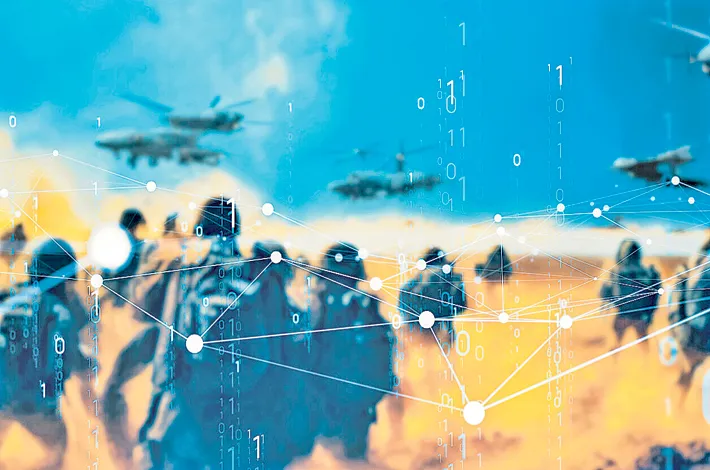
In an era where wars were once fought over territory, oil, shipping lanes, and strategic choke points, a dangerous new front is emerging in modern warfare. The battlefield is rapidly expanding into the digital infrastructure that powers the world's economy. Recent events in West Asia suggest that data centers, cloud services, and undersea internet cables are becoming legitimate targets, with the potential to disrupt not just regional stability but global commerce, finance, and daily digital life.
These are not mere commercial facilities. Data centers form the backbone of cloud computing, financial transactions, government services, and everyday digital operations. The implications are wide-ranging. At the same time, cyber warfare is escalating in parallel. US medical technology giant Stryker suffered a massive cyber attack claimed by an Iran-linked hacking group, resulting in wiped systems, stolen data, and disrupted global operations. Such incidents demonstrate how digital attacks can cripple real-world supply chains almost overnight.
Experts warn that the next highly destabilizing target could be the vast network of undersea internet cables. These cables crisscross the world's oceans, with critical lines running through the Red Sea, the Persian Gulf, and the Strait of Hormuz. Nearly 95% of internet traffic in the Middle East travels through fiber optic cables beneath the Red Sea and Persian Gulf. Many of these cables pass through shallow waters, making them especially vulnerable.
A map of global cable routes highlights how connected the world is—and how any damage in this conflict zone could ripple across continents, affecting Asia, Africa, Europe, and beyond. Previous cable damages near Yemen have already caused internet slowdowns in India, the Gulf, and parts of Africa. The Middle East has also become a major global data hub, with Saudi Arabia and the UAE attracting billions in investments from tech giants like Amazon, Microsoft, Google, Oracle, and OpenAI. If conflict spills over into this digital infrastructure, the consequences will no longer remain regional.
From a West Asia lens, a middle east explained that the internet has always been the soft underbelly of the global economy. The Red Sea is particularly critical, carrying 17% of global data, including 90% of Europe-to-East Asia communications. The Houthis have already demonstrated their capability by cutting cables twice—once in February 2024 and again in September 2025—using tactics like dragging ship anchors.
These incidents caused oil spills, affected desalination plants, and led to widespread internet disruptions across East and South Asia, as confirmed by NetBlocks. With the rise of AI, cloud services, and 5G, data centers in the UAE and Saudi Arabia—key to their 2030 and 2035 visions—have taken a significant hit. Recovery is daunting: only about 60 cable repair ships exist worldwide, with just two dedicated to the Red Sea. Insurance costs exceed $100,000 per day, making repairs a massive challenge.
A martitime expert described the situation as asymmetric warfare. Iran and its proxies, unable to match adversaries militarily, are deliberately targeting the "soft underbelly"—business centers, real estate, and data centers—to hurt the US and its allies. The Bab el-Mandeb Strait, even narrower than the Strait of Hormuz, gives the Houthis immense leverage. Their goal is maximum disruption with minimal direct confrontation.
A cyber security expert highlighted the evolving vulnerability of data centers. Regulations promoting data localization and sovereignty have created physical footprints in conflict-prone regions, turning them into targets. Attacking a data center isn't just about the building; cooling systems, power supplies, and fire management can all be compromised, leading to lengthy recovery. The collateral damage extends to local economies, businesses, and even the very AI and cloud technologies used to conduct modern attacks. This raises serious trust issues for the digital ecosystem.
From India's standpoint, the risks are significant. Much of the country's internet traffic to Europe passes through this volatile region. Disruptions to Gulf-based data centers would affect Indian businesses, while economic downturns could impact the millions of Indian workers in the region and the $55 billion in annual remittances. Energy security and indirect business effects add further layers of concern. The Indian government has been engaging with Gulf countries and Iran to mediate and protect non-military targets.
One point has now become crystal clear: war is no longer confined to borders, battlefields, or power plants. It is moving into the invisible systems—cloud servers, data centers, undersea cables, and networks—that keep modern economies and societies running. The question is no longer whether this can happen again, but whether governments, companies, and societies worldwide will come together to prepare for this new reality.