22 September, 2026 | 10:31 AM


Modi poised for historic agenda push
20-07-2026 12:00:00 AM
ANITA SALUJA I NEW DELHI
Prime Minister Narendra Modi is all set to script history, by implementing his pet political agenda. As the Monsoon Session of Parliament commences on Monday, there's heightened optimism in the Modi Establishment of achieving the numbers required to implement RSS political agenda.
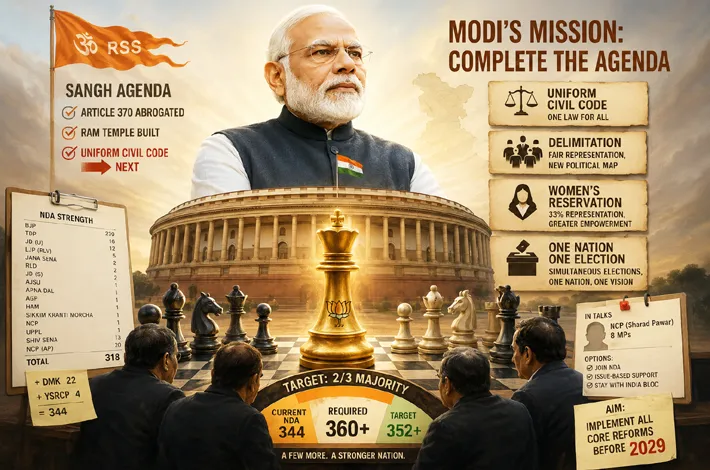
To push through the Agenda, Modi needs a clear two-thirds majority to overcome the stiff opposition of the political parties. In the General Election in 2024, the BJP set a 400-plus seats target for achieving wider changes and the blueprint included Delimitation, Women's Reservation, Uniform Civil Code and One Nation, One Election.
Prime Minister Modi has already implemented two of the three issues on Sangh Core Agenda. Abrogation of Article 370 of the Constitution conferring Special Status on Jammu & Kashmir was important for BJP, as it was seen as Muslim appeasement, since Kashmir is Muslim-majority region. Non-construction of Ram Temple in Ayodhya was also linked to Muslim appeasement. With the BJP Government all set to introduce the Uniform Civil Code in Parliament, Prime Minister Modi is aiming to complete the implementation of Sangh Agenda.
Alongside Uniform Civil Code Bill, there are other pet agenda of Modi's Bills which include Delimitation, Women's Reservation and One Nation, One Election. All these issues are highly controversial. For instance, Delimitation is contentious because it can seriously transform the political landscape, since it's designed to break the stranglehold of vote banks mainly Minorities and Dalits.
Women's Reservation is controversial due to its linkage to the increasing number of seats. Women's Reservation will be implemented in the additional seats created, without altering the existing general seats. It is mainly to ensure that men do not lose out on account of Women's Reservation.
One Nation, One Election is equally contentious, as the new law strictly enforces simultaneous Lok Sabha and State Assembly elections once in five years, without adequately addressing the issue of fall of Governments on the floor of the House, which necessitates midterm elections.
Modi is determined to push for the Delimitation and Women's Reservation Bill, after the political setback in the previous Budget Session of Parliament, where the Government failed to muster the numbers of two-thirds majority required for the passage of the Constitution Amendment Bill.
During the inter-session period between the previous Budget Session and ensuing Monsoon Session of Parliament, floor managers of the ruling dispensation worked hard to get their act together. A massive political realignment strategy was meticulously crafted and implemented.
Numbers speak for the work of the ruling party parliamentary floor managers, working in tandem with regional satraps, like West Bengal Chief Minister Suvendhu Adhikari and Maharashtra Chief Minister Devendra Phadnavis and Maharashtra Deputy Chief Minister Eknath Shinde, under the overall supervision of Union Home Minister Amit Shah.
The NDA tally in Parliament has soared, with surging political support carefully garnered by the ruling party at the Centre. The numbers speak. BJP 239; TDP 16; JD (U) 12; LJP (Ram Vilas) 5; Jana Sena 2; RLD 2; JD (S) 2; AJSU 1; Apna Dal 1; AGP 1; HAM 1; Sikkim Kranti Morcha 1; NCP 1; UPPL 1; Shiva Sena 13, after Lok Sabha Speaker Om Birla admitted 6 MPs from Shiv Sena (UBT); and Nationalist Citizens Party of India (NCPI) 20. It adds up to 318.
The DMK with 22 MPs has given the green signal for Delimitation and with YSRCP's 4 MPs, NDA tally goes up to 344.
The BJP is working to bring on board the NCP (Sharad Pawar) with 8 MPs. This could take the NDA tally up to 352. This brings BJP into a striking distance from its goal of eight to 10 MPs. Required number for two-thirds majority in a full House of 543 MPs is 362 and in the present House of 540, the threshold number is 360.
The marginal shortfall of around 8 to 10 MPs can be achieved with some MPs abstaining during the voting. This will help the ruling party in effectively reducing the strength of those present and voting, thereby bringing down the threshold of two-thirds majority.
There are about 7 Independent MPs and 37 MPs of the Samajwadi Party of Akhilesh Yadav. The BJP floor managers are working on tackling this group of 44 MPs. Making 10 to 14 MPs to abstain is no tall order, to bring down the strength of those present and voting. Voting on the Constitution Amendment Bill entails the presence of 50 per cent of the strength of the House and support of two-thirds of those present and voting.
Sharad Pawar's NCP has eight MPs. Pawar is in talks with the Modi Government. He has three options. Join the NDA, which means reunification of the NCP and Pawar family, as his nephew late Ajit Pawar's wife Sunetra Pawar is Deputy Chief Minister in Maharashtra in NDA Government. This means Union Cabinet Minister for Sharad Pawar's daughter Supriya Sule, with Pawar retiring. Second option is to stay out of NDA but extend issue-based support to the Modi Government. The third option is to stay put with INDIA Bloc, where he is at unease presently.
The much-touted Modi's Cabinet reshuffle has been delayed primarily due to the hesitation of the DMK and NCP (SP) of Sharad Pawar in joining the NDA. These two parties, together, account for 30 MPs in Lok Sabha, which is a sizable number.
Numbers have been the perpetual problem for the Saffron Party, right from the times of former Prime Minister and BJP patriarch Atal Behari Vajpayee. It may be recalled, Vajpayee was forced to put Abrogation of Article 370, Ayodhya Ram Temple and Uniform Civil Code, the pet issues of the Sangh Parivar, on the backburner during his tenure as Prime Minister from 1998 to 2004.
Prime Minister Modi managed to break the numbers jinx and was successful in the implementation of two of the three major issues of Abrogation of Article 370 and construction of Ram Temple in Ayodhya.
After the recent forced pause, Prime Minister Modi seems set to regain his lost political momentum, forging ahead with the implementation of the last of the three issues on the Sangh Parivar Core Agenda, Uniform Civil Code, along with his other pet themes like Delimitation, Women's Reservation and One Nation, One Election.
With Prime Minister Modi effectively back in the game, it's merely a question of prioritizing and sequencing his moves. But, he is very much on the right political track to implementing all his pet issues, ahead of the next General Election in 2029. Modi is out to script a new history.
(Writer is Delhi-based senior journalist, analyst and political commentator. Views are personal.)