25 August, 2026 | 12:17 AM


Dividing Hindus?
20-06-2026 12:00:00 AM
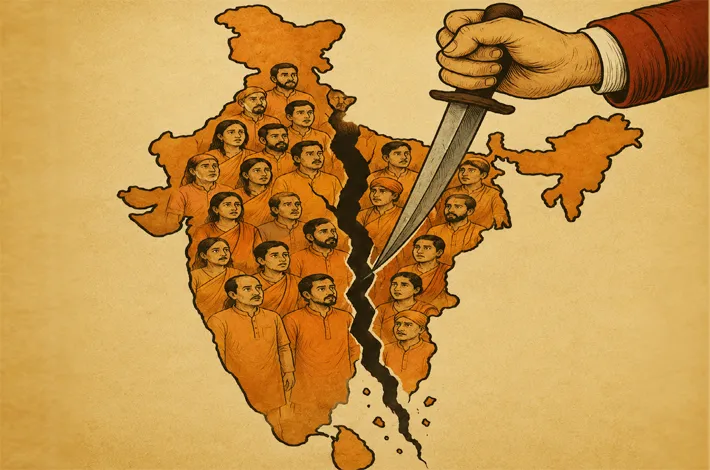
Nomani questions Hindu majority status
AIMPLB leader Maulana Khalilur Rahman Sajjad Nomani argued that Hindus cannot be considered a majority if caste, tribal, regional and religious identities such as SCs, STs, Lingayats, Sikhs, Jats and Adivasis are counted separately.
Official data contradicts claim
India's 2011 Census records Hindus at about 79.8% of the population, while demographic projections indicate they will remain the country's largest religious community for decades.
metro india news I hyderabad
In a development that has reignited communal and political tensions across India, Maulana Khalilur Rahman Sajjad Nomani, a senior member and spokesperson of the All India Muslim Personal Law Board (AIMPLB), has made controversial assertions questioning the majority status of Hindus. His statements, originally delivered at the Millat Times Conclave in February 2026, resurfaced prominently in mid-June 2026, triggering widespread backlash, sharp rebuttals from BJP leaders, and intense media scrutiny, prominently featured in Republic TV debates anchored by Arnab Goswami.
Nomani's core claim is that Hindus cannot legitimately be considered a majority community in India when accounting for distinct social, caste, and regional identities. He argued that groups such as Scheduled Castes (SCs), Scheduled Tribes (STs), Lingayats, Sikhs, Jats, Tamils, Adivasis, and others should not be counted as Hindus.
Swearing on Islamic holy sites, he declared, “I place my hand on Hajr-e-Aswad and the cover of the Kaaba and say that Hindus are a minority in India. Under no circumstances can Hindus be considered a majority.” He further contended that Sikhs, Christians, and Buddhists are separate, and that many communities have distinct self-identities outside a monolithic Hindu fold.
This framing is not new for Nomani, who has a history of provocative commentary on religious and social issues in India. Critics view these remarks as a deliberate strategy to fragment Hindu society along caste and regional lines, undermining the constitutional and demographic reality of Hindus as India's largest community. Official 2011 Census data pegs Hindus at approximately 79.8% of the population, with projections from Pew Research suggesting they will remain around 77-79% even by 2050. Nomani's analysis, based on his claimed decades of ground-level observation, seeks to reinterpret these figures by disaggregating subgroups.
Republic TV's coverage, including full-length debates and short clips featuring Arnab Goswami, has amplified the controversy. In one segment, Goswami highlights how cameras have captured what might have been intended as private remarks, exposing the AIMPLB's alleged intent to "divide Hindus." He frames it as a wake-up call to the "woke brigade," accusing the cleric and the organization of advancing a divisive agenda. Clips show intense panel discussions questioning the implications for national unity, minority politics, and ongoing debates around issues like the Uniform Civil Code (UCC).
Political reactions and broader context
The BJP and its allies have been vocal in condemnation. Leaders like Shehzad Poonawalla have described the remarks as reflective of a "jihadi mindset," while others argue it exposes a pattern of attempts to weaken Hindu consolidation. The resurfacing of the video has led to calls for accountability, with some demanding action against what they see as hate speech or efforts to incite division. Opposition voices and certain commentators have pushed back, framing the outrage as manufactured or an overreaction that stifles minority perspectives on social realities like caste discrimination within Hindu society.
This episode occurs against a backdrop of heightened sensitivities around religious demographics, identity politics, and governance reforms in India. The AIMPLB has long been a vocal opponent of initiatives like the UCC, which seeks to replace religion-specific personal laws with a common framework. Nomani's comments tap into deeper fault lines: the tension between a pan-Indian Hindu cultural identity—often emphasized in majoritarian politics—and the reality of India's immense diversity, including caste hierarchies, linguistic regionalism, and tribal autonomy.
Supporters of Nomani's view might argue he is highlighting genuine sociological distinctions. Lingayats in Karnataka have historically sought separate religious status, many Dalit and tribal groups maintain unique traditions and have complex relationships with mainstream Hinduism, and Sikhism is constitutionally recognized as distinct.
However, critics counter that selectively excluding these groups from the Hindu demographic count is disingenuous and politically motivated, especially when census enumeration and constitutional provisions (such as those for SC/ST reservations) treat many of them within the broader Hindu fold for administrative purposes. Hinduism's pluralistic nature—encompassing a wide array of beliefs, practices, and communities—has historically allowed for such diversity without negating its overarching demographic weight.
Implications for national discourse
The controversy underscores several pressing issues in contemporary Indian politics. First, the fragility of social cohesion in a diverse democracy where identity-based narratives can quickly polarize. Second, the role of religious bodies like the AIMPLB in public discourse; while they represent specific community interests on personal law, their forays into redefining majority-minority dynamics invite scrutiny. Third, media's amplification power—Republic's aggressive coverage drives engagement but also risks entrenching echo chambers.
From a governance perspective, such statements complicate efforts toward inclusive development and social harmony. India's Constitution recognizes both individual rights and group protections, balancing secularism with cultural pluralism. Attempts to redefine majorities algorithmically could fuel demands for revised policies on reservations, political representation, or even delimitation exercises. They also intersect with ongoing concerns about demographic shifts, conversions, and migration in certain regions.
Analysts note that while caste and sub-identity politics are legitimate subjects of reform—evident in movements for social justice—the explicit decoupling from Hindu identity in a religious conclave setting raises questions about intent. Is it a call for acknowledging diversity or a tactical move amid debates on temple reforms, UCC, and electoral strategies? Hindu organizations and political parties have responded by stressing unity in diversity, urging communities to reject divisive external narratives.
As the debate rages, it serves as a reminder of India's complex social fabric. Census data and sociological studies provide empirical baselines, still interpretations remain contested. True progress likely lies not in denying demographic realities or erasing sub-identities, but in fostering equitable integration, addressing historical inequities within communities, and prioritizing national integration over fragmentation.
Whether this episode leads to constructive dialogue or further polarization will depend on how political actors, civil society, and media navigate the aftermath. In a nation of 1.4 billion with profound pluralism, sustaining the idea of "unity in diversity" requires vigilance against narratives that undermine shared citizenship.
It is high time that the Hindu’s realise the conspiracy of some radical Muslim elements in trying to divide the Hindu community and take remedial measures to counter such anti-Hindu, Anti-National plans.