1 October, 2026 | 12:27 PM


Coaching Giants Converge on Hyderabad
02-03-2026 12:00:00 AM
The new battleground for India’s test-prep and school education
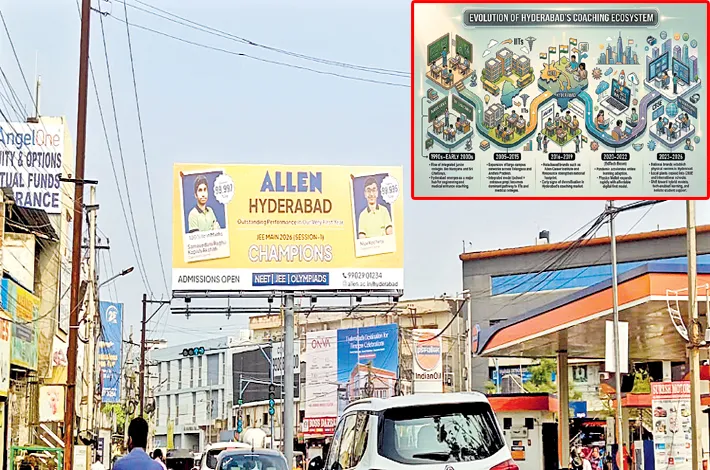
For decades, the city’s coaching ecosystem was dominated by local powerhouses such as Narayana and Sri Chaitanya, whose integrated junior colleges became synonymous with engineering and medical entrance success. However, the entry of national coaching brands like Resonance, Allen Career Institute, and Physics Wallah has transformed the competitive dynamics of the city.
For years, Hyderabad’s coaching culture revolved around tightly structured “integrated” models where school education and entrance preparation were merged into a single system. Institutions like Narayana and Sri Chaitanya built vast networks, producing consistent ranks in national entrance exams and shaping a highly results-driven ecosystem. Their dominance was so strong that students and parents often saw them as the only pathway to top engineering and medical colleges.
That equation is now changing. National coaching brands, particularly those with strong reputations in Kota and the online edtech space, have begun establishing physical centers in Hyderabad. Allen and Resonance bring with them a legacy of specialized test-prep pedagogy, research-based academic systems, and strong faculty training models. Meanwhile, Physics Wallah represents a new hybrid model—blending affordable digital learning with offline centers—making high-quality coaching accessible to a wider student base.
This influx has intensified competition in multiple ways. First, it has expanded choices for students. Earlier, aspirants preparing for engineering and medical entrance exams were largely confined to a few dominant institutional systems. Today, they can select from diverse approaches—traditional classroom coaching, hybrid learning models, or fully digital platforms.
Second, the competition has sparked a strategic shift among established local players. Recognizing that the market is evolving, many traditional coaching giants are now expanding beyond junior colleges into mainstream school education. By launching or strengthening CBSE and international-curriculum schools, they aim to secure students earlier in their academic journey rather than only at the pre-university stage.
This transition reflects a larger trend in India’s education sector—the blurring of boundaries between schooling and competitive exam preparation. Parents increasingly seek integrated solutions that combine strong academic foundations, conceptual learning, and early exposure to entrance-exam readiness. Institutions, in turn, are redesigning their models to offer a continuum from primary school to competitive exams.
Another major impact of this competition is the shift toward quality differentiation. Institutes are investing more in teacher training, student wellness support, technology-enabled learning, and flexible academic pathways. There is also growing awareness about balancing rigorous preparation with holistic development, as students and parents demand less stressful and more student-friendly learning environments.
Hyderabad today represents a microcosm of India’s evolving education marketplace—where legacy institutions, national coaching giants, and new-age edtech players are all vying for influence. The result is a more diverse, competitive, and student-centric ecosystem.
Ultimately, this convergence signals a broader transformation: entrance exam preparation in India is no longer controlled by a handful of regional giants. Instead, it is becoming a dynamic, nationwide arena shaped by innovation, accessibility, and expanding educational choices.