22 September, 2026 | 11:19 AM


Can Telangana implement 42% BC reservation?
21-07-2026 12:00:00 AM
Metro India News | Hyderabad
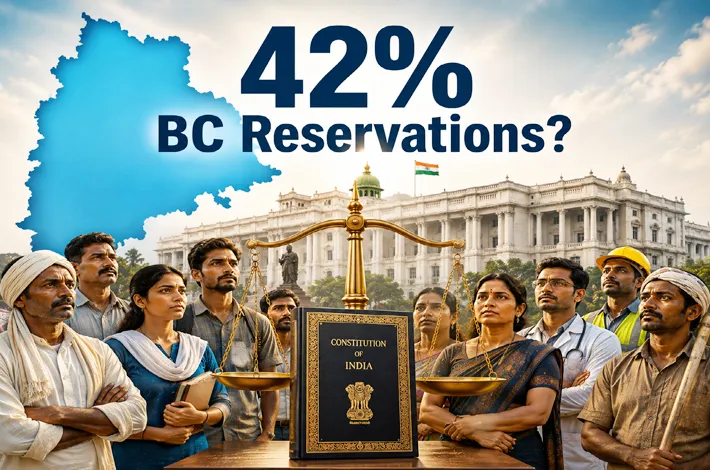
The demand for 42% reservation for Backward Classes (BCs) in Telangana has regained attention with the commencement of Parliament's Monsoon Session, as the State's reservation Bills continue to await the President's assent. The two Bills, passed by the Telangana Assembly and forwarded to the Central Government in April 2025, have remained pending for the past 15 months, prompting renewed debate over their constitutional validity and political future.
The Bills seek to provide 42% reservation for BCs in education, public employment and local body institutions. They are based on the Telangana government's caste survey, which found that Backward Classes constitute 56.33% of the State's population. The proposal has also revived discussions on whether reservations can legally exceed the judicially evolved 50% ceiling.
The Constitution contains several provisions enabling affirmative action for socially and educationally backward communities. Articles 15(4) and 15(5) permit special provisions in education, while Article 16(4) allows reservation in public employment for backward classes that are inadequately represented. Articles 38 and 46 direct the State to promote social and economic justice, while Articles 243D and 243T provide for reservations in local self-government institutions. Reservations under Articles 15(4) and 16(4) have no time limit, unlike the ten-year provision under Article 334, which applies only to political reservations in Parliament and State legislatures.
Reservations are intended to address historical social and educational backwardness rather than poverty. The Constitution follows the principle of substantive equality, recognising that people from unequal social backgrounds cannot be treated identically if equal opportunities are to be achieved. The objective is to improve representation in education, government jobs and governance while addressing long-standing discrimination.
The Constitution does not prescribe a 50% ceiling on reservations. The limit emerged through Supreme Court judgments. In the 1962 M.R. Balaji case, the court observed that reservations should ordinarily remain below 50%, but treated it as a guideline rather than a constitutional rule. In the 1976 N.M. Thomas judgment, the court held that equality does not mean treating unequal groups alike and recognised affirmative action as part of equality itself.
The landmark Indra Sawhney judgment of 1992 upheld 27% reservation for OBCs and reaffirmed the general 50% limit while making it clear that extraordinary circumstances could justify exceeding it. Later rulings in M. Nagaraj (2006) and Jarnail Singh (2018) held that governments must support reservation policies with quantifiable data showing social backwardness, inadequate representation and the need for reservation. In 2022, the Supreme Court upheld the 10% Economically Weaker Sections (EWS) reservation, a verdict that strengthened the argument that the 50% ceiling is not part of the Constitution's Basic Structure.
Several States already have reservation levels exceeding 50%. Sikkim has around 90% reservation, while Arunachal Pradesh, Meghalaya, Mizoram and Nagaland provide about 80%. Tamil Nadu has 69%, Chhattisgarh 68%, Karnataka around 66% including EWS, and Telangana currently has nearly 64% reservation when SC, ST, BC and EWS quotas are combined.
The Supreme Court's I.R. Coelho judgment held that laws placed in the Ninth Schedule can still be reviewed if they violate the Constitution's Basic Structure. However, legislation providing higher reservations may still withstand judicial scrutiny if backed by strong empirical evidence, constitutional justification and proper legislative drafting.
For Telangana's proposal to succeed, the government will have to establish through reliable data that BCs continue to face social and educational backwardness, remain inadequately represented in education and public employment, and that extraordinary circumstances exist in the State, where SCs, STs and BCs together account for nearly 88% of the population. Publication of the caste survey, submission of complete statistical evidence before courts and, if necessary, additional legislative protection through Parliament would strengthen the case.
The State had earlier attempted to introduce 42% BC reservation in local body elections, but the proposal stalled after the High Court observed that the complete caste survey and supporting data had not been placed before it. A future attempt supported by comprehensive empirical evidence could produce a different legal outcome.
Concerns that reservations beyond 50% would reduce administrative efficiency continue to be debated. However, administrative performance depends on factors such as education, infrastructure, institutional capacity, industrial growth and governance reforms rather than reservation percentages alone. Tamil Nadu, despite maintaining one of the country's highest reservation levels, has consistently remained among India's leading States in manufacturing, healthcare, higher education and human development.
There is also no constitutional provision or Constituent Assembly decision prescribing a 30% ceiling on reservations. Judicial interpretation has consistently recognised Article 16(4) as an independent enabling provision intended to secure adequate representation for backward classes.
With the Telangana Bills still pending before the Centre, the future of 42% BC reservation will depend on constitutional scrutiny, judicial precedents, credible empirical evidence and political consensus. The issue is expected to remain a key subject of discussion as Parliament continues its session and Telangana presses for approval of the pending legislation.