27 September, 2026 | 12:25 PM


Bihar politics- Will it be a turning point for BJP?
07-03-2026 12:00:00 AM
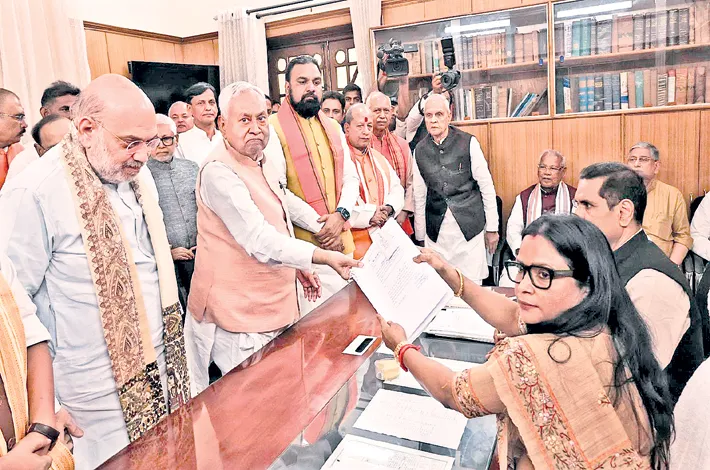
In a dramatic political development in Bihar, veteran leader Nitish Kumar has filed his nomination for the Rajya Sabha (upper house of Parliament), signalling the end of his record-breaking tenure as the state's Chief Minister. After more than two decades in power—including a historic 10th term sworn in just months earlier following the NDA's landslide victory in the 2025 Bihar Assembly elections—Kumar is stepping aside from the top state post to enter national politics.
The move, confirmed in early March 2026, comes amid speculation that it paves the way for the Bharatiya Janata Party (BJP) to install its first Chief Minister in Bihar. The NDA alliance, comprising the BJP and Kumar's Janata Dal (United) (JD(U)) , secured a commanding 202 out of 243 seats in the November 2025 assembly polls, with the BJP emerging as the single-largest party. Kumar's decision to transition to the Rajya Sabha fulfills a long-standing personal ambition—he has already served as an MLA, MLC, and Lok Sabha MP but never in the upper house. In a message to supporters, he emphasized his lifelong desire to be a member of both houses of Parliament and both houses of the Bihar legislature, assuring continued guidance and support for the new government in developing Bihar.
The announcement has sparked intense debate across India's political spectrum. Opposition parties, including the Congress and Rashtriya Janata Dal (RJD), have portrayed it as evidence of the BJP's aggressive strategy to absorb or dismantle allied regional parties. Critics likened the BJP to a "cobra that eats its own babies," arguing that the party ultimately cannibalizes its partners after leveraging them for power. They drew parallels to the "Maharashtra model," where alliances shift to favor the BJP's dominance, and warned that similar fates await other NDA allies nationwide. Some opposition voices accused the BJP of engineering a "hostile takeover" of the JD(U), claiming Kumar's exit was not entirely voluntary and that his tweet announcing the shift—promising to guide the new government—was drafted or influenced externally in Delhi.
A senior JD(U) leader, staunchly defended Kumar's autonomy, insisting no one can pressure or remove him. He described Kumar as a decisive leader who has switched alliances in the past based on his own judgment and Bihar's interests. He highlighted Kumar's long partnership with the BJP since 2005, his courageous decisions (such as resigning in 2014), and the NDA's cohesive performance in the recent elections. He rejected claims of a BJP-orchestrated ouster, portraying the move as Kumar's personal choice to fulfil a lifelong goal while remaining influential in Bihar's development.
An RJD spokesperson countered sharply, questioning the sudden shift from Chief Minister to "margdarshak" (guide). She mocked the irony of opposition parties now defending Kumar after previously criticizing his fitness and leadership. She argued this was political "assassination" where Kumar himself was writing his "obituary," pointing to discontent among JD(U) workers, ministers, and even family members who expressed shock and betrayal. She highlighted Kumar's earlier prime ministerial ambitions within the INDIA alliance and contrasted them with settling for a Rajya Sabha seat, labelling it a demotion engineered by the BJP.
A political analyst accused the BJP of a covert "Coventry operation," alleging sleeper cells within the JD(U) had facilitated the shift—naming figures like Lallan Singh, Vijay Choudhary, and Sanjay Jha as alleged insiders working for the BJP. He compared the move to historical precedents where senior leaders like L.K. Advani and Murli Manohar Joshi were sidelined to "margdarshak" roles under Narendra Modi, suggesting Kumar's political currency was nearing its end.
A BJP national spokesperson pushed back, emphasizing mutual trust within the NDA. He noted that despite the BJP winning more seats, it had supported Kumar as CM for consecutive terms, underscoring alliance cohesion over numerical claims. He dismissed opposition hypocrisy, recalling how they had previously attacked Kumar's mental and physical fitness but now expressed concern. He rejected notions of coercion, affirming Kumar's independence and the NDA's joint decision-making.
Ultimately, Kumar's transition marks the close of an era dominated by his "sushasan" (good governance) brand. Whether viewed as a graceful, self-chosen exit for a 75-year-old leader seeking a respectable national role—or a calculated BJP consolidation—the development has Bihar's politics buzzing with uncertainty about the next CM (with names like Samrat Choudhary floated) and the JD(U)'s future influence. Kumar has promised ongoing guidance, but the opposition sees it as the saffron party's unstoppable march swallowing regional partners whole.