17 September, 2026 | 9:56 AM


Bharat Mandapam statue symbolizes resurgent Bharat
17-09-2026 12:00:00 AM
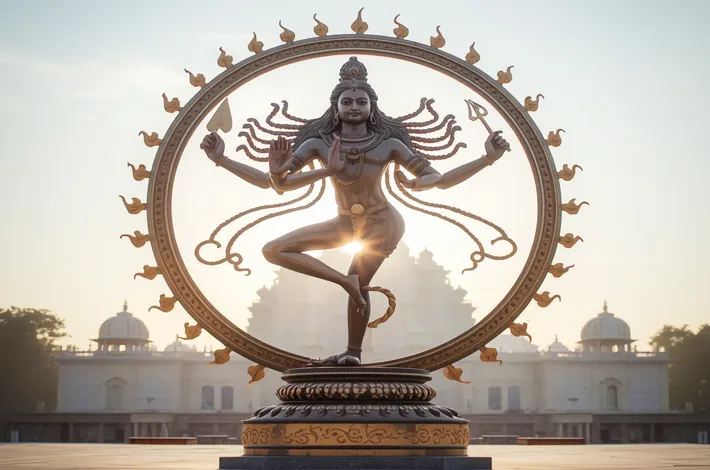
Metro India News | Hyderabad : During the recently concluded BRICS summit in New Delhi, visuals of the tall Nataraja statue at the entrance of Bharat Mandapam drew public attention. Installed during the G20 Summit in September 2023, the statue is considered the world’s tallest Nataraja statue made of Ashtadhatu, an eight-metal alloy, standing 27 feet high.
Among the great images of Indian civilisation, few possess the visual authority of the Nataraja. In immortalised Chola statue, Shiva dances within a circle of flame, one foot planted on ignorance and the other raised in liberating grace. His hair flies outward and his arms extend in several directions, yet his face remains serenely composed.
In Nataraja, motion and stillness, destruction and renewal, are held together in one form. This is not merely a god dancing; it is a philosophical vision of a universe that is continuously becoming, dissolving, and beginning again.
As physicist Brian Greene sees, “In the dance of Nataraja, we find the beauty of mathematical precision and the mystery of artistic expression converging. It is a celebration of both the rational and the intuitive aspects of human consciousness.”
In Sanatan, Shiva represents universal consciousness. His cosmic dance reflects the continuous play between consciousness and manifestation, as Shiva projects and withdraws the universe. Manifestation unfolds into countless forms, energies, and experiences, while withdrawal dissolves them back into source consciousness, expressing the perpetual cycle of creation and dissolution.
Shiva is always accompanied by Shakti. The Ardhanarishvara form symbolises their inseparable union. Here, Shakti represents the dynamic aspect of consciousness that gives rise to diversity in forms and experiences. This divine feminine energy permeates existence, and the interplay of Shiva and Shakti is seen as the force behind reality’s continual unfolding and transformation.
Sanatan philosophy also recognises Maya: the illusion of separation and duality within manifestation. Maya creates the appearance of individuality, veiling the underlying unity of consciousness and giving rise to the perception of separate entities, experiences, and limitations.
Spandan refers to the pulsation or vibration of consciousness—the underlying rhythm that gives rise to the continuous flux and transformation of reality. Nataraja statues are common in Sanatani households and public spaces. Three prominent examples—the ancient Nataraja at the New York State Museum, the statue at CERN, and the recent installation at Bharat Mandapam—tell distinct stories. The New York statue recalls how India’s cultural heritage was plundered by the West. The CERN statue testifies to global recognition of the depth of Indian science and philosophy. The Bharat Mandapam statue symbolises a resurgent Bharat ready to take its rightful place among nations.
(S K Joshi, served as Chief Secretary of Telangana from February 2018 to December 2019)