20 September, 2026 | 2:08 AM


Bairanpally’s Silent Witness to history
20-09-2026 12:00:00 AM
Lalita Iyer Musings
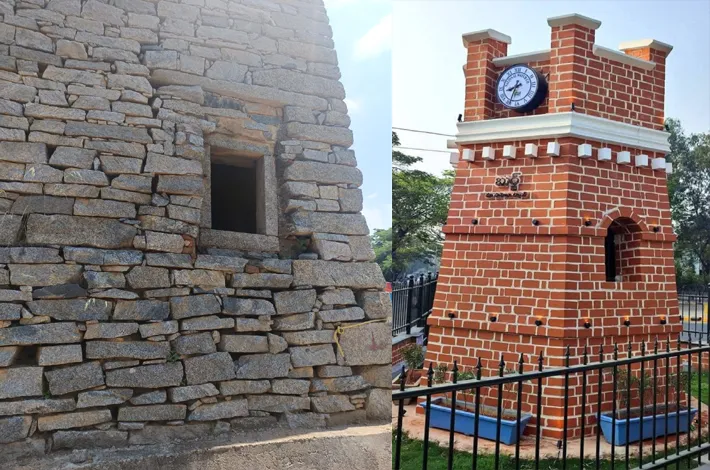
We were driving down the Lakdi-ka-pul to Masab Tank Road, where you take a right turn to come to Banjara Hills from under the flyover. At this traffic island is a little watch tower in red bricks. This heritage-style burj and clock tower was inaugurated at Masab Tank on December 31, 2025, marking 157 years of municipal administration service, spanning from 1869 to 2025.
I remembered one such mud tower somewhere near Siddipet. Then with the help of Google, good friend Mallepalli Lakshmiah and with a contact number at Cherial, I left the next day to Bairanpally. Which also happened to be September 17. The same day in 1948, when the Hyderabad or Nizam state merged into the Indian Union. This was after Sardar Patel launched Operation Polo or the police action against the then Nizam and his army of the Razakars. There is a thought that Bairanpally might have been the triggering point.
A trip, in my dictionary does not mean just the assignment, so it had to start with breakfast after Shamirpet. Earlier Rajiv Rahdhari used to be more peaceful and breakfast was available only after Mulugu (Janata Hotel and a favourite of mine. It also had a clean toilet way back then). This route has changed now with all kinds of food trucks and a lot more people eating breakfast. Which means we got fresh, hot stuff. Any bandi stuff is fresh, especially if there is a crowd. Rule of thumb.
I met up with Bala Narasimhagaru at Cherial and we left for Bairanpally. He is close to the then CM and was the Executive Engineer, R&B department at Siddipet. Knowledgeable and ready to share, he was easy to talk with. What a picturesque landscape, with paddy fields on either side of the road, even as Narasimhagaru kept saying this was a drought-prone region, adding that thanks to the previous CM, K Chandrasekhar Rao (KCR), the lakes and borewells were full, with the rejuvenation of water bodies.
The winding road, with a couple of villages and the familiar red flags of CPI(M) flags fluttering in the air added to the excitement. The Left party had a rally at this village and the stage was set, with the loudspeakers belting out Red songs. Very reminiscent.
We reached an hour early and so had time to absorb the ambience and talk to the local two-time sarpanch Barma Rajamallaiah. His grandfather, also of the same name was present on that fateful day. And typically, the office room got filled with the local reporters and other locals and we had a delicious cup of hot tea. Even that small cup was very satisfying.
The Buruju or mud watch tower was just that. It was used by the local village people to spot approaching forces and then use nagaras (huge drums) to announce a stranger or an attack, in order to defend their community during the turbulent Razakar (the private militia of the Nizam's regime) times. Those were cruel times and barely mentioned in history books.
Bairanpally was then part of Nalgonda district (Geographically, I still cannot get my head around this fact that it was then Nalgonda district, but we are talking about 75 years ago) and this route had many watch towers. But Bairanpally got into history books for the tragedy behind it. Figures keep changing but there is a stupa as you enter the village and it has 119 names etched on to it. We will stick to that.
After two to three attempts at plundering the village, on the fateful day of August 27, 1948 the village came under attack and people got massacred. Some may even call it the Jalianwala Bagh of Telangana. This village is also called Veera Bairanpally because the village folk had stood strong against the Razakars. Both men and women. With implements which they used on their small farms and smaller kitchens.
The rest, as they say, was bloodshed and a mute mud tower as the sole witness. There are a few old men, who were 10 or 11 years of age then who are now just happy to talk of that fateful day. "It was dark and I was just 11 years of age. All I remember is that they killed a lot of people and I was there crying," says Pukati Istaru. Once he started talking, old men around seconded him and talking louder than him.
While the burju was only to be a watch tower, some people took shelter within too. Now there is a reinforced wall and a little window space from where you can peep in. But the adventurous among them also climbed to raise a fist in salute.
And the burju at Bairanpally stands definitely as a symbol of bloodshed amidst courage and sacrifice.
- Lalita Iyer
Senior Journalist