21 September, 2026 | 5:20 PM


US bombing of Iran expands
21-07-2026 12:00:00 AM
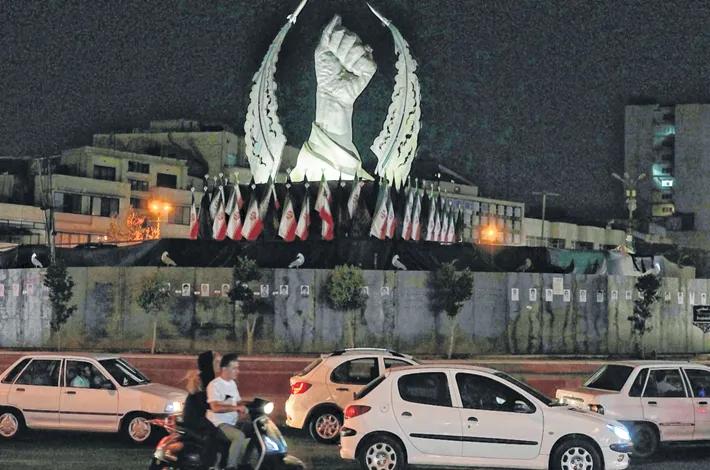
ninTH STRAIGHT NIGHT | Tehran retaliates against Gulf as strait issue is on boil
Dubai/Washington: The US conducted a new round of airstrikes early on Monday targeting Iran after announcing the death of another American service member, hitting areas around a northwestern city believed to be home to underground missile bases.
Iran responded by launching attacks targeting Bahrain, home to the US Navy’s Fifth Fleet, and Kuwait.
The US military said the service member was killed in Iraq on Saturday during the “controlled detonation” of a downed Iranian drone.
“We hit them very hard again tonight,” US President Donald Trump said. “And we did that in honour of” the soldiers killed, he said.
TEHRAN: MEDIATORS HAVE PROPOSED CEASEFIRE IDEAS
Tehran has confirmed receiving proposals from mediators to halt its conflict with the US, even as both sides continued military operations.
Iranian Foreign Ministry spokesperson Esmaeil Baghaei told a press conference that mediators were working to prevent further escalation but declined to disclose details of the proposals. The acknowledgement is the first official confirmation by Tehran that mediation efforts are under way since the collapse of the June 17 memorandum of understanding (MoU) between the two countries.
“The fact that mediators are active and trying to prevent an escalation of tension is clear," Baghaei said. “The proposals put forward through mediators have been communicated to us and we have received them, but for now allow me not to go into their details."
Baghaei said Iran’s diplomatic efforts would continue alongside military operations. “While our armed forces are responding with strength and power and destroying the source and origin of American aggression, diplomacy also knows its duties well and spares no effort," he said.
RUBIO: US is OPEN TO NEGOTIATIONS
Secretary of State Marco Rubio told reporters the US was still open to negotiating with Iran, but “it has to be real".
“We’re going to continue to respond. If the door opens to diplomacy, if the guys that want to do something productive for Iran win and take control of that system, or take control of the negotiations, that’ll be a very positive development," Rubio said. “That’s not where we are tonight, unfortunately."
9TH NIGHT OF STRIKES
The US military’s Central Command announced a new round of strikes early on Monday, marking the ninth consecutive night of attacks. Central Command said it targeted “Iranian military command centres, air defence and coastal surveillance sites, maritime capabilities, missile and drone launch sites and communications networks".
Iran’s state-run IRNA news agency reported the American strikes killed at least one person around Tabriz, a northwestern city about 520km from Tehran.
Tabriz is believed to host underground missile bases run by Iran’s paramilitary Revolutionary Guard.
US strikes also likely hit Bandar Imam Khomeini in Khuzestan, Sirik and Jask in Hormozgan, and Konarak and Chabahar in Sistan and Baluchistan, IRNA reported.
As the strikes began, a vessel caught fire early on Monday in the strait after being hit by a projectile near the coast of Oman, the British military’s United Kingdom Maritime Trade Operations centre said.
The crew abandoned the vessel, which was adrift and still ablaze hours later, the UKMTO said.
The route around Oman has been one the US military has encouraged ships to use to avoid Iran’s control. The Revolutionary Guard later claimed it was targeting tankers in the strait.
Tehran retaliated by attacking US-allied countries across West Asia. Bahrain sounded its missile alert sirens on Monday morning, while Kuwait said its air defences fired at an incoming Iranian barrage.
Houthis declare blockade on Saudi
A new pressure point could emerge for world energy markets as Yemen’s Houthi rebels announced on Monday a maritime embargo against Saudi Arabia in response to an attack on Sanaa International Airport last week.
With the strait blocked, Saudi Arabia has been relying on a pipeline to transport oil through the Red Sea.
Trump has threatened to target Iran’s power stations and bridges to compel Tehran to loosen its hold on the strait.
The halfway point has passed in the 60-day period the deal set out for negotiating a permanent end to the war and addressing other issues, including Iran’s nuclear programme.
ONLY DIPLOMACY WILL WIN: IRAN EX-MINISTER
Mohammad Javad Zarif, a former Iranian foreign minister who helped elect President Masoud Pezeshkian, acknowledged in an essay published on Monday by Foreign Policy the interim “deal could never survive such dissonance” over the strait.
“As the current conflict makes clear, Washington cannot eliminate the Iranian government," Zarif wrote. “Only diplomacy, a new peace agreement, and a new security framework produced by regional states and for regional states will allow the US to turn its attention elsewhere."
However, Zarif warned the country’s theocracy that “if Iran repeatedly threatens maritime traffic, it could turn much of the world against it."