27 September, 2026 | 10:57 AM


Tradition vs law- The debate continuous at Sabarimalai
06-03-2026 12:00:00 AM
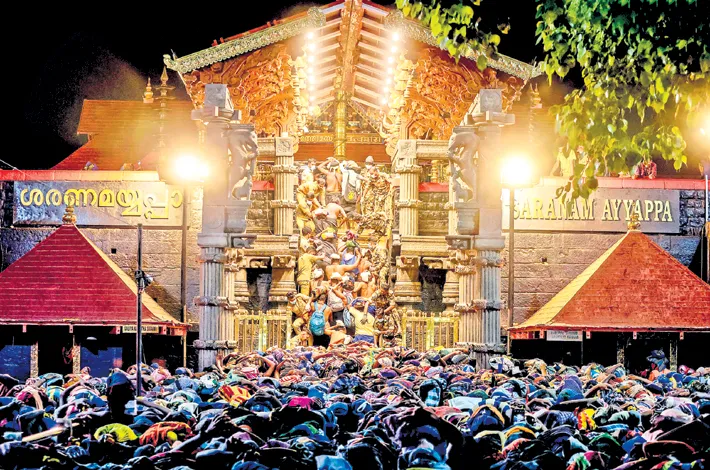
The Travancore Devaswom Board (TDB), the statutory body responsible for managing the famed Sabarimala temple in Kerala, has passed a significant resolution on March 2, 2026, formally opposing the Supreme Court's 2018 verdict that allowed women of menstruating age (typically 10-50 years) to enter the shrine. This move marks a notable shift in stance and comes at a critical juncture, as the Supreme Court prepares to hear review petitions related to the judgment in April 2026 before a nine-judge Constitution Bench.
The resolution underscores the TDB's commitment to preserving the centuries-old customs and traditions of the Sabarimala temple, dedicated to Lord Ayyappa. TDB President K. Jayakumar addressed the media following the board meeting, emphasizing that protecting temple traditions forms the core of the Board's constitutional mandate. He stated, “The Board was constituted in 1949 to protect temple traditions (under the provisions of the Travancore-Cochin Hindu Religious Institutions Act XV of 1950).” Jayakumar further clarified that this opposition represents the TDB's "default legal position," as previous boards had consistently upheld the exclusion in principle, though without a formal resolution until now.
The 2018 Supreme Court verdict, delivered by a five-judge Constitution Bench in a 4-1 majority, struck down the age-old ban on women of menstruating age entering the temple. The majority held that the restriction violated constitutional principles of equality (Article 14), non-discrimination, and the right to freedom of religion (Article 25). The court reasoned that biological factors alone could not justify denying access to a place of worship, and that the ban, rooted in Rule 3(b) of the Kerala Hindu Places of Public Worship (Authorisation of Entry) Rules, 1965, was unconstitutional.
Justice Indu Malhotra dissented, arguing for greater deference to essential religious practices and the collective rights of devotees to follow their faith's customs. The verdict sparked widespread protests in Kerala and beyond, particularly during the 2018-2019 period when attempts to implement women's entry led to violent clashes and the "Women's Wall" counter-protest organized by leftist groups. The "Save Sabarimala" campaign saw massive mobilization by devotees and organizations like the Nair Service Society (NSS) and Sree Narayana Dharma Paripalana Yogam (SNDP), who viewed the ruling as an infringement on religious autonomy.
Fast-forward to 2026, the issue has resurfaced with the Supreme Court scheduling a comprehensive review. A nine-judge Bench is set to hear arguments starting April 7, 2026, with review petitioners slated for April 7-9 and opponents from April 14-16. The TDB's resolution will serve as the foundation for an affidavit the Board plans to file by mid-March 2026 . This affidavit will formally urge the court to uphold the traditional ban, prioritizing the temple's unique celibate deity form and associated rituals, such as the 41-day vratham (austerity) that devotees undertake.
The resolution has drawn swift reactions from key stakeholders. The SNDP Yogam, led by general secretary Vellappally Natesan, welcomed it as a "course correction," noting that changing positions is acceptable if aligned with public sentiment. Natesan had long opposed the 2018 judgment.
The NSS, another influential Nair organization, has criticized political parties for exploiting the issue: it accused the BJP of failing to enact central legislation to safeguard temple customs and slammed the Congress for superficial support without concrete action. Notably, the LDF government appears to be recalibrating its approach. CPI(M) State secretary M.V. Govindan recently hinted at protecting devotees' beliefs, distinguishing between party ideology and pragmatic governance.
Devaswom Minister V.N. Vasavan indicated the Cabinet would discuss the matter, while Law Minister P. Rajeeve spoke of seeking a "balance" between religious practices and constitutional rights. This development carries profound political weight in Kerala, where Sabarimala remains a sensitive electoral flashpoint. Hindu organizations like the NSS and SNDP command significant influence among communities that form a large voter base. The LDF's earlier support for women's entry alienated many devotees, contributing to challenges in subsequent elections.
Questions linger about harmonizing equality with faith-based customs, especially when biological or traditional justifications are invoked. Critics of the TDB's resolution argue it perpetuates gender discrimination, undermining women's dignity and equality. Supporters counter that the temple's practices stem from devotion to a celibate deity, not misogyny, and that judicial overreach risks eroding cultural diversity in a secular state. As the Supreme Court gears up for hearings, the TDB's stance adds momentum to efforts to revisit the 2018 ruling.
Whether this leads to a reversal, reaffirmation, or nuanced compromise remains uncertain, but it highlights the enduring tension between progressive constitutional ideals and deeply held religious traditions in modern India. The coming months will likely see intensified legal arguments, public discourse, and possibly renewed activism around one of Kerala's most revered pilgrimage sites.