18 September, 2026 | 1:16 AM


The idea of distances
18-09-2026 12:00:00 AM
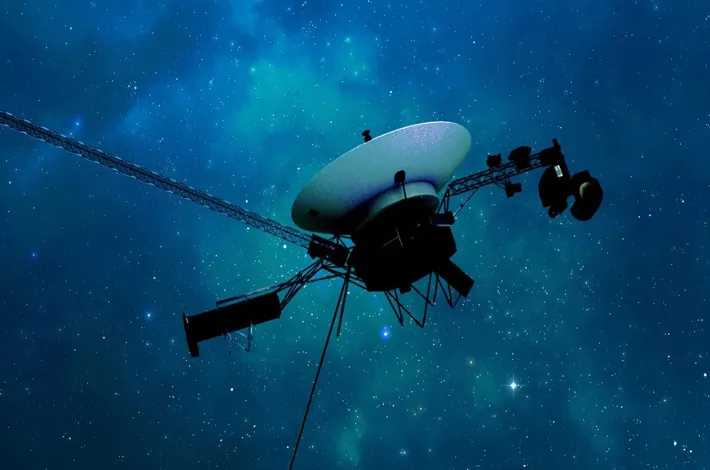
The Voyager-I was launched on 5th September 1977 to explore the outer space. In an unlikely event of encounter with an extraterrestrial intelligent being, famous scientist Carl Sagan designed a special capsule inter-alia, the probe carrying messages in different human languages, recorded laughter along with a set of instruments to carry out intended scientific experiments. Although the life span of the probe was four to five years, it had survived till now by remote maneuvering from ground control. As per NASA, 18th November 2026 is going to be a land mark day when a man-made spacecraft would have travelled farthest and be exactly one light day away from the Earth. One light day is the distance travelled by light in 24 hours.
After crossing the heliopause (edge of the solar system), it will enter into interstellar space. This historic moment is the result of centuries of sustained human efforts to defy the limits of distance. To begin with our journey, let us understand the concept of ‘distance’?
Societies had followed different scales to measure distances namely, Yojan, feet, furlong, miles, meters and Kilometers etc. Distances between cities ought to be measured in Kms as a convenient unit of measurement. In addition to giving separate names to different measuring units, a convenient system had also been devised to measure the distances in terms of the positive or negative powers of 10 m. As an example, 10-1 , 100 and 101m means 10cm, 1m and 10m respectively. Measuring still larger distances, a unit of light year is used that is the distance travelled by light in a year (9.4607x 10¹² km).
Our planet Earth is a rocky planet, one among billions roughly 12,742 km across – a speck compared to gas giants like Jupiter, eleven times wider. At this scale, the horizon curves, weather systems swirl for thousands of kilometers, and satellites orbit around Earth only few hundred kilometers up. The Sun holds 99.8% of the Solar System’s mass, with planets, moons, asteroids, and comets orbiting under its gravity. Despite the scale, the solar system is mostly empty - planets occupy a tiny fraction of the volume between them. The Oort cloud, the Sun’s true gravitational boundary, may extend nearly a thousand times farther than Neptune’s orbit.
Next to the solar system is our Milky Way, a galaxy of estimated 200 Billion Stars. The Milky Way’s spiral arms contain stars, gas and dust, all orbiting a central supermassive black hole. The Solar System sits in a minor spiral arm, about 26,000 light – years from the galactic center – an unremarkable suburb. Distances here are so vast that astronomers switch units entirely – a light year alone is about 9.5 x 10¹⁵ meters.
As Voyager I is expected to send signals from another 2-3 years, let us keep our fingers crossed for a chance encounter with another intelligent being. With our inflated ego, it is clear that mankind is less than a spec in the overall scheme of things.

S K Joshi served as Chief Secretary of Telangana from February 2018 to December 2019