18 September, 2026 | 1:14 AM


When machines know, what should students learn?
18-09-2026 12:00:00 AM
Metro India News | Hyderabad
Young use Artificial intelligence to find information, understand concepts, complete assignments, translate passages, write code and prepare for employment. The challenge is ensuring technology supports learning without replacing independent thought. As this transformation gathers pace, education must confront a larger question: what should learning mean in a world where information can be retrieved, summarised and generated within seconds?
For generations, formal education has focused heavily on acquiring information, remembering concepts and demonstrating knowledge through examinations. This approach developed when access to information was limited and the ability to find it quickly was itself a valuable skill. Artificial intelligence has changed that environment. A machine can now produce an explanation, organise data, draft an essay or offer several possible answers almost instantly.
This does not make knowledge unnecessary. On the contrary, strong foundations in language, mathematics, science and individual disciplines may become even more important. Students need knowledge to judge whether an AI-generated response is accurate, incomplete or entirely wrong. Without subject understanding, they may be unable to recognize a confident but misleading answer.
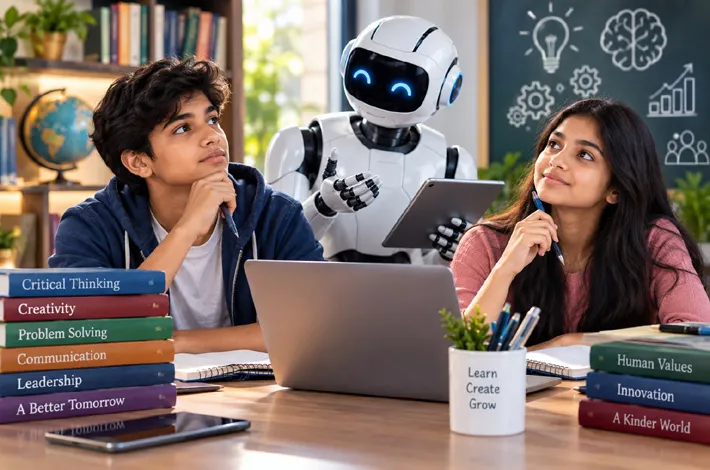
What is changing is the role of knowledge. Knowing something is increasingly becoming the beginning of learning rather than its destination. When an AI system provides an answer, students must ask: Is it accurate? What evidence supports it? What assumptions does it contain? Has it ignored an important fact? Could another interpretation be equally valid? Critical thinking must therefore move beyond curriculum language and become part of daily classroom life. Students should regularly face questions requiring comparison, interpretation, argument and judgment instead of simply reproducing material from textbooks.
Creativity will also become more important. AI can generate writing, images, presentations, designs and possible solutions at extraordinary speed. Yet producing possibilities is not the same as understanding which possibility is valuable. A machine can help construct an answer, but human beings must identify the problem worth solving. That requires observation, imagination, curiosity and an understanding of context. A technically impressive solution is of little use if it addresses the wrong problem. These changes will inevitably affect examinations. Assessment systems may need to place greater emphasis on explanation, application, discussion, project work and independent reasoning. The purpose should not be to create tests that merely defeat technology. Examinations should assess the abilities education genuinely wants students to develop.
The teacher’s role will also change, but it will not disappear. If information becomes more readily available through digital tools, teachers may become even more important. They can help students interpret evidence, challenge assumptions, make connections and understand consequences. They can recognise confusion, encourage hesitant learners and respond to the emotional and social dimensions of education—areas that automated systems cannot personally experience.
This makes teacher preparation especially important. Teachers need a sound understanding of AI’s capabilities, limitations, biases and risks. They must know when technology can support learning and when human interaction is more valuable.AI literacy, meanwhile, cannot mean merely learning to operate an application or write an effective prompt. A student may obtain an impressive response from a system and still be unable to judge its reliability. Genuine AI literacy must include verification, source awareness, privacy, ethical use and an understanding of how automated systems can produce convincing inaccuracies.
AI may make students efficient at producing outputs without developing independent thinking. If machines write drafts, solve problems and summarise lessons, students may save time but miss the struggle, reflection and revision essential to learning. Higher education must prepare graduates who can use technology while communicating, collaborating, adapting and making sound decisions. India must also address unequal access to devices, connectivity, digital skills and quality teaching, which could widen the educational divide. Schools and universities should encourage students to investigate problems, debate ideas, test assumptions and apply knowledge. AI should support learning, not replace it. Education must help students ask better questions.

(Vangeepuram Srinivasa Chary is a counsellor, human development trainer and writer. He holds an International Diploma in Guidance and Counselling from the Regional Institute of Education (NCERT), Mysuru.)