21 September, 2026 | 6:25 AM


Telangana contractors marginalised
05-08-2026 12:00:00 AM
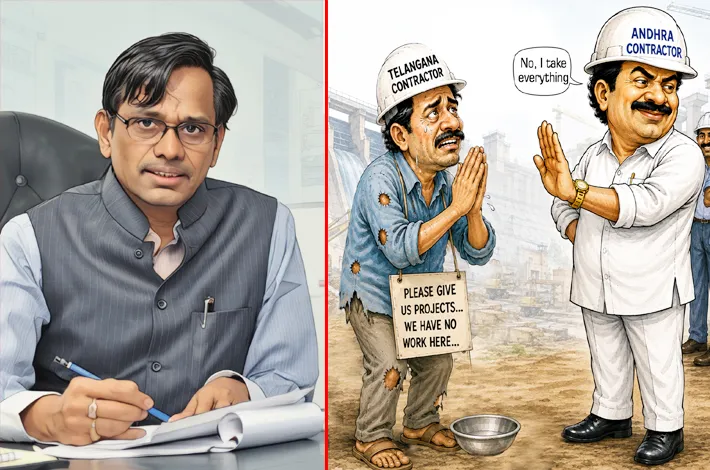
Local contractors say their hard-built businesses, bank limits, and financial stability have eroded. Some report facing the prospect of bankruptcy and severe mental strain
Contract Bias Persists
■ High-value government projects are still predominantly awarded to large Andhra companies, leaving Telangana firms with only subcontracts, piece-work, or labour supply roles.
■ Contractors claim eligibility norms based on high turnover, financial capacity, and project scale are designed in a way that excludes many capable Telangana firms while benefiting established Andhra-based players.
■ Local contractors say delayed payments, lack of direct contract opportunities, and dependence on Andhra firms for work have weakened their businesses.
■ Contractors argue that the same contracting pattern that existed before state bifurcation.
C L Rajam
Twelve years after the formation of Telangana as a separate state, local contractors are expressing deep frustration over what they describe as a continuation—and in some ways an intensification—of the discrimination they faced during the united Andhra Pradesh era. A detailed study highlights how Telangana-based contractors, who actively supported the statehood movement in hopes of greater opportunities, find themselves largely side-lined in government projects.
Major contracts continue to flow predominantly to large firms from Andhra Pradesh, reducing many local players to subcontractors, piece-rate workers, or labor suppliers. This situation has sparked accusations of systemic bias in tender processes, financial distress among local firms, and questions about whether the aspirations of the statehood struggle have been fulfilled for all sections of society.
The background traces back to the Telangana movement, which gained momentum around demands for fairer allocation of funds, water resources, and jobs, alongside a strong assertion of regional self-respect. Local contractors were not exempt from the grievances of that period. In the United AP, the bulk of significant projects routinely went to big Andhra contractors. Even when local firms possessed the necessary qualifications, tender conditions were adjusted to favour larger external players. Telangana contractors often received only minor works after considerable pleading, and payments remained uncertain.
They supported the movement in the expectation that a separate state would open doors for them to participate meaningfully in reconstruction and development works, securing a substantial share of contracts within their own region. That expectation, according to the contractors’ accounts, has not materialized. Over the past decade and more, governments in Telangana have undertaken projects worth lakhs of crores of rupees across the state.
Despite changes in political leadership, the pattern of awarding major contracts to Andhra-based big contractors has persisted, the local players contend. Tender norms, they argue, have been framed in ways that effectively disqualify many Telangana firms by emphasizing scale, turnover, and financial parameters that favor established large players from outside.
As a result, local contractors say their hard-built businesses, bank limits, and financial stability have eroded. Some report facing the prospect of bankruptcy and severe mental strain. The transformation in their professional roles forms a central grievance. Rather than securing independent large contracts, many Telangana contractors now operate under the umbrella of Andhra firms—taking on subcontracts, performing piece work, or supplying labor.
This arrangement, they say, carries its own humiliations. When seeking payments for completed work, they often wait for hours to speak with personal assistants or lower-level staff of the main contractors. Timely bill clearance is rare, compounding cash-flow problems. The cumulative effect has been financial weakening, with reports of family hardships, inability to arrange marriages for daughters in some cases, and even instances of suicide linked to economic distress.
Local contractors contrast this with the united-state period, when at least limited smaller works were occasionally available after sustained efforts. In their own state, they feel reduced to a form of bonded dependence, waiting for residual opportunities from external firms that dominate the landscape. A recurring allegation points to the influence of one particular large Andhra contractor.
Local voices claim that successive Telangana governments have operated under the signals of this individual regarding the allocation of works, their value, and the timing of fund releases. Commissions collected from various contractors are said to be channelled to political leaders and parties, creating a nexus that keeps decision-makers aligned with the interests of the dominant firm.
Even when funds are released, the bulk reportedly reaches the big contractor first, with only token amounts directed elsewhere. This, the critics argue, has locked a wide range of contractors into economic dependence. The broader implications extend beyond the contracting community. Local contractors note that Andhra firms have accumulated substantial assets in Telangana—hotels, hospitals, media outlets, and large residences—consolidating economic influence.
They question whether the sacrifices of the statehood movement, including the lives of martyrs, were meant to result in continued dominance by external players in key economic sectors. The sense of alienation is sharpened by the observation that failed projects executed by the favoured contractor rarely attract serious scrutiny or blacklisting; instead, further opportunities continue to be extended. In response, the affected contractors are calling for urgent corrective measures.
They urge the government to revise tender conditions to create genuine space for local firms with proven capability, ensure transparent allocation, and prioritize timely payments. Political parties and leaders are pressed to examine the influence of large external contractors and break patterns that perpetuate dependency. Without change, some warn, discontent could escalate into a new wave of agitation, potentially drawing in younger generations observing these disparities.
They appeal to the administration to stand firmly with Telangana’s own people, traders, and contractors so that the benefits of statehood are shared more equitably. The issue raises larger questions about regional economic empowerment after the creation of a new state. While major infrastructure and development works have progressed, the distribution of opportunities remains a point of sharp contention among those who expected greater inclusion.
Telangana contractors maintain that self-respect and fair access to contracts in their own soil formed part of the original promise of statehood. Addressing their concerns would require deliberate policy shifts in tender design, oversight of large contract awards, and mechanisms to strengthen local capacity. Failure to do so, they argue, risks deepening a sense that the fruits of the movement continue to elude significant sections of the local economy.
The coming period will test whether political leadership responds with structural reforms or allows the present pattern to solidify further. Local voices insist that genuine change is both necessary and overdue if the spirit of the statehood struggle is to translate into tangible economic dignity for Telangana’s own enterprise community.