30 June, 2026 | 11:13 AM


Stalled talks deepen volatility across continents
27-04-2026 12:00:00 AM
Markets Hold Breath
Conflict stretches into 9th week, straining supply chains, unsettling currencies, and forcing policymakers into cautious recalibration worldwide
Prolonged confrontation tests resilience of institutions, exposing fragile interdependence between geopolitics, finance, and everyday economic survival
Palazhi Ashok Kumar
MUMBAI
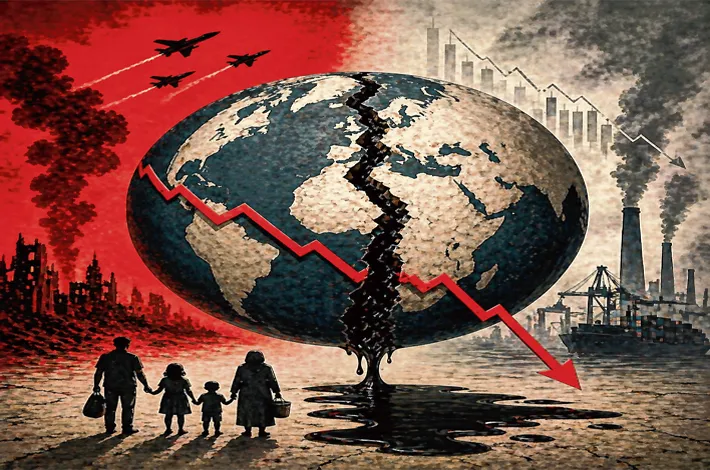
The war involving the United States, Israel, and Iran enters its 59th day today, April 27, not merely as a conflict of arms, but as a theatre of collapsing certainties—where diplomacy falters, markets tremble, and the architecture of global stability shows visible strain.
In capitals and trading floors alike, a single question now lingers with unsettling persistence: has the world entered a prolonged age of strategic paralysis? The absence of meaningful engagement between Washington and Tehran has turned what might have been a negotiable crisis into a hardened standoff.
Iran refuses to yield under pressure; the US refuses to dilute its demands. Between them lies a narrowing corridor of trust—almost exhausted. The Strait of Hormuz, the world’s most vital energy artery, remains functionally constrained, with Brent crude holding above $100 per barrel, injecting volatility into every economy dependent on imported fuel.
For India and other emerging markets, the consequences are stark. Elevated crude prices threaten to widen fiscal imbalances, weaken currencies, and reignite inflation just as policymakers prepare for critical decisions. The week ahead—featuring rate signals from the US Federal Reserve, the Bank of England, and the European Central Bank—unfolds under the shadow of war, where interest rates must now answer to geopolitics as much as to growth. Investor sentiment has become a barometer of fear.
Markets surge on whispers of de-escalation and recoil at signs of escalation. Airlines are cancelling routes as jet fuel costs soar. Industries face mounting input expenses. Households, quietly but steadily, absorb the shock in everyday life. Diplomatic fractures have only deepened the crisis. US President Donald Trump’s cancellation of envoy-level engagements, alongside Iran’s hardened stance, has stalled mediation attempts. Pakistan continues to offer itself as a bridge, yet the gulf between positions remains formidable.
Compounding the uncertainty, a fresh assassination attempt on President Trump late Saturday has unsettled global capitals, raising troubling questions about internal stability and its potential intersection with external conflict. At the core of the deadlock lie irreconcilable demands. Washington insists on a complete halt to Iran’s nuclear programme and custody of its estimated 400 kg of highly enriched uranium—conditions Tehran rejects, proposing only time-bound limits.
Iran, in turn, demands sanctions relief, the unfreezing of $20 billion in assets, and compensation nearing $270 billion for war damages. It also insists on maintaining shipping restrictions until US blockades end—a position Washington refuses, cementing the stalemate. Sanctions have intensified, targeting Chinese-linked refiners and shipping networks handling Iranian crude, threatening to fragment already strained trade systems.
Meanwhile, reports of internal tensions within Iran, including recent executions tied to insurgent activity, underline deeper regional fractures—where the Sunni–Shia divide continues to evolve into a modern geopolitical contest.
A limited ceasefire extension between Israel and Hezbollah offers a fleeting pause—but not a resolution. The broader confrontation remains entrenched, its economic aftershocks spreading faster than diplomacy can contain. There are moments in history when silence between nations becomes more dangerous than conflict itself. This may well be one of them.