3 July, 2026 | 4:33 AM


Secret behind AAP MPs defection
26-04-2026 12:00:00 AM
metro india news I new delhi
In a stinging rebuke to his former party, Naveen Jaihind — ex-husband of newly defected AAP Rajya Sabha MP Swati Maliwal and a one-time Haryana unit convenor of the Aam Aadmi Party — has demanded that the seven MPs who quit AAP and merged with the BJP on Thursday come clean about the “sins” and “crimes” they no longer wished to be part of.
His remarks, made hours after Raghav Chadha announced the mass defection, add a deeply personal and explosive layer to what is already being called one of the biggest crises in AAP’s 14-year history.
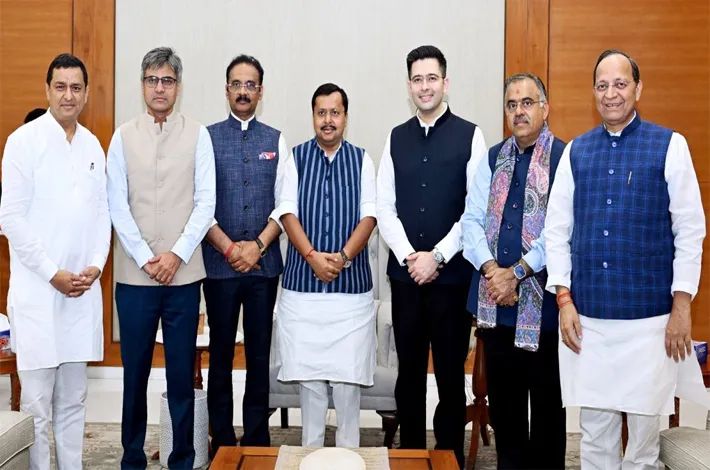
On April 24, Raghav Chadha, once seen as Arvind Kejriwal’s blue-eyed boy and a key national face of AAP, dropped a political bombshell. Flanked by Sandeep Pathak and Ashok Mittal, Chadha declared that two-thirds of AAP’s 10 Rajya Sabha MPs — himself, Swati Maliwal, cricketer-turned-politician Harbhajan Singh, Ashok Mittal, Sandeep Pathak, Vikramjit Singh Sahney and Rajendra Gupta — were exercising the constitutional provision for merger and joining the BJP.
The move, which shields the lawmakers from anti-defection disqualification, comes just months before the crucial 2027 Punjab Assembly polls, where AAP holds power. Chadha cited the party’s “deviation from honest politics,” erosion of internal democracy and a shift toward “corrupt and compromised” elements as reasons for the exit.
For Swati Maliwal, the decision marks the culmination of years of public rupture with Kejriwal. Once his close aide and former Delhi Commission for Women chief, Maliwal had accused Kejriwal’s personal assistant Bibhav Kumar of assaulting her at the Chief Minister’s official residence — infamously dubbed “Sheesh Mahal” — in 2024. Her exit had been widely anticipated, but bundling it with six other senior leaders has left AAP reeling.
Enter Naveen Jaihind. Married to Maliwal in 2012 during the Anna Hazare movement days, the couple divorced in February 2020. Jaihind served as AAP’s Haryana convenor and was a prominent face of the party in the state until he drifted away. Though no longer formally with AAP, he has remained a vocal critic of Kejriwal’s inner circle, repeatedly alleging physical assaults, financial irregularities and a culture of fear inside the party.
In a video posted on X (formerly Twitter) on April 24 itself — the very day of the defection — Jaihind did not mince words. “The ghost of Sheesh Mahal is not leaving Kejriwal alias ‘Katia’,” he wrote, using a derogatory nickname for the AAP supremo. He claimed he had “changed house today” (in an apparent reference to shifting base or metaphorically distancing himself further) and urged the seven MPs: “You must give a sharp reply to them or else you will be called cowards.
Tell us which sins you did not want to be partners in. Tell us what sins were committed.” He ended by predicting that “27 MLAs of Punjab will leave soon too.” The post carried hashtags including #raghav and #kejriwal, directly linking the exodus to his long-standing allegations of internal violence and corruption.
Jaihind’s intervention is significant because he has levelled similar charges against Chadha himself in the past. In early April, he publicly claimed that Raghav Chadha had been assaulted at Kejriwal’s residence, suffered an eye injury requiring treatment abroad, and was even made to “stand like a rooster” (murga bana ke peeta gaya) during the alleged thrashing.
He had called Chadha Kejriwal’s “raazdaar” (confidant) and “maaldaar” (wealthy beneficiary) in an extortion racket involving funds from Delhi and Punjab. Those claims, made when the Chadha-Kejriwal rift was still simmering, now appear prescient in light of the mass exit.
AAP leaders have dismissed the defections as “Operation Lotus” engineered by the BJP and have accused the rebels of succumbing to pressure or inducements. Kejriwal himself has termed the move a “betrayal of Punjab.” Yet the loss of seven Rajya Sabha MPs — nearly the entire Upper House strength — has left the party numerically and morally weakened in Parliament and dented its image as an anti-corruption outfit.
Political observers note that Jaihind’s call for the defectors to “expose the sins” puts the new BJP entrants in a delicate spot. While Chadha and company have spoken in broad terms about ideological drift, they have so far stopped short of detailing specific criminal allegations. Maliwal’s own past accusations against the Kejriwal household remain a sensitive flashpoint; her ex-husband’s public demand that the group reveal more could either bolster the defectors’ narrative or force them into uncomfortable territory.