26 September, 2026 | 10:15 PM


Science before silos
26-09-2026 12:00:00 AM
Science Corner
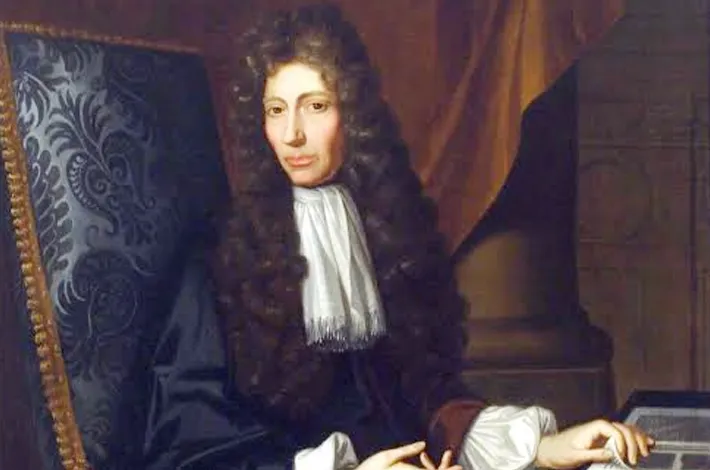
Until a few centuries ago, science was not divided into the distinct disciplines as it is today. Tt had no rigid boundaries. The individuals we now call physicists, chemists, biologists, and engineers were simply seekers of knowledge. The natural philosopher, Irish physicist and chemist Robert Boyle (born on 25th January, same as me) demonstrated that sound requires a medium to travel. In his famous experiment conducted in 1660, he placed a ringing bell inside an airtight glass vessel and gradually removed the air using a vacuum pump.
As the air was pumped out, the sound became fainter until it could no longer be heard, even though the bell continued to ring. This experiment proved that sound cannot travel through vacuum and must have a medium such as air, water, or a solid material to propagate.
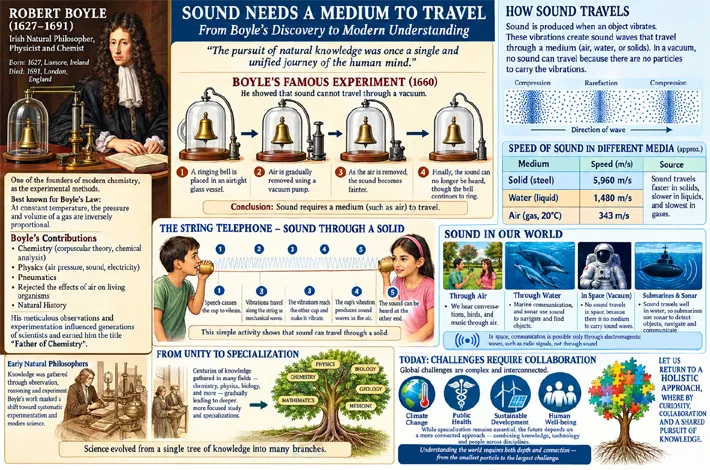
Sound is produced when an object vibrates. These vibrations create sound waves that travel through a medium by causing its particles to move back and forth. The particles transfer energy from one another, allowing the sound to move from its source to a listener. It travels at different speeds in different media, fastest in solids because their particles are packed closely together, slower in liquids, and slowest in gases. Thus, it travels much faster through steel than through air.
This principle can be observed in a simple childhood game of the string telephone. Two matchboxes are connected by a tightly stretched thread. One person speaks into one box while another listens through another box at the other end. When a person speaks, sound waves cause the bottom of the box to vibrate. These vibrations travel along the stretched thread and reach the second box, causing it to vibrate as well. The vibrations are then converted back into sound waves, allowing the listener to hear the message. This simple activity clearly demonstrates that sound can travel through a solid medium.
We hear people speaking because sound travels through air. Whales communicate over vast distances underwater because sound travels efficiently through water. So, submarines rely heavily on sonar systems; vessels can often be detected long before they are visible. In contrast, astronauts working outside their spacecraft cannot hear one another directly because outer space is nearly a vacuum and lacks a medium to carry sound. So, they rely on radio communication systems. This is well depicted in the fictional story, The Martian, where the astronaut, Mark could not communicate with earth because the communication infrastructure was damaged, and was restored through Pathfinder.
Thus, this discovery reminds us of a time when science was united. In fact, Boyle is considered one of the founders of modern chemistry using experimental methods and is best known for Boyle’s law, which describes the inverse relationship between the pressure and volume of a gas when temperature is constant. He conducted experiments in chemistry, hydrostatics, physics, medicine, and natural history, saw the effects of air pressure on living organisms, and electrical forces.
His meticulous approach to observation and experimentation influenced generations of modern chemists and physicists. He came up with corpuscular theory of chemical composition of matter and chemical analysis. He argued so strongly for application of the principles and methods of chemistry to the study of the natural world and medicine, that he was known as “father of chemistry.”
Knowledge was unified, all disciplines including art were fluid, interconnecting to a broader understanding. As the knowledge expanded, specialization became necessary to manage the growing volume of information. Science segregated to different disciplines, each developing its own methodologies, terminology, and institutional structures, accelerating the progress within individual fields, creating barriers that limited communication and collaboration.
Today, globally climate change, public health, and sustainable development require multidisciplinary solutions, interestingly, there is appreciation for the holistic scientific approach that characterized the early history of human knowledge.

(Dr Swarnabala Ganti is a seasoned chemist, regulatory affairs specialist and R&D scientist across India, Iran, Japan, and Taiwan. She is a researcher & Consultant at Swaram Biochem)