22 November, 2026 | 2:20 AM


‘Let’s make India drug free’
22-11-2026 12:00:00 AM
Hyderabad hosts BJP-led city convention on Drug-Free India as leaders flag spreading menace
Under Prime Minister Narendra Modi’s leadership, the country has made significant strides in curbing terrorism and enhancing security. The battle against drugs must now receive the same urgency.
-G Kishan Reddy Union Minister for Coal and Mines
metro india news I hyderabad
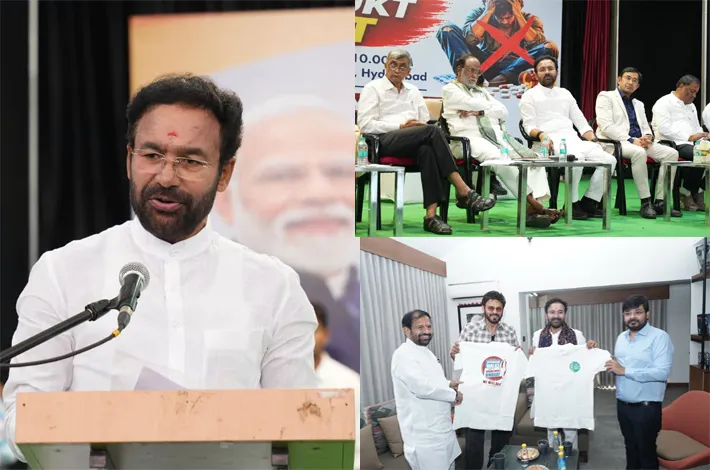
Union Minister for Coal and Mines G. Kishan Reddy on Saturday led a City Convention on Drug-Free India at Srinagar Colony (Sri Satya Sai Nigamagamam) in Hyderabad, underscoring the growing threat of drug abuse in the Telugu states and calling for collective action to build a nasha-mukt society The event, held under the banner of the Nasha Mukt Bharat Abhiyan and linked to the hashtag #HyderabadWalksForNashaMuktBharat, drew BJP leaders, public representatives, scholars, and citizens. It forms part of the national campaign launched in 2020 by the Ministry of Social Justice and Empowerment to reduce demand for narcotics, particularly among urban youth. Reddy, who also serves as BJP Telangana state president, used the platform to elevate the issue from a social concern to a national priority on par with the fight against terrorism.
In his address, Reddy stressed that drug abuse poses a grave threat to India’s future, its youth, and its families. He noted that under Prime Minister Narendra Modi’s leadership, the country has made significant strides in curbing terrorism and enhancing security. The battle against drugs, he said, must now receive the same urgency. Highlighting the spread of the menace that has long afflicted Punjab, Reddy warned that it has reached the Telugu states, endangering young lives from Hyderabad’s bastis to its IT corridors. India’s greatest asset—its youth—cannot be allowed to fall prey to addiction, he emphasised.X
Reddy pointed to troubling local trends, including the reported manufacture of drugs in some closed companies and the cultivation of ganja on house terraces in parts of the city. He called upon parents, community leaders, teachers, IT professionals, youth, and ordinary citizens to unite, create awareness, and take collective responsibility. The central government has set a target of making India drug-free by December 31, 2029, he added, aligning the local effort with the broader national resolve articulated by the Prime Minister and Union Home Minister Amit Shah.
A formal anti-drug pledge was administered by former MLA Dr. Jayaprakash Narayana. Participants resolved to stay away from drugs and work together toward a drug-free society. Other dignitaries present included Member of Parliament Dr. K. Laxman, MLA A. Mahesh Reddy, MLC Malka Komaraiah, scholar Garikipati Narasimha Rao, BJP Telangana President N. Ramchander Rao, and several other guests.
The convention serves as a preparatory gathering ahead of a three-day padayatra, “Hyderabad Walks for Nasha Mukt Bharat,” scheduled from November 25 to 27. The walk will cover a route from Amberpet to Jubilee Hills and is intended to turn awareness into a jan andolan (people’s movement). Reddy has publicly invited citizens, youth, parents, artists, and professionals to join, framing participation as a shared civic duty rather than a partisan exercise. Helplines promoted in connection with the campaign include the anti-narcotics number 1933 and the de-addiction line 14446. An associated Nasha Mukt Yuva app has also been highlighted for youth engagement.X
The Nasha Mukt Bharat Abhiyan has relied on city-level conventions and public mobilisation to complement enforcement measures under the Narcotic Drugs and Psychotropic Substances Act. Officials and party leaders present portrayed the Hyderabad event as one more step in expanding the campaign’s southern footprint. Reddy’s dual role as a Union minister and state party chief was seen by observers as lending political weight to what is primarily a social-justice ministry initiative, particularly in a state where the BJP seeks deeper organisational roots.
Speakers and organisers reiterated that supply-side crackdowns alone are insufficient without demand reduction through awareness, community vigilance, and rehabilitation. The focus on both low-income neighbourhoods and professional IT hubs underscored the message that the problem cuts across economic and social lines in a rapidly growing metropolitan city. Reddy urged the city’s educated and influential sections—especially young professionals—to take the lead in the fight.
The event comes amid wider national attention on the drug issue. Recent statements by the Prime Minister at a Council of Ministers meeting and by Home Minister Shah have reinforced the 2029 target. In Telangana and neighbouring Andhra Pradesh, party units are expected to expand monitoring committees and awareness programmes in the coming months.
Local political voices at the convention also pressed the state government for greater transparency. One BJP leader called for a white paper detailing the number of drug cases registered, arrests made, and seizures effected in the state. Such demands reflect the partisan contestation that often accompanies social campaigns in India’s competitive political landscape, even as organisers insisted the anti-drug effort transcends party lines.
By the close of the convention, the emphasis remained on practical next steps: public pledges, the upcoming padayatra, digital tools for youth, and sustained community involvement. Whether the visibility generated in Srinagar Colony and the planned walks translate into measurable reductions in substance abuse will depend on follow-through by enforcement agencies, rehabilitation services, educational institutions, and families.
For now, the message from the Hyderabad gathering was clear. Drug abuse is no longer viewed as a distant or regional problem. Leaders present framed it as an immediate challenge to the city’s young population and to the nation’s demographic dividend. The City Convention on Drug-Free India sought to convert concern into collective resolve, setting the stage for further street-level mobilisation later this month.