22 November, 2026 | 2:20 AM


Telugu States Ignite Investment Race as Amaravati and Bharat Future City Rise
22-11-2026 12:00:00 AM
metro india news I Hyderabad/Amaravati
In the heart of southern India, the two Telugu-speaking states of Andhra Pradesh and Telangana are writing a compelling new chapter of ambition and growth more than a decade after their separation. What began as a complex bifurcation in 2014 has evolved into a dynamic partnership of competition and shared aspirations, with both states aggressively courting global investors while shaping futuristic urban landscapes and addressing the vital resource of river water that binds them.
Andhra Pradesh recently captured headlines with a spectacular show of investor confidence at the 31st CII Partnership Summit held in Visakhapatnam. Chief Minister N. Chandrababu Naidu oversaw the signing of 303 memoranda of understanding valued at approximately Rs 10 lakh crore. These commitments span renewable energy, data centres, manufacturing, ports, aerospace and social development initiatives. Major players such as JSW Steel pledged ₹15,000 crore, Indian Oil Corporation committed ₹6,600 crore, and AirTrunk India-JCK Infra proposed a massive data centre project exceeding ₹1 lakh crore. Earlier investment intents since 2024 had already crossed ₹22 lakh crore, with a significant portion now moving toward grounded projects expected to generate millions of jobs.
The energy in Visakhapatnam was palpable. Officials highlighted the state’s push under the Investor Protection Act planned for the next assembly session, aiming to create a seamless environment for businesses.
Proposals in space technology from companies like Agnikul Cosmos and Hathor Rockets added a futuristic flavour, while green energy commitments underscored Andhra Pradesh’s determination to emerge as a clean power hub. The state’s long coastline and focus on ports, including expansions at Kakinada, position it strongly for logistics and export-oriented growth.
Meanwhile, Telangana is preparing its own grand stage. The Invest Telangana Global Summit scheduled for December 7 to 9 in the emerging Bharat Future City near Hyderabad promises to draw thousands of global investors, industrialists and policymakers. Chief Minister A. Revanth Reddy has framed the event as a cornerstone of the Telangana Rising 2047 vision, which aims to transform the state into a $1 trillion economy by 2034 and a $3 trillion powerhouse by 2047. The government has already attracted substantial interest, with proposals from major technology and hospitality firms flowing into the planned greenfield city.
Bharat Future City, envisioned about 60 kilometres from central Hyderabad, is designed as a hub for artificial intelligence, education, life sciences and advanced manufacturing. Infrastructure investments of around Rs 18,000 crore are earmarked for roads, water, power and related facilities. Parallel to this, Andhra Pradesh continues refining Amaravati as its capital, with land pooling covering over 33,000 acres and infrastructure projects valued at ₹66,000 crore underway. Recent MoUs specifically for the Amaravati region have added nearly Rs 43,000 crore in commitments. The two cities, one a revived capital dream and the other a bold new industrial vision, symbolise how both states are building distinct identities while drawing on their shared Telugu heritage of enterprise and resilience.
Infrastructure connectivity forms another powerful link. Telangana has unveiled ambitious road expansion plans exceeding ₹60,000 crore, including the Regional Ring Road, eight-laning of the Hyderabad-Vijayawada highway, and an elevated corridor toward Srisailam. Critically, proposals for a greenfield highway connecting Bharat Future City to ports via Amaravati highlight the practical interdependence. Both governments have urged the Centre to expedite clearances, recognising that seamless road and rail links will multiply the benefits of their individual investment drives.
Water remains the most sensitive shared resource. The Krishna and Godavari rivers sustain agriculture and daily life across both states. Recent communications from the Krishna River Management Board urged consensus, stressing that new irrigation projects require prior technical clearance and that contentious issues stay unresolved without mutual agreement. Both chief ministers have at various points spoken of a give-and-take approach. Meetings involving leaders from Andhra Pradesh, Telangana and neighbouring Karnataka have focused on cooperative solutions for basins like the Tungabhadra, while discussions continue on equitable allocations and telemetry systems for transparent monitoring.
Farmers in both states watch these developments closely. Assured irrigation supports vast agricultural landscapes that still employ large sections of the population. Completing pending projects and modernising systems can stabilise incomes and boost food production. At the same time, the shift toward industry and services in urban centres is creating new opportunities for the youth.
Telangana’s services-led growth, powered by Hyderabad’s IT and pharmaceutical strengths, has delivered strong per capita income gains over the past decade. Andhra Pradesh, with its balanced focus on agriculture, industry and emerging sectors, recorded robust real growth rates in recent years and continues to expand its manufacturing and renewable energy base.
Culturally, the bonds remain unbroken. Telugu language, cinema, festivals such as Ugadi, Sankranti and Bathukamma, and shared culinary traditions continue to unite families across the border. People travel freely for work, education and celebrations, reinforcing a sense of common identity even as political and administrative structures operate independently.
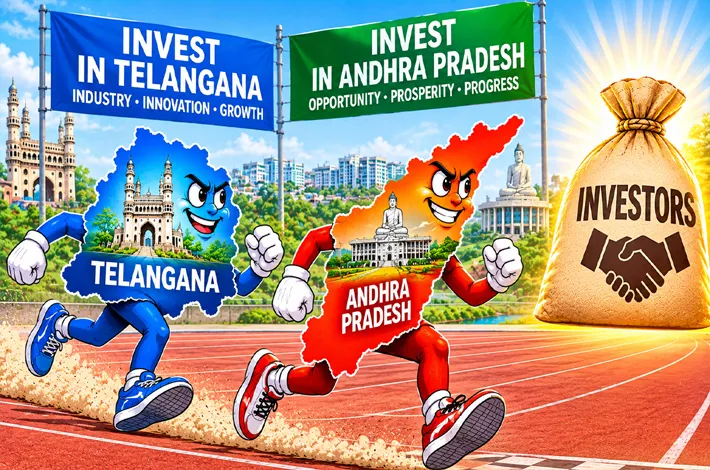
Two states, once one, are now racing ahead with parallel summits, twin city visions and complementary infrastructure goals. The competition for investments is healthy and intense, driving both governments to refine policies, improve ease of doing business and showcase unique strengths. Andhra Pradesh leverages its coastline and industrial corridors, while Telangana builds on its established technology ecosystem and ambitious new urban project.
Observers note that sustained progress will depend on pragmatic cooperation, especially on water sharing and pending bifurcation matters. When the states move in alignment on connectivity and resource management, the entire region stands to gain. Global investors already see the combined potential of a large, skilled Telugu-speaking workforce, strategic location and progressive leadership.
As the December summit in Telangana approaches and projects in Amaravati gather pace, the twin states present a fascinating study in post-separation evolution. They compete vigorously for capital and talent, yet their destinies remain interwoven through rivers, roads, language and people. The coming years will reveal how effectively this blend of rivalry and collaboration can lift millions into greater prosperity and position the Telugu region as a standout growth engine in India’s larger economic story.