15 October, 2026 | 12:44 AM


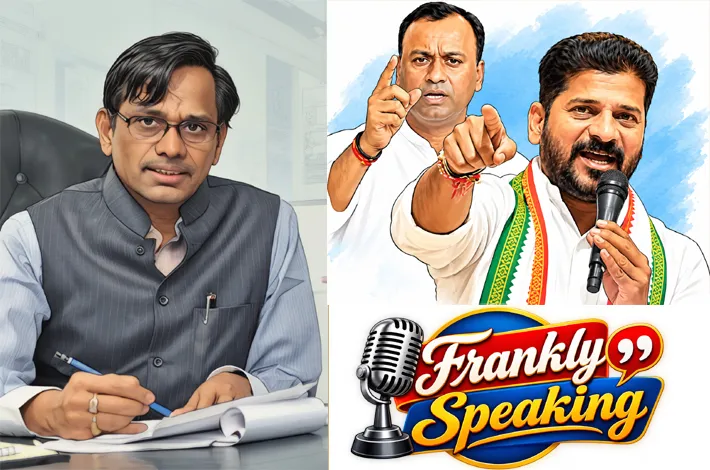
Rajgopal Reddy vs Revanth Reddy
15-10-2026 12:00:00 AM
Rs 600 Crore Road Tender Row Rocks Congress
C L Rajam :
The recent controversy surrounding the Radial Road-2 tenders in Telangana has exposed deep fault lines within the ruling Congress and raised serious questions about transparency in public procurement. The project, estimated at Rs 3,296 crore, involves constructing an 81.15-km greenfield expressway connecting the Outer Ring Road at Kothwalguda (Budwel) to NH-167N near Nacharam. Divided into three packages, the contracts were awarded to NCC Limited for Package-I at Rs 1,286.03 crore (3.95 per cent above the estimated cost), BVSR for Package-II, and GKC for Package-III. Critics allege these awards favour three Andhra Pradesh-based contractors and point to a potential loss of around Rs 600 crore to the state exchequer.
Congress MLA Komatireddy Rajgopal Reddy, representing Munugode, has emerged as the sharpest internal critic. His family-linked firm, Sushee Infra and Mining Limited, submitted bids for all three packages that were reportedly nearly Rs 600 crore lower than those of the successful bidders. The firm was disqualified at the technical evaluation stage on the ground that its experience certificate lacked the countersignature of a Superintending Engineer.
Rajgopal Reddy has described this as a flimsy ground and claimed that clarifications could easily have qualified the company. He has alleged dummy bids, interference from the Chief Minister’s Office discouraging participation, and deliberate favouritism towards out-of-state firms. The company has approached the Telangana High Court seeking cancellation of the tenders and evaluation of its financial bids.
BRS working president KT Rama Rao has added fuel by writing an open letter to Chief Minister A Revanth Reddy. He demanded immediate cancellation of the tenders, a comprehensive inquiry, and full disclosure of estimated costs, quoted prices, comparative statements, technical evaluation reports, and reasons for each disqualification. KTR questioned how 13 bids could be processed within roughly five working days after the September 30, 2026, deadline and highlighted inconsistencies, such as GKC being disqualified for one package but qualified for another. He specifically referenced the potential Rs 600 crore loss cited in Sushee Infra’s court submissions.
Public perception has crystallised around the bidding pattern. The three successful bidders quoted between 3.0 and 4.5 per cent above estimates, with each emerging as the lowest in one package while providing supporting bids to the others. This has been widely viewed as a classic cartel arrangement. Many observers note that the state government could have sought clarifications to qualify Sushee Infra rather than disqualifying it outright. Interestingly, sections of the media perceived as closer to BRS have amplified Rajgopal Reddy’s concerns, creating confusion within Congress ranks. The BJP has remained notably silent on the alleged Rs 600 crore loss, offering no public comment.
The episode sends a clear political message from the Chief Minister’s camp. Rajgopal Reddy, who hails from a long-standing Congress family and has served as MLA, MLC and MP, played a prominent role in the party’s 2023 victory, particularly in securing the Bhongir Lok Sabha seat. He was widely expected to receive a ministerial berth as promised by the high command. Instead, the delay in cabinet expansion and the disqualification of his firm have left him feeling sidelined.
The Chief Minister appears unwilling to accommodate either his political ambitions or his business interests, signalling to other contractors that alignment with the current power structure remains essential. From a legal standpoint, specifying qualification criteria remains the prerogative of the tender-inviting authority. Once tenders are advertised and submitted digitally, the government is entitled to apply those criteria strictly.
Courts exercise limited jurisdiction over tender processes and rarely interfere unless clear illegality or arbitrariness is established. The Telangana High Court, while hearing Sushee Infra’s petitions, declined to grant an interim stay, observing that stalling the process at this advanced stage would not serve public interest. It directed the company to implead the successful L-1 bidders and asked the government to file counters within two weeks. Without concrete proof of cartelisation, judicial cancellation of the awards appears unlikely.
The Chief Minister’s calculated approach reflects larger political realities. Congress governs only two major states, Telangana and Karnataka. Telangana is expected to contribute substantially to the party’s national election machinery, including upcoming contests in Uttar Pradesh, Punjab, Gujarat and others. Estimates suggest the party requires Rs 5,000 to 7,000 crore for organisational and electoral needs in the state alone.
Managing resources through land deals and controlled contract awards has become an unspoken necessity in an environment where voters increasingly demand cash incentives ranging from Rs 2,000 to 5,000. Bringing a figure like Rajgopal Reddy into the cabinet could complicate this internal resource mobilisation. Revanth Reddy’s growing stature, visible during the Kerala elections, his attendance at the Goa meeting in place of senior leaders, and recent protests in Delhi, positions him as a key player for the party’s future assembly campaigns.
A pragmatic resolution remains possible. Congress leaders, including Rajgopal Reddy, need to present a united front against the organisationally strong BRS and the rising BJP. The Chief Minister could offer a post or controlled access to contracts with the clear precondition that Rajgopal Reddy will neither obstruct nor question cabinet decisions and will extend full cooperation. For Rajgopal Reddy the choices are limited: accept the authority of the current leadership, explore other political options, or wait for the next assembly elections due in roughly two years. Time will ultimately determine which path he chooses and how the party navigates this internal turbulence while defending its governance record.