25 June, 2026 | 2:15 AM


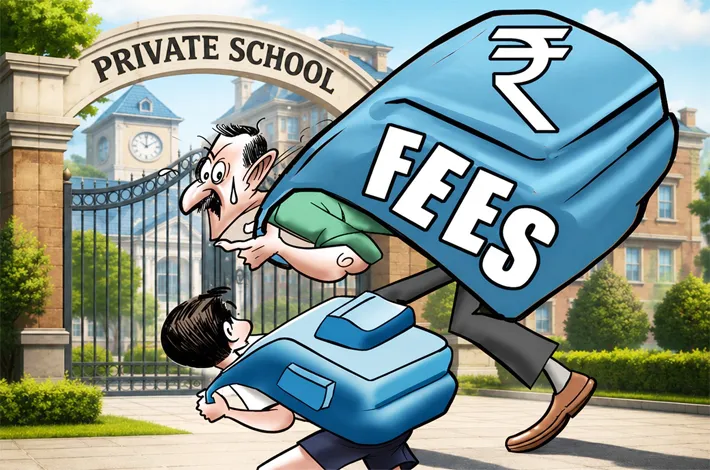
Private school fee surge continues, Govt silent
07-05-2026 12:00:00 AM
metro india news I hyderabad
The much-awaited fee regulation law, which parents—especially from middle-class families—have been hoping for, appears to be stuck in limbo. The government has remained silent on the issue, raising concerns that parents will once again bear the financial burden in the upcoming academic year. Despite repeated assurances to curb the unchecked fee hike by private and corporate schools, the promise remains unfulfilled even after two-and-a-half years in power.
With the new academic year set to begin from June 12, there has been no official announcement on regulating school fees. This has left parents frustrated, as private schools continue to increase fees at will. Every year, promises of regulation remain confined to statements, while schools go ahead with steep hike. As a result, the start of every academic year brings financial stress for families. Although a bill to regulate fees has been ready for over a year, it has yet to be enacted into law. Taking advantage of the delay, many private schools have increased fees by 20 to 30 percent.
For the 2026 academic year, private schools have already finalized their fee structures and begun admissions. Parents are facing a double burden—high fees on one side and additional expenses for books, uniforms, and accessories on the other. In many cases, school fees have surpassed the annual tuition fees of engineering courses.
This trend is particularly visible in schools across Greater Hyderabad.
In the state, the highest annual tuition fee for engineering courses stands at Rs.1.83 lakh, followed by Rs.1.75 lakh, while the minimum is around Rs.45,000. In contrast, several private schools are charging over Rs.5 lakh annually, with at least ten institutions falling into this category. Many schools also compel parents to purchase books, notebooks, uniforms, shoes, and accessories directly from them, adding to the financial burden. Additionally, annual fee hikes and increased costs of study materials have become a regular practice.
Meanwhile, guidelines for fee regulation have long been prepared. The School Education Department had drafted proposals and submitted them to the government earlier. The Telangana Education Commission also presented a draft bill for a Private Unaided School Regulatory and Monitoring Commission in January last year. Two months ago, the commission submitted another report under the Telangana Education Policy.
According to these proposals, private and corporate schools could be allowed to increase fees by up to 8 percent once every two years. Any hike beyond that would require approval from a district-level fee regulatory committee. There were also suggestions to fix fees based on the category of schools. It was widely expected that the cabinet would discuss the matter and pass legislation in the Assembly, but that has not materialized.
Over the years, several committees and commissions have submitted reports on fee regulation, including the Prof. Tirupati Rao Committee in 2017, which recommended that annual fee hikes should not exceed 10 percent. However, none of these recommendations have been implemented. While governments continue to delay action, private schools carry on increasing fees by 20 to 30 percent every year without restraint.
Engineering intake expected to drop
Fee reimbursement issues in Telangana persist, with many students likely to shift from costly engineering courses to more affordable degree programmes like BSc and BCom. Rising fees and uncertainty in reimbursement have prompted institutions to anticipate a drop in engineering admissions, a trend noted by college managements and the Federation of Associations of Telangana Higher Institutions in Hyderabad.
Ravi Kumar, FATHI Secretary General, said the matter is before the High Court, which has allowed colleges to collect fees from 2026 while the government must reimburse eligible amounts. “Earlier, students expected largely free education support through reimbursement,” he said, adding that DBT proposals and unclear timelines are causing financial stress. “There is a high possibility for students to shift to degree courses, creating and impact”, he added.
FATHI flagged massive pending dues worth thousands of crores, disrupting operations and staff salaries. It warned that without a transparent, time-bound system, confidence in professional education may decline further.
TG SHRC orders crackdown on pvt schools
Taking serious note of a complaint against a private school in Boduppal for collecting advance fees, the Telangana State Human Rights Commission (TSHRC) has directed officials to act and enforce fee regulations. The complainant alleged the school collected 50% of annual fees for 2026–27 in advance, along with payments for books and uniforms, even before the academic year began in March 2026. Calling the practice improper, arbitrary,
and against legal norms, the commission stressed that education, a right under Article 21, cannot be commercialised. It also flagged the financial burden on parents and lack of transparency in vendor choices. The commission directed the District Educational Officer to take action, ensure phased fee collection, and submit a report within the stipulated time.